
Why Care About Domestic Violence? —What Is It, Exactly?
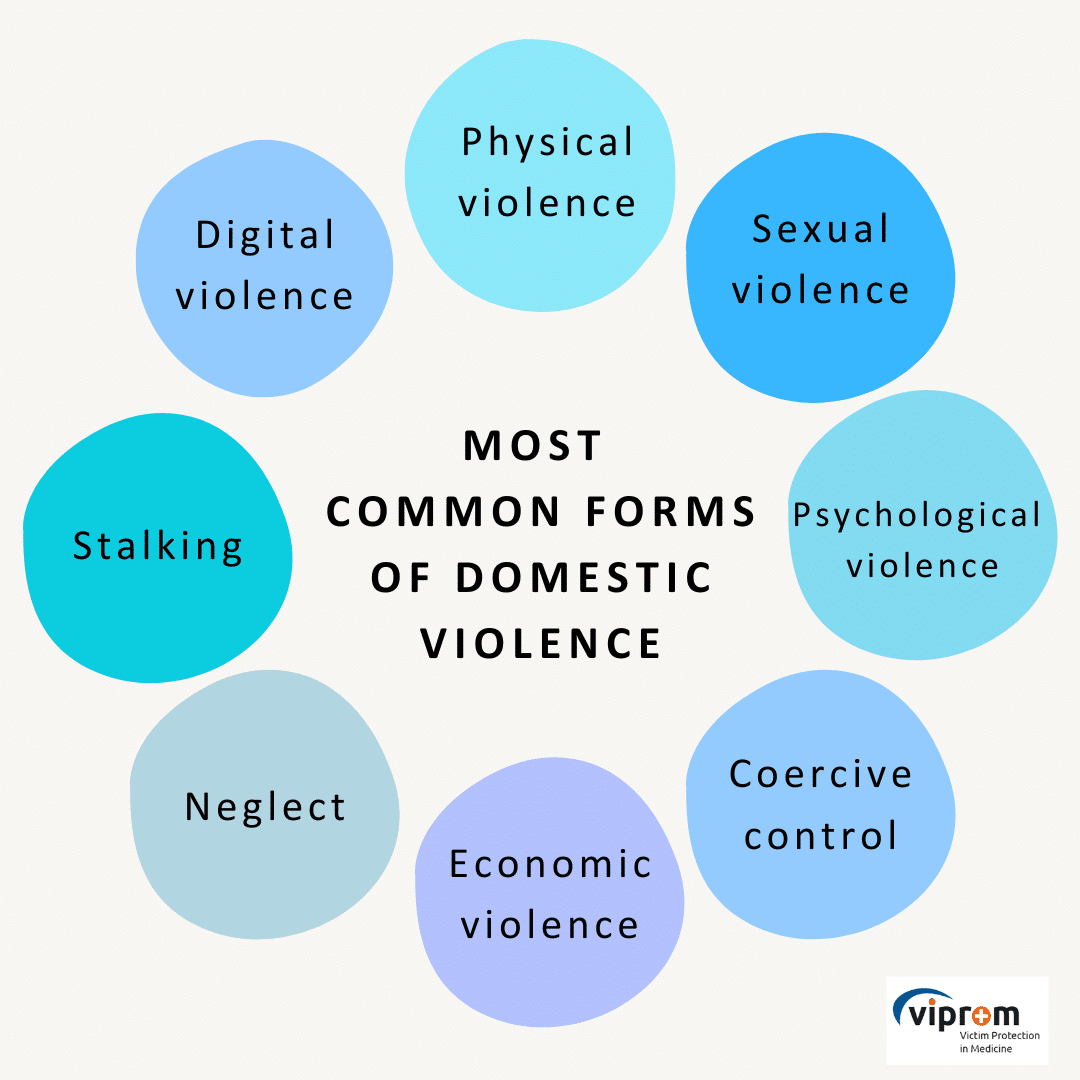
In our mini-series, which we just completed on the Grail-UFER parallel event for the 2026 United Nations Commission on the Status of Women (CSW 70), for a panel entitled Girls’ Voices: Without Us, No Justice, a topic was mentioned repeatedly by the teen presenters.
Several of the presenters included domestic violence as one of their country’s safety issues that was not being given the justice for girls that it deserved.
For example, Emiliana (16) from Mexico said:
There are times when girls dare to approach the justice system to escape, for example, a violent home where they are beaten or otherwise hurt, and what they achieve is [to be] put in contact with the people responsible for the aggression, which in the long run can lead to increasing violence and even femicide.
[Femicide is the killing of women just because they are women. For coverage on femicide, see my post of September 26, 2025: FEMICIDE and PATRIARCHY
Sirira (17) from Mozambique said:
In Mozambique, access to justice for girls remains uneven. Harmful cultural practices persist despite legal reforms. Implementation remains critically inconsistent. Enforcement gaps persist. Most girls remain excluded from meaningful access to justice. Many girls do not know how to report to the police what kind of support they can receive or what their rights are during the process. Without understanding how the path to justice works, justice seems distant. For example, in my community many girls who suffer domestic violence at home do not report it because the social norms teach them that what happens at home is not to be told to people outside.
Rita (17) from Portugal said:
[A] big challenge for girls like me is financial independence. Most of us rely on our parents, and if a girl faces abuse or violence at home, she may not have the money or freedom to hire a lawyer or even travel to get legal help. On top of that, many of them don’t know what support services exist or how to access them.
And so, I thought it would be worthwhile to take a closer look at domestic violence at this time.
What is domestic violence?
The United Nations refers to it as domestic abuse:
Domestic abuse, also called "domestic violence" or "intimate partner violence", can be defined as a pattern of behavior in any relationship that is used to gain or maintain power and control over an intimate partner. (emphasis mine)
Abuse is physical, sexual, emotional, economic or psychological actions or threats of actions that influence another person. This includes any behaviors that frighten, intimidate, terrorize, manipulate, hurt, humiliate, blame, injure, or wound someone.
It can occur within a range of relationships including couples who are married, living together or dating.
Domestic violence affects people of all socioeconomic backgrounds and education levels.
Victims of domestic abuse may also include a child or other relative, or any other household member.
Anyone can be a victim of domestic violence, regardless of age, race, gender, sexual orientation, faith or class.
Domestic abuse is typically manifested as a pattern of abusive behavior toward an intimate partner in a dating or family relationship where the abuser exerts power and control over the victim.
Incidents are rarely isolated, and usually escalate in frequency and severity. Domestic abuse may culminate in serious physical injury or death.
Power and Control Wheel
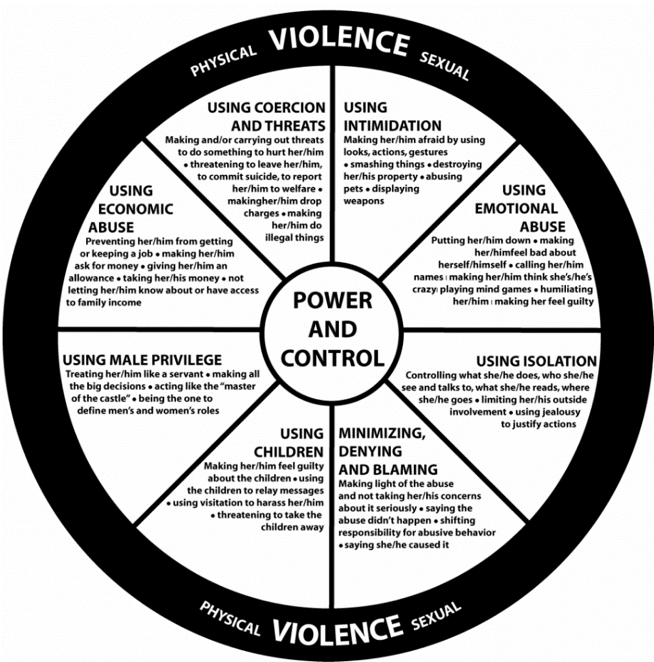
I would add that oftentimes domestic violence is about power and control over someone abusers consider lesser than themselves and whose dignity they do not respect.
National Institutes of Health
Family and domestic violence, including child abuse, intimate partner abuse, and elder abuse, is a common problem in the United States. Family and domestic violence is estimated to affect 10 million people in the United States every year.
Approximately 1 in 3 women and 1 in 10 men 18 years of age or older experience domestic violence. Annually, domestic violence is responsible for over 1,500 deaths in the United States.
It is a serious and challenging public health problem. Domestic violence victims typically experience severe physical injuries requiring care at a hospital or clinic. The cost to individuals and society is significant. The national annual cost of medical and mental health care services related to acute domestic violence is estimated at over $8 billion.
Child Abuse
Each year, there are over 3 million referrals to child protective authorities. The fatality rate is approximately 2 deaths per 100,000 children.
Intimate Partner Violence
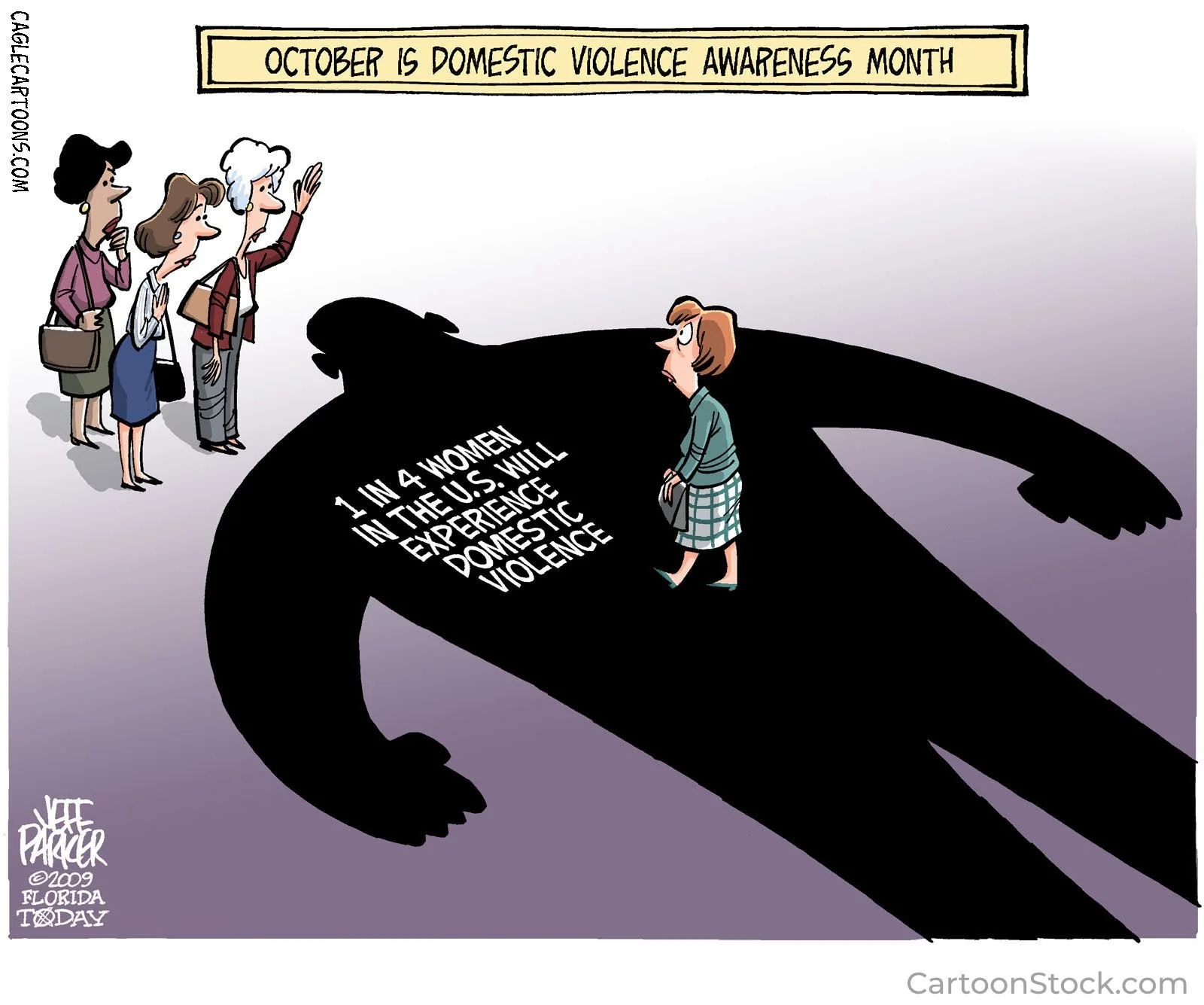
According to the CDC, 1 in 4 women and 1 in 7 men experience physical violence by their intimate partner at some point during their lifetime…with intimate partner violence occurring in over 10 million people each year.
Children
Domestic violence at home results in emotional damage, which exerts continued effects as the victim matures.
Approximately 45 million children are exposed to violence during childhood.
Approximately 10% of children are exposed to domestic violence annually, and 25% are exposed to at least 1 event during their childhood.
Gay, Lesbian, Bisexual, and Transgender
Domestic violence occurs in gay, lesbian, bisexual, and transgender couples, and the rates are thought to be similar to those of heterosexual women, approximately 25%.
Men
Usually, domestic violence is perpetrated by men against women; however, females may exhibit violent behavior against their male partners.
Approximately 5% of males are killed by their intimate partners.
Older Adults
Older adults are often mistreated by their spouses, children, or relatives.
Annually, approximately 2% of older adults experience physical abuse, 1% sexual abuse, 5% neglect, 5% financial abuse, and 5% suffer emotional abuse.
The annual incidence of elder abuse is estimated to be 2% to 10%, with only about 1 in 15 cases reported to the authorities.
National
Fifty percent of women seen in emergency departments report a history of abuse, and approximately 40% of those killed by their abuser sought help in the 2 years before death.
Only one-third of police-identified victims of domestic violence are identified in the emergency department.
Healthcare professionals who work in acute care need to maintain a high index of suspicion for domestic violence, as supportive family members may, in fact, be abusers.
Reason Abusers Need to Control
Anger management issues
Jealousy
Low self-esteem
Feeling inferior
Cultural beliefs hold that they have the right to control their partner
Personality disorder or psychological disorder
Learned behavior from growing up in a family where domestic violence was accepted
Alcohol and drugs, as an impaired individual may be less likely to control violent impulses
CYCLE OF VIOLENCE
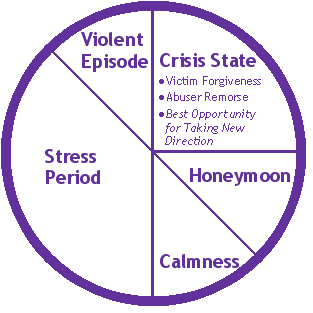
Please note: This is common but is not always present in a violent relationship.
During the Calmness phase of the cycle, everything is going along fine. To outsiders, it is a normal, healthy relationship. However, this phase is often limited in duration in comparison to the abuse in the relationship.
During the Stress Period, the abusive partner is looking for anything to start a fight. This is often referred to as the tension building phase. Possessiveness, jealousy, and attempts to control the behavior of the other person in the relationship comes into play.
Following the stress period, a Violent Episode occurs. This episode can take form as physical, sexual, and/or emotional abuse. A violent episode could even consist of the abuser harming loved ones and/or children in order to gain control over their partner.
After the violent episode, the couple enters the Crisis State. The abuser expresses remorse, takes the blame, asks forgiveness, etc. This is the point in the cycle where the best opportunity for taking new direction is. The victim has either the choice to forgive the abuser once more, thus perpetuating the cycle of violence, OR they can choose to break the cycle of violence by seeking support from their family and friends or an agency like DVIS.
If the cycle is not broken, the couple enters the Honeymoon Phase. During this phase, it seems like everything will work out. The couple may be particularly affectionate and loving towards one another.
In abusive relationships, the severity of the blowup and the abuse may be greater each time, making the period of remorse and making up even more dramatic. Sometimes the period following a violent episode is the only time a victim receives any affection from their partner.
The extreme displays of affection and attention in the honeymoon period is also called love bombing. Love bombing is often a tool that abusers use to later defend their actions.
Following this honeymoon period, everything returns to “normal” by entering the calmness stage of the cycle before repeating again.
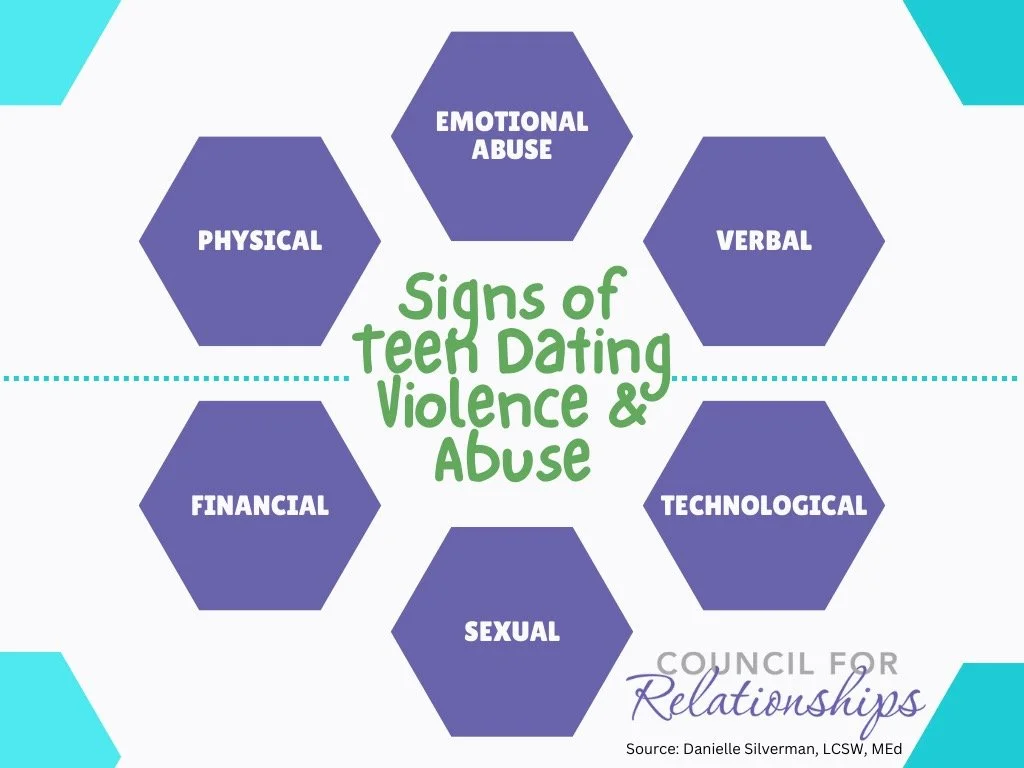
An article on teen intimate relationships from:
“Signs of Teen Dating Violence”
by Danielle Silverman, LCSW, MEd February 12, 2024
Article topics:
—Having the Hard Discussions about Teen Dating Violence
—Signs of Teen Dating Violence & Abuse
—Six Steps for Helping a Teen in a Violent Relationship
FOR SURVIVORS OF DOMESTIC VIOLENCE
This is a tough one when technology is involved.
Just reading about ways to survive with technology can be disturbing to someone who has not experienced domestic abuse.
However, unfortunately, someone you know—perhaps someone you love—may be experiencing it and could benefit from the following survivor guide.
THE GUIDE
On February 19, 2026, Elena Abate sent C:WED a note through our website. She had found us online and was especially drawn to the post I wrote a year ago on the #MeToo movement: The #Me Too Movement And Beyond, Mini-Series #2, May 13, 2025.
This is the note Elena sent us:
Hello Eleanor, I work in digital safety for vulnerable populations and recently assisted on a project with ExpressVPN that created a guide for survivors of domestic violence.
It focuses on how to secure devices, communications, and personal data when technology becomes part of the abuse.
Here’s the guide:
https://www.expressvpn.com/blog/tech-safety-for-survivors-of-domestic-violence/
Your platform does meaningful work giving voice and support to survivors, and I believe this resource could genuinely help your audience stay safer online.
Would you consider including it here: https://cwed.org/blog/the-metoo-movement-mini-series-part-two?
Warm regards, Elena
I have pulled out a few items from the guide Elena has offered us:
Who might benefit from this guide
This guide will show you how to protect yourself from online surveillance so you can securely maintain contact with others and seek help privately.
The guide is meant to serve as a more technical complement to, not a replacement for, other guides on this topic, such as those from:
National Network to End Domestic Violence [NNEDV]
Phone: 202-543-5566
Email: ContactUs@NNEDV.org. (not a monitored email; will not provide immediate response.)
Safety Net is a project of NNEDV. The Safety Net Project focuses on the intersection of technology and abuse, and we work to address how that abuse impacts the safety and privacy of survivors.
Our team provides expert training and technical assistance, creates and disseminates resources, and influences conversations on technology abuse and safety globally.
Note: NNEDV is not a crisis service agency and is not equipped to provide crisis support.
NNEDV strongly encourages survivors to contact a national or local hotline for immediate and direct assistance from providers who are more familiar with the services and options in your area.
[More resources are listed at the end of this post.]
SOME ADDED EXPANSIONS:
From the NNEDV website—8 FAQ:
1. What is domestic violence?
Domestic violence is a pattern of coercive, controlling behavior that can include physical abuse, emotional or psychological abuse, sexual abuse or financial abuse (using money and financial tools to exert complete control over a victim’s every action without ever using violence or only using subtle threats of violence. All types of abuse are devastating to victims.
Domestic violence is a pervasive, life-threatening crime that affects millions of individuals across the United States. High-profile cases of domestic violence will attract headlines, but thousands of people experience domestic abuse every day, and they come from all walks of life.
Abusive partners make it very difficult for victims to escape relationships. Sadly, many survivors suffer from abuse for decades. It is important for survivors to know that the abuse is not their fault, and that they are not alone.
2. What resources are available for victims?
Survivors have many options, from obtaining a protection order, staying in a shelter, exploring options through support groups, or making an anonymous call to a local domestic violence shelter or national hotline. There is hope for victims, and they are not alone.
There are hundreds of local shelters across the United States that provide safety, counseling, legal help, and other resources for victims and their children.
Information and support are available for victims of abuse and their friends and family.
[Note: I have relocated the list of hotlines and information resources that were in this #2 spot and placed them at the end of this post to allow for a handy compiled list.]
3. Why do victims sometimes return to or stay with abusers?
The question is not “Why doesn’t the victim just leave?” The better question is “Why does the abuser choose to abuse?”
The deck is stacked against victims as they navigate safety.
Abusive partners work very hard to keep victims trapped in the relationship.
They may try to isolate the victim from friends and family, thereby reducing the people and places where the survivor can go for support.
Through various tactics of financial abuse, abusive partners create financial barriers to safety.
There is real fear of death or more abuse if they leave, as abusers may perceive this act of independence as a threat to the power and control they’ve worked to gain, and they may choose to escalate the violence in response.
Through “gaslighting,” abusers cause victims to feel like they are responsible for the abuse. Gaslighting is a form of emotional abuse that abusers use to confuse and shift blame onto the victim. This often causes the victim to doubt their sanity and feel like they are responsible for the abuse and, therefore, unable to stop it.
Abuse takes an emotional and physical toll over time, which can translate to additional health issues that make leaving more difficult.
Survivors often report that they want the abuse to end, not the relationship. A survivor may stay with or return to an abusive partner because they believe the abuser’s promises to change.
4. Do abusers show any potential warning signs?
There is no way to spot an abuser in a crowd, but most abusers share some common characteristics. Some of the subtle warning signs include:
They insist on moving quickly into a relationship.
They can be very charming and may seem “too good to be true.”
They insist that you stop participating in your preferred leisure activities or spending time with family and friends.
They are extremely jealous or controlling.
They do not take responsibility for their actions and blame others for everything that goes wrong.
They criticize their partner’s appearance and make frequent put-downs.
Their words and actions don’t match.
Domestic violence is first and foremost a pattern of power and control. Any one of these behaviors may not be indicative of abuse on its own, until it is considered as part of a pattern of behavior.
And remember: it’s never your fault if someone chooses to hurt or abuse you, whether there were “warning signs” or not.
5. Is it possible for abusers to change?
Yes, but they must first make the choice to change their behavior. It’s not easy for an abusive partner to stop choosing abusive behavior, and it requires a serious commitment to change. Once an abuser has had all of the power in a relationship, it’s difficult to transition to a healthy relationship where each partner has equal respect and power.
Sometimes an abusive partner stops one form of the abuse – for example, the physical violence – but continues to employ other forms of abuse, such as emotional, sexual, or financial abuse. It is important to remember that domestic violence includes one or more forms of abuse and is a part of an overall pattern of seeking power and control over the victim.
6. Are men victims of domestic violence?
Yes, men can be victims of domestic abuse. Domestic violence is a pervasive, life-threatening crime that affects millions of individuals across the United States.
According to the Centers for Disease Control and Prevention, more than four in 10 men (44.2% or 52.1 million) in the United States reported contact sexual violence, physical violence, and/or stalking by an intimate partner at some point in their lifetime.
Pervasive stereotypes that men are always the abuser and women are always the victim discriminates against survivors who are men and discourages them from coming forward with their stories. Survivors of domestic violence who are men are less likely to seek help or report abuse. Many are unaware of services for men, and there is a common misconception that domestic violence programs only serve women.
When we talk about domestic violence, we’re not talking about men versus women or women versus men. We’re talking about violence versus peace and control versus respect. Domestic violence affects us all, and all of us must be part of the solution.
Domestic violence affects us all, and all of us must be part of the solution. (emphasis mine)
7. How does the economy affect domestic violence?
A bad economy does not cause domestic violence – and the only person responsible for abuse is an abuser – but economic stressors can worsen certain aspects of domestic violence. The severity and frequency of abuse can increase when factors associated with a bad economy are present. Job loss, housing foreclosures, debt, and other factors contribute to higher stress levels at home, which can lead some people to choose to channel their frustration into violent, controlling behavior against partners or other family members.
As the abuse gets worse, a weak economy also limits options for survivors to seek safety or escape. Additionally, domestic violence shelters and programs may experience funding cuts right when they need more staff and funding to keep up with the demand for their services. Victims may also have a more difficult time finding a job to become financially independent of abusers.
8. What can I do to help?
Everyone can speak out against domestic violence.
Use our 10 Tips to Have an Informed Conversation about Domestic Violence to help guide your conversations with friends, colleagues, and loved ones.
Every person can take individual action to create a supportive community for survivors. Get involved in your community – we’ve got ideas for creative ways to get involved in our Get Involved Toolkit.
Members of the public can donate to local, statewide, territorial, or national anti-domestic violence programs or victim assistance programs, like NNEDV. Find your state or territory coalition here.
You can call on your public officials to support life-saving domestic violence services and hold perpetrators accountable. Learn more, or take action here.
If you, or someone you know, is experiencing domestic or family violence, help and confidential support are available.
If you are in immediate danger and feel comfortable involving law enforcement, please call 911.
From NNEDV:
Hotlines
In the United States, you may contact:
National Domestic Violence Hotline
Languages: English, Spanish and 200+ through interpretation service
Hours: 24/7
Call: 1-800-799-SAFE (7233)
Text START to 88788
Chat: TheHotline.org
Official Website: https://www.thehotline.org/
Loveisrespectprovides teens and young adults confidential and anonymous support.
Reach out by:
Phone: 1-866-331-9474
TTY: 1-866-331-8453
WomensLaw.org a project of NNEDV, provides legal information and resources for victims.
Help is available in English and Spanish.
Reach out by email through the Women’sLaw.org Email Hotline.
Information
Technology can be used by victims to increase safety and privacy.
It can also be misused by perpetrators to harass, abuse, or harm victims.
Find information, including resources and toolkits related to technology safety at TechSafety.org.
Financial abuse is widespread. Learn more about rebuilding from financial abuse from The Moving Ahead Curriculum.
Find state- and territory-specific legal information on WomensLaw.org related to custody, protection orders, divorce, and more.
U.S. State and territorial coalitions: NNEDV’s trusted members supporting thousands of local programs
Find your own state or territorial domestic violence coalition here.
TIP: Before using online resources, know that your computer or phone may not be safe.
Some abusive partners misuse technology to stalk and track a partner’s activities on a computer, tablet, or mobile device.
—and—
The NO MORE GLOBAL DIRECTORY is a first-of-its-kind, comprehensive international directory of domestic and sexual violence helplines, specialist support services, and resources for men, women, and those who identify as non-binary in almost every [United Nations]-recognized country and territory in the world.
The NO MORE Foundation created the site in partnership with the United Nations and the World Bank, and it serves as a global hub of information and resources for victims and their loved ones.
This directory is the latest step in our efforts to create a world with NO MORE domestic and sexual violence.
The NO MORE GLOBAL DIRECTORY offers the opportunity to click on a country of choice; then click on more localized areas to find local domestic and sexual violence support services.
The NO More Global Directory covers these regions:
Africa, Asia, the Americas, Europe, and Oceana
To find resources in a country of your choice:
Open the NO MORE Global Directory website.
Scroll down (or up) and click on one of the five regions.
National flags of that region will pop up.
Click on the flag of the country of your choice.
That country’s resources will pop up.
This NO MORE Global Directory is a fantastic endeavor!
So, in conclusion, why should we care about
Domestic Violence?
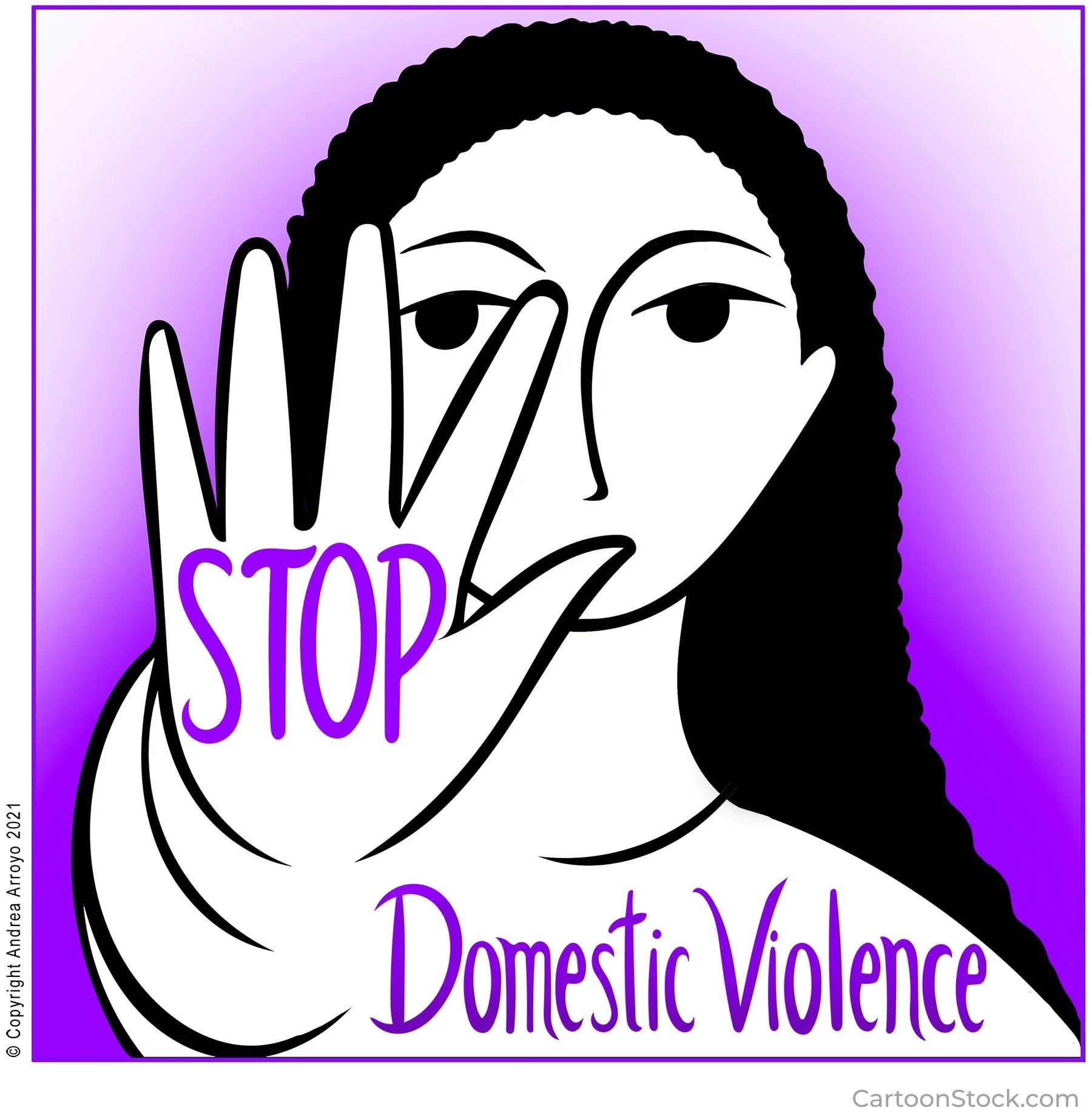
Domestic violence affects us all, and all of us must be part of the solution.
IN YOUR OWN WORDS:
Previous Post: "Finale in New Orleans on Justice for Girls — Mini-Series #6,” Written by Anne Andersson May 15, 2026
—Loved Melanie’s song. Thanks for sharing it, Anne. —Maryanne
—Thank you. —RE
—Thanks Anne. As always a very interesting piece…. As a Midwesterner who attended a school staffed by the Sisters of Loretto, I was introduced to ideas and experiences that were unfamiliar to my NY sisters. For example, my Freshman religion teacher was Mary Luke Tobin. She was the only female in attendance at Vatican 2. She treated her students as young women who would change the world. I was 13.
So continue your good work But don't underestimate the importance of what your Sunday classes* may be planting in the minds of those youngsters. Lots of love. —LB
My response:
*My (Anne’s) response: The Sunday classes, to which LB is referring, is the Montessori-based Catechesis of the Good Shepherd (CGS) religious formation program for children ages 3-12. I have been a catechist for the program in our parish church since 1994. My husband Bruno and I introduced CGS to our church and he served as a catechist with me in the program from 1994 until his passing in 2019.
The Epstein Survivors
After reading the teenagers’ presentations of their stories on justice—or lack of—for girls in their countries through our mini-series,
could we relate even better to the women who are speaking out—the Epstein survivors
—and—
possibly understand them as the teen girls they were at the time of their abuse?
Keep these adult women in mind and in your prayers.
Their saga,
which includes a true-to-life cover-up,
cannot be lost among other current news.
C:WED WISH LIST:
We always ask that you continue to support us and we so very much appreciate all your assistance.
Your help, even the smallest amount, assists us with technology monthly and annual fees and subscriptions.
To make a contribution, you may click on this safe link: