
A Christmas Reflection
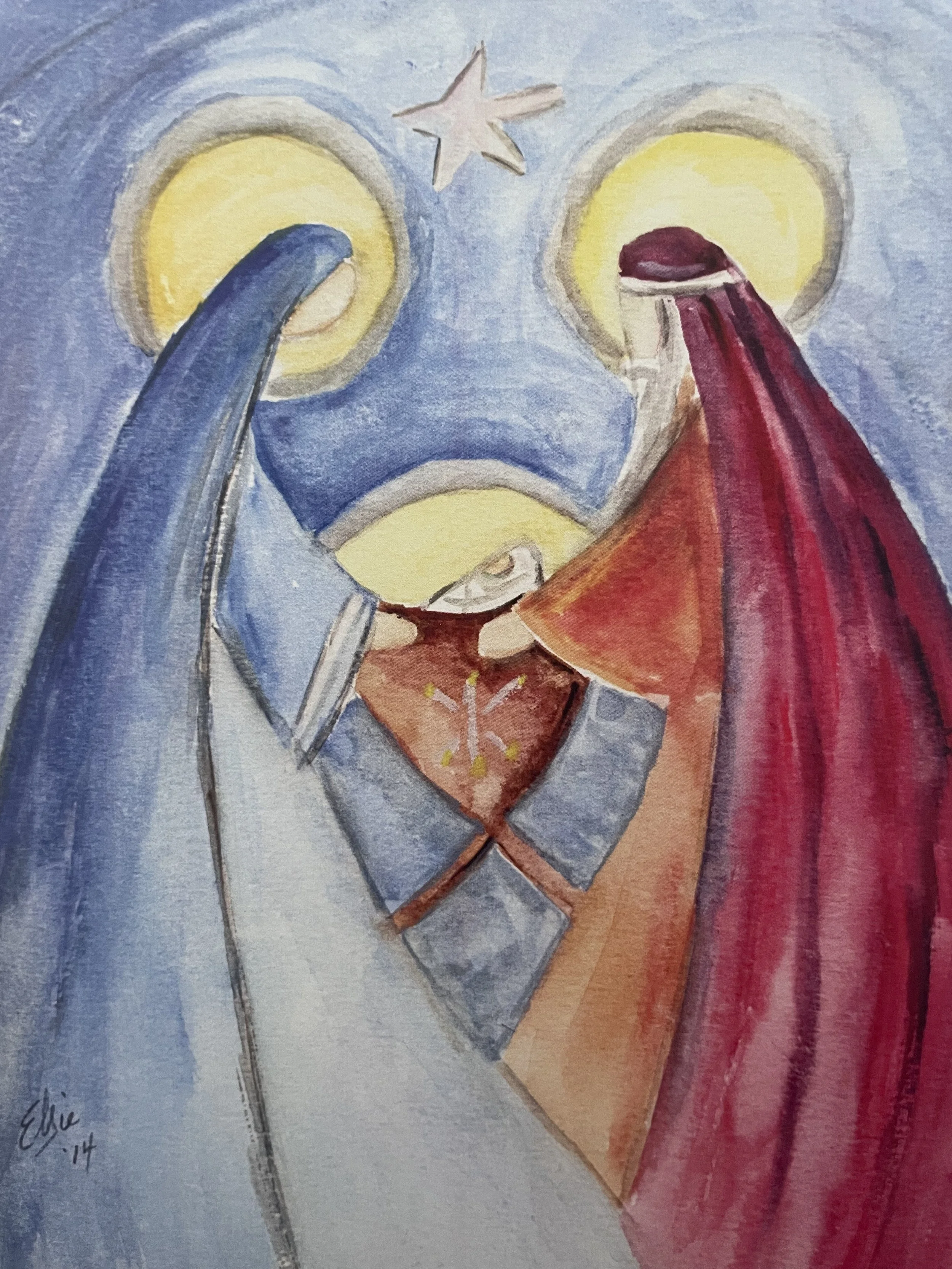
Nativity by Elsie Christensen Kleppe 2014
(Included with permission)
Today the world stands still!
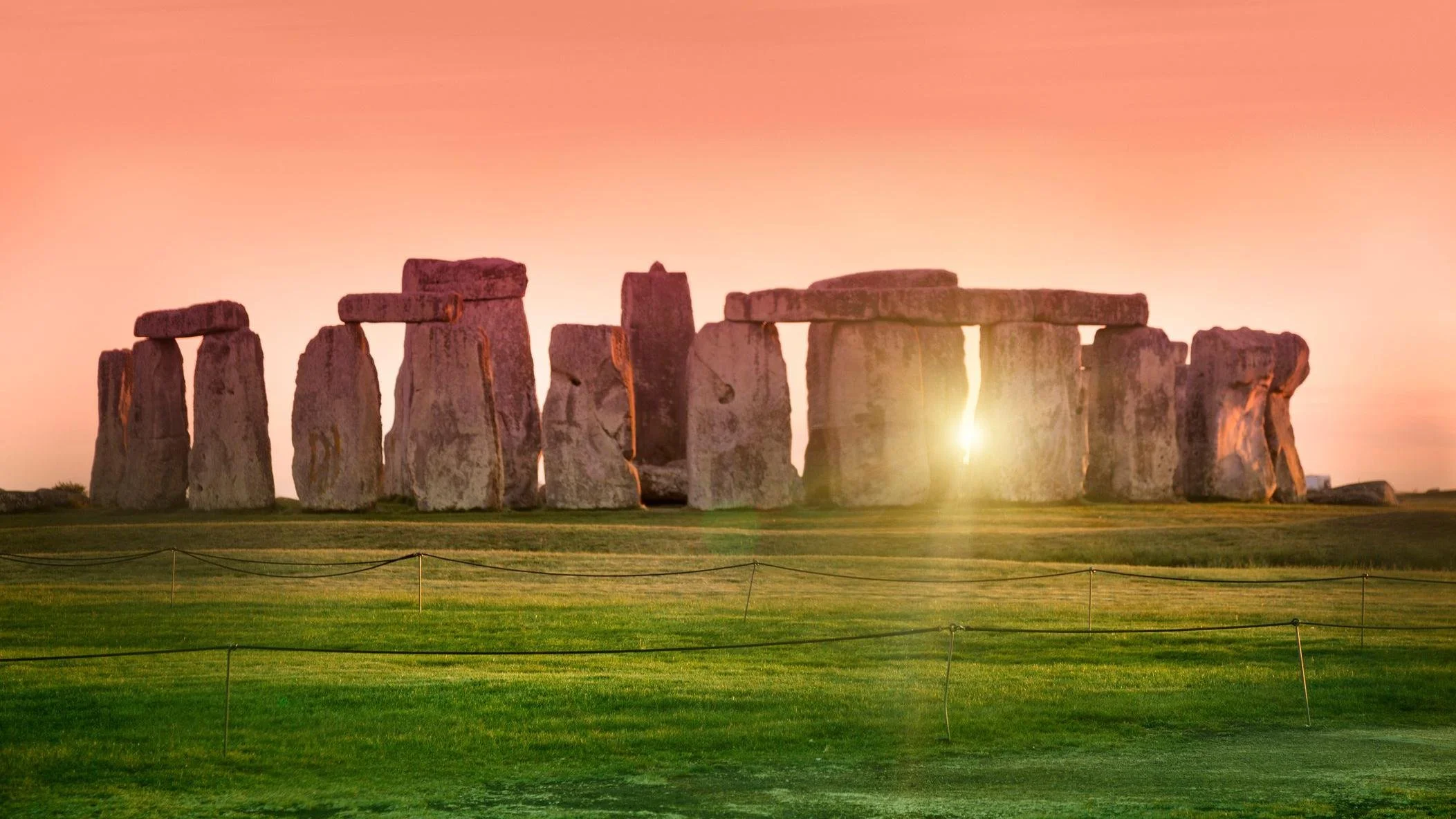
The Winter Solstice happens today, Sunday, December 21, 2025 in the U.S. at 10:03 AM, and at Stonehenge in the U.K. (pictured above) at 8:09 GMT—leaving behind the longest night of the year in the Northern Hemisphere and beginning the time of longer days to come.
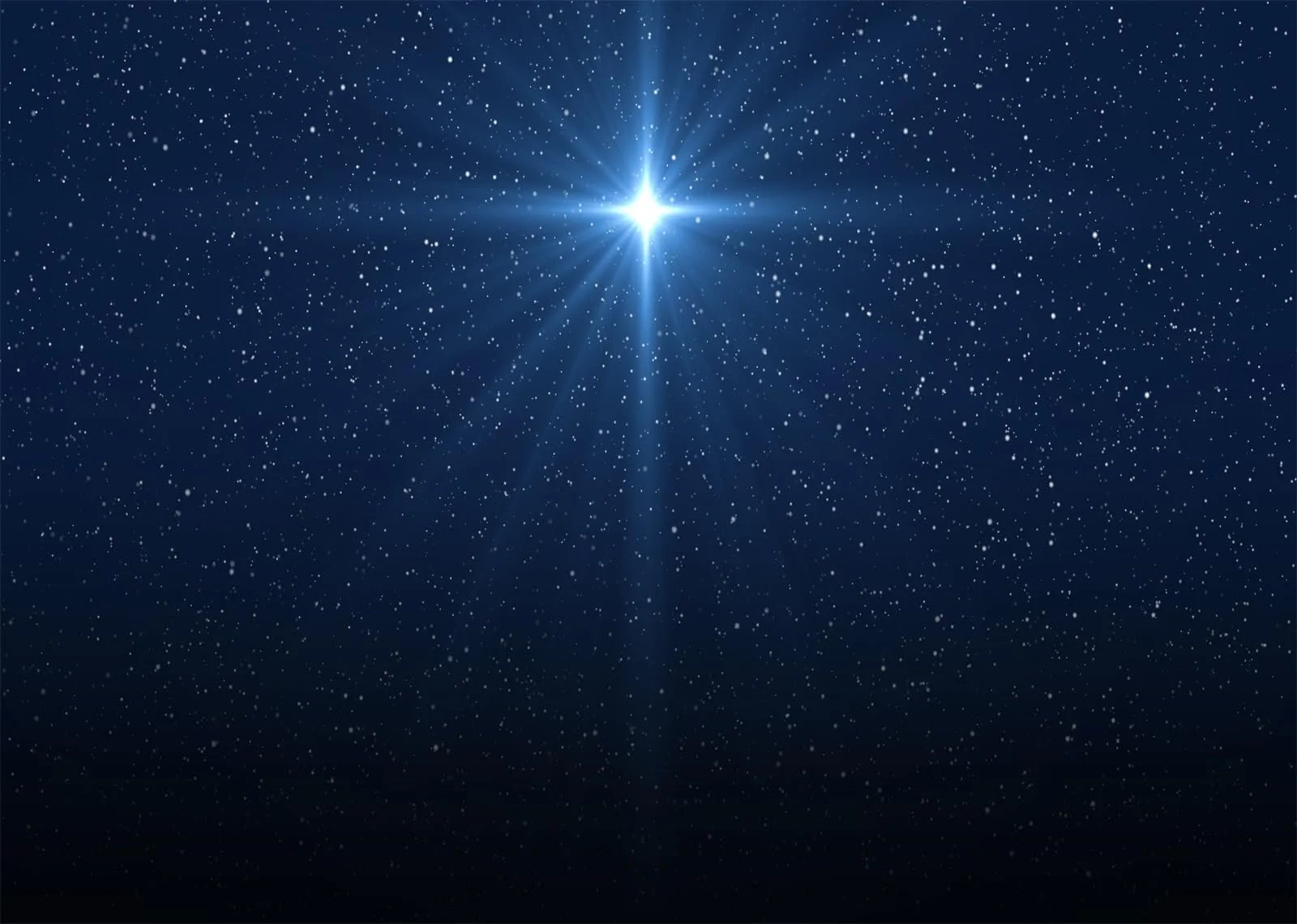
What a perfect time to be celebrating Christmas, the birth of Christ, the Incarnation, a cosmic moment that brought in the light of a Divine birth.
One of my favorite theologians whose views have long inspired me is Pierre Teilhard de Chardin, S.J., French Jesuit, Catholic priest, scientist, paleontologist, philosopher, theologian, mystic, and teacher.
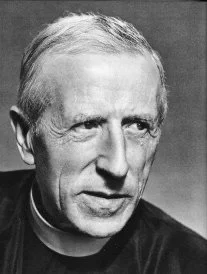
Pierre Teilhard de Chardin (1881-1955)
I thought I would include in this post his mystical insight and perspective on the Incarnation, which is what Christmas is all about: the birth of Christ, when the Divine entered more specifically into the material world and shared our humanity.
Teilhard, being very Christo-centric, referred to the Divine in Christic terms: so that, as Sr. Kathleen Duffy, SSJ, Ph,D., president of the American Teilhard Association (ATA), explained in ATA’s Advent 2025 webinar this week:
“The Christic is Teilhard’s ultimate image of God.” [1]

Teilhard offers us a broader view of the Incarnation: a vision which extends far beyond that moment in Bethlehem. The Incarnation, for Teilhard, was not just a singular event that occurred once on a long-ago night.
Rather, Teilhard places the Incarnation at the Creation—as the words of the Prologue to the Gospel of John declare:
“In the beginning was the Word, and the Word was with God. And the Word was God.” John 1:1
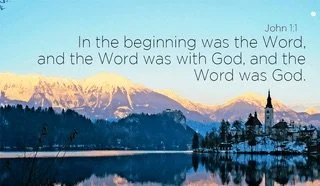
What is also profound in Teilhard’s insight is: not only does he see the Incarnation as occurring at the Creation, but he sees the Incarnation as ongoing and continually occurring every day.
The following passage is from Teilhard’s The Heart of Matter where he offers a description of the Creation and the ongoing Incarnation:
…the flame lit up the whole world from within.
All things individually and collectively are penetrated and flooded by it, from the inmost core of the tiniest atom to the mighty sweep of the most universal laws of being: so naturally has it flooded every element, every energy, every connecting-link, that one might suppose the cosmos to have burst spontaneously into flame.
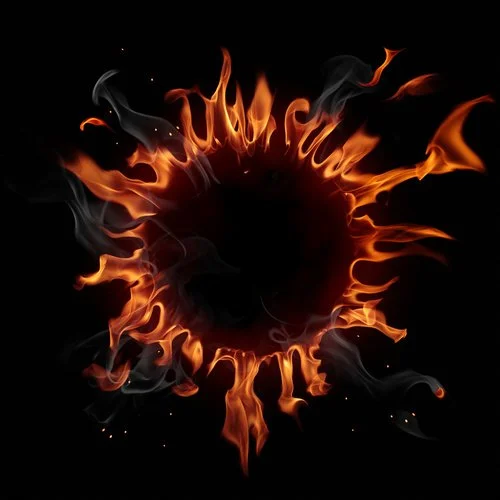
And each day, Christ, the Fire of the ongoing Incarnation, breathes a soul into the newly formed fragile film of matter that is freshly clothing our Earth.
Each day, Christ plunges into the depths and the totality, present and past, of our world to reach us simultaneously through all that is most immense and most inward within us and around us.
—Teilhard, The Heart of Matter, page 122.
Teilhard helps us to see Christ in the cosmic sense, that is, as the Cosmic Christ, the Universal Christ who is available to all people regardless of their faith traditions.
He also helps us to understand that Christ is present with us, at all times, in all the materiality of our Earth and its life, including within us. Teilhard saw the material universe as the “Divine Milieu.”
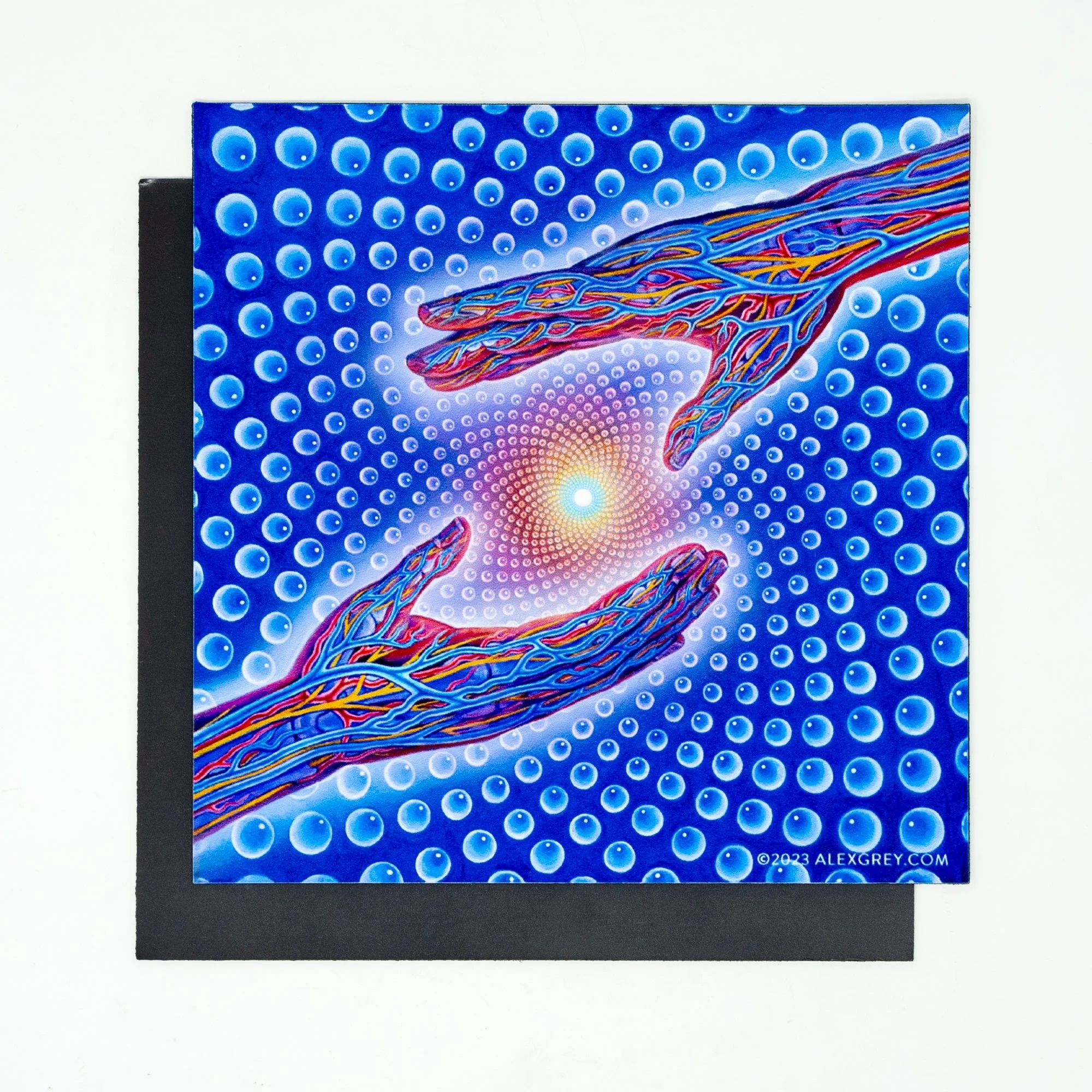
Another of Teilhard’s mystical insights of importance was that he saw the Incarnation and Evolution as two sides of the same coin: he understood that both participate in a process of increasing consciousness and complexity.
And he considered the Incarnation and Evolution to be fueled by the Cosmic Christ; propelling the development of consciousness toward what Teilhard calls the Omega Point.
The Omega Point will be utterly and truly the Divine in All. At the heart of the Omega Point—is Love.

Going back to the Cosmic Christ, to deeply grasp this concept, we need to first understand “Jesus” and “Christ” as two separate faith declarations.
How might we do this?
In order to see the Christ as one faith declaration and Jesus as another faith declaration, it would help to fast-forward through the life of the historical Jesus and focus on his Death, Resurrection, and Ascension.
I believe Teilhard’s trajectory might have looked something like this:
The Cosmic Christ is identified as “the Word” in the Prologue to the Gospel of John, and declared to have been present at the Beginning, at the Creation.
The Cosmic Christ then entered the material world just over 2000 years ago in Bethlehem as a human infant—the Jesus we have come to know.
However, this was an infant of a different sort. As declared by the Catholic Church’s Council of Chalcedon in 451 AD, this child, this Jesus, was held to have been one person with two natures, fully human and fully Divine. Thus, Jesus was fully human, of course, but he was also fully Divine—he retained his nature as the Comic Christ.
As the gospels relate, that human Jesus, as an adult, was then murdered.
Three days later, Christ was risen.
The being who was risen, who emerged from the tomb on the day Christians now celebrate as Easter, was a cosmic being—the Cosmic Christ.
The human Jesus was no longer present on the Earth.
It was the Cosmic Christ who then walked on the Earth and spent time with apostles, friends, and followers. And they, in turn, experienced the full presence of Christ.
After forty days, Christ ascended back into the cosmos.
I dare say that understanding the risen Christ as the Cosmic Christ helps to explain the way, in which Christ’s appearances are described in the Gospels of the Christian Testament: that is, how Christ was present to the apostles during that interim period between Resurrection and Ascension.
For example, there were times when his followers did not recognize him, as on the road to Emmaus (Luke 24:13-16).
Sometimes he just “appeared” spontaneously within their midst while they were gathered in a room, as they were when Thomas doubted. (John 20: 24-29).
Or he disappeared from sight in front of them as in the Emmaus story. (Luke 24:30-31).
And it was, after all, the risen Christ, the Cosmic Christ, whom Mary Magdalene really saw in the garden at the tomb—not a resuscitation of the human Jesus she had known. And so, she too did not recognize him (until he spoke her name, “Mary”). (John 20:11-16a)
The Jesus whom the Church has emphasized for us has mostly always been the human historical Jesus who was born in Bethlehem on that silent night over 2000 years ago.
He is all we have known, for the most part.
The Catholic Church leaders have done well with imparting and celebrating that story of God’s immersing Godself into matter on that blessed night in Bethlehem.
Lacking, however, seems to have been any readiness to expand on explanations about the Christ of the Prologue of the Gospel of John—the Cosmic Christ (referred to as the Word)—and who was there in the beginning at the Creation.
Richard Rohr, OFM, an American Franciscan priest and writer whose spirituality centers on the Universal Christ, describes the dilemma quite well:
Most Christians know about Jesus of Nazareth, but very few know about the Christ, and even fewer were ever taught how to put the two together. Many still seem to think that Christ is Jesus’ last name.
By proclaiming my faith in Jesus Christ, I have made two acts of faith, one in Jesus and another in Christ.
The times are demanding this full Gospel of us now.[2]
As mentioned above, Jesus the man was always also Jesus the Cosmic Christ.
Today we do not have Jesus the man; we do have the Christ.
So, when we pray going forward, we might find it inspiring to heed this paraphrase of an additional message from the president of the American Teilhard Association, Sr. Kathleen Duffy, SSJ:
When we pray now, we probably have the human Jesus in mind, and we are praying to him, when, in actuality, we should be praying to the Cosmic Christ. [3]
Teilhard understood that the Cosmic Christ is the one already at work from the start helping us to get to the Omega Point.
And we do get closer to Omega with each kind act we perform for as long as we are alive on this Earth.
May this Christmas invite us—whatever our beliefs—to trust that every small act of care matters, and that even in uncertainty, life is evolving toward deeper connection, culminating in the Omega Point, which, as Teilhard tell us, is pure LOVE.
Pierre Teilhard de Chardin
Teilhard de Chardin sought to integrate science, evolution, and spirituality. Writing at a time when these fields were often seen as incompatible, Teilhard envisioned the universe as a sacred process moving toward greater consciousness, unity, and love.
Notes:
[1] Adapted from Richard Rohr, “Franciscan Mysticism: A Cosmic Vision,” Radical Grace, Vol. 25, No. 1 (Center for Action and Contemplation: 2012).
Rohr’s article is on the website of the Center for Christogenesis, which was founded by theologian Sr. Ilia Delia, OSF, Ph.D., a Franciscan sister and writer who specializes in the area of science and religion.
1], [3] Sr. Kathleen Duffy, SSJ, Professor Emerita of Physics and president of the American Teilhard Association. Host of the two-part ATA Zoom Advent 2025 webinar “Living Into Incarnation with Teilhard” (December 2, 2025 and December 19, 2025). Quotes from second session, December 19, 2025.
IN YOUR OWN WORDS:
Previous Post: “A VERY SPECIAL ZOOM MEETING!”
Written by Anne Andersson, December 12, 2025
—”Lovely post, Anne. I know the four saints are up there smiling and proud.” —Cyndy
—”Very special indeed.” —ER
—”So glad you wrote about your zoom visit! I was enthralled when you told me about it before. Still hoping they will be canonized as saints. It is so intriguing!” —LC
—”A very interesting and enlightening article. Thanks for taking the time to do all the research for these weekly posts! Happy holidays!” —Barbara
Do remember the survivors!
Pray for the women
As they are speaking out now,
Risking danger.
C:WED’S WISHES:
We wish you a holy Christmas!
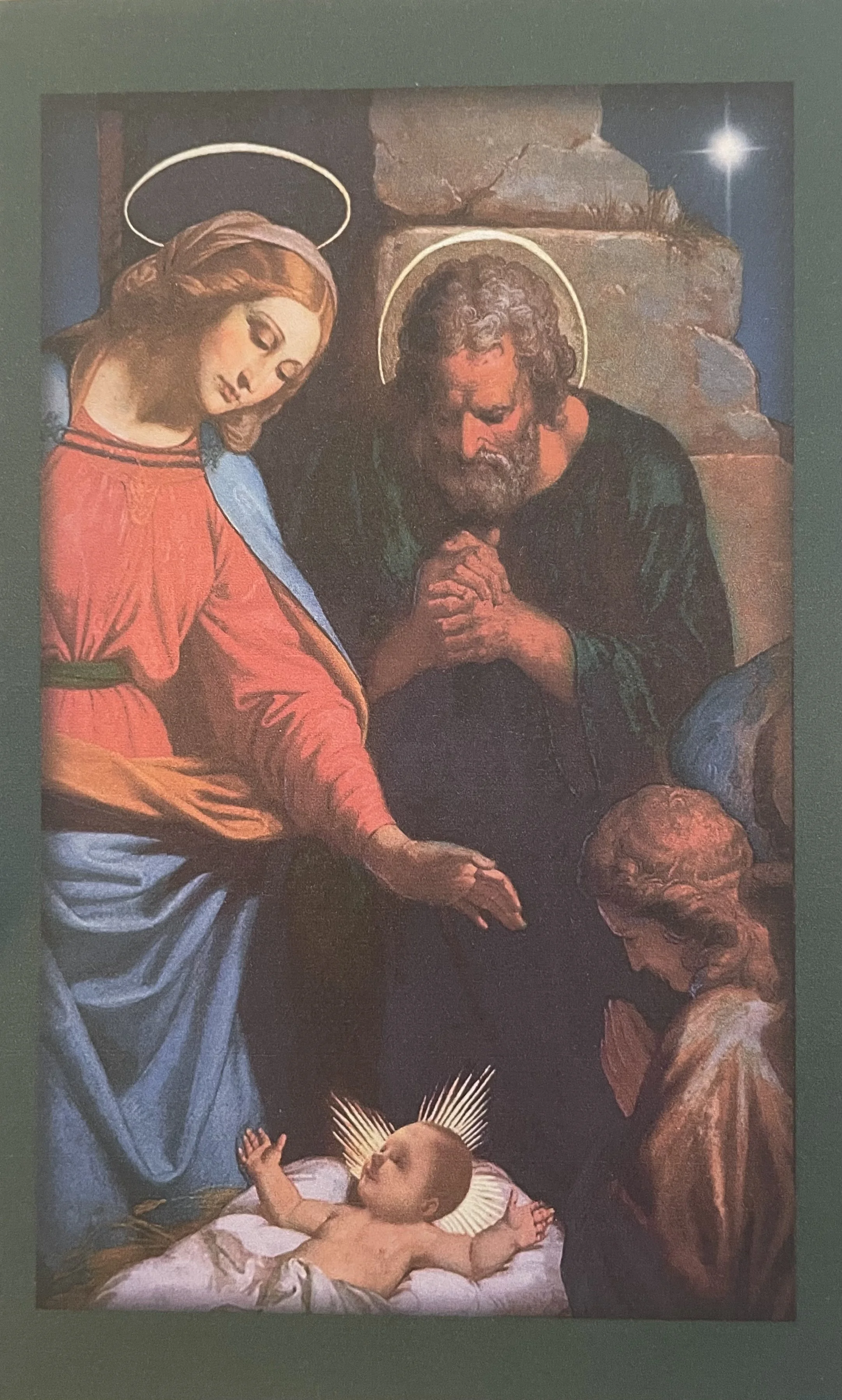
December 25, 2025
And a continually blessed Hanukkah!

Hanukkah: Evening of Sunday December 14 to Monday December 22, 2025