1980: El Salvador: FOUR MARTYRED WOMEN: 45TH ANNIVERSARY
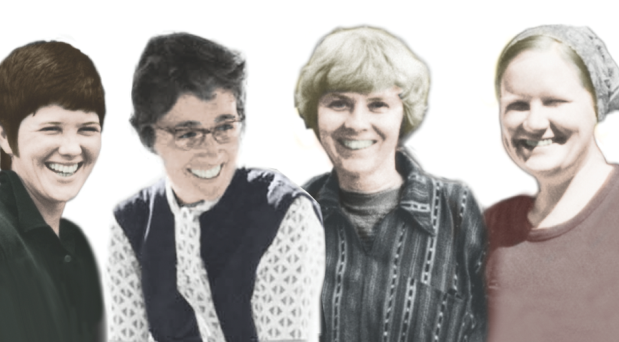
Left to Right:
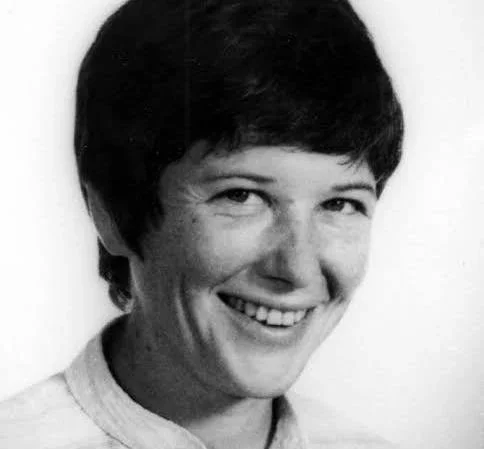
Ita Ford, MM (Maryknoll Sister) Born in Brooklyn, NY April 23, 1940—December 2, 1980
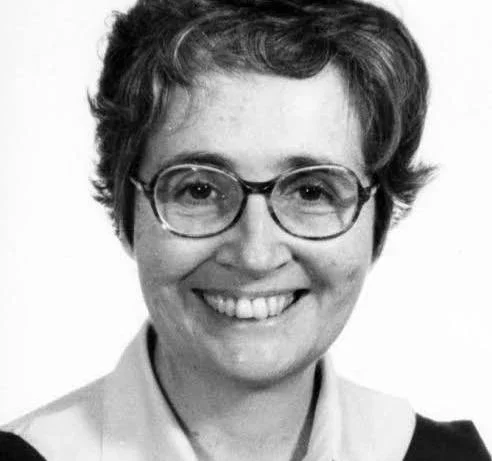
Maura Clarke, MM (Maryknoll Sister). Born in Queens, NY January 13, 1931—December 2, 1980
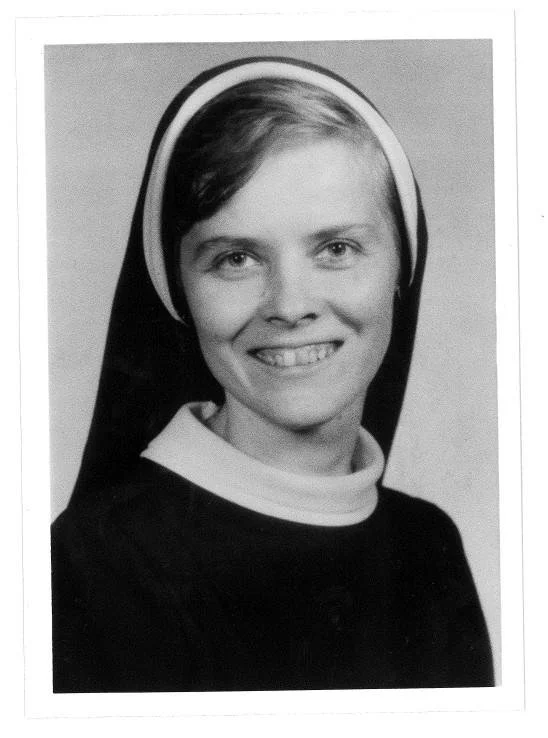
Dorothy Kazel, OSU. (Ursuline Sister) Born in Cleveland, Ohio June 30, 1939—December 2, 1980
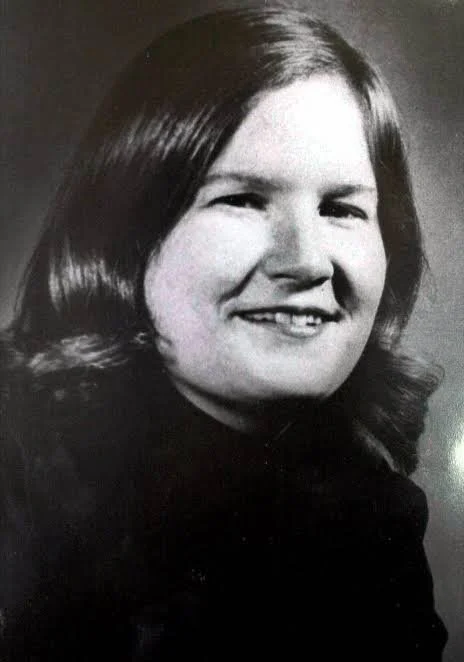
Jean Donovan, Lay Missionary Born in Westport, CT April 10, 1953—December 2, 1980
Prayer service marks 45th anniversary of murders
SAN DIEGO — A prayer service honoring three religious sisters and a lay missionary who were murdered in El Salvador 45 years ago will be held on Sunday, November 30, 2025 at Immaculate Conception Church in Old Town, San Diego, CA..
“We want to celebrate their lives and reflect about how their ministry impacts us today,” said Sister Kathleen Warren, director of the diocesan Office for Women Religious.
~~~
Sister Maura Clarke, Sister Ita Ford, Sister Dorothy Kazel, and Jean Donovan all had a ministry of accompaniment to Salvadorans displaced by war and poverty. They were relentless in their fortitude in the face of danger in a place like El Salvador during the 1970s and 1980s when civil war was raging and thousands were being killed.
The women were murdered on December 2, 1980 by members of the Salvadoran National Guard for their work supporting marginalized communities during the Salvadoran civil war.
Jean and Dorothy were picking up Ita and Maura at a nearby airport when the two were returning from a Maryknoll Conference.
Their van was intercepted as they were driving to their home in La Libertad, and they were raped and shot. The reason? They were helping, teaching, and caring for the poor of the area.
The Salvadoran civil authorities considered the Church and its people to be subversive because they were serving the poor of the country.
The bodies of the women were found in a shallow grave on December 4, 1980

That same year, less than nine months earlier on March 24, 1980, Archbishop Oscar Romero, whom the Catholic Church declared a saint in 2018, was murdered for similar reasons—his preferential option for the poor.
However, for Archbishop Saint Oscar Romero, the likely immediate motivation for his assassination was that he had begun outrightly preaching over the radio to the Salvadoran soldiers, telling them to stop the killing. “Stop the repression,” were his words.
Jean was motivated by Romero and she went often to the Cathedral to participate in Mass there and to hear his homilies. She also brought him her freshly baked chocolate chip cookies.
~~~
Aftermath:
United States response:
The United States government had been implicitly involved with Salvador as it had been supporting the Salvadoran regime by sending guns and helicopters to the civil authorities.
Discussing the murders, U.S. Secretary of State Alexander Haig suggested in a Congressional hearing that the women might have run a roadblock and were killed in an exchange of fire.
President Reagan’s foreign policy advisor Jean Kirkpatrick declared her “unequivocal belief” that the Salvadorean army was not responsible, adding that “the nuns were not just nuns. They were political activists.”
Haig’s testimony was heavily criticized by the families of the victims as well as others, who pointed out that the women were abducted, raped, and murdered by members of the Salvadoran National Guard.
A later report acknowledged that Haig’s statement was a mistake.
The perpetrators:
In 1984, four national guardsmen were convicted of murdering the four women and they and their superior were sentenced to 30 years in prison.[10]
In 1998, the four assassins confessed to abducting, raping and murdering the four churchwomen and claimed that they did so because they had been informed that they had to act on orders from high-level military officers.[10] Some were released from prison in a deal.[14]
The head of the National Guard, General Carlos Eugenio Vides Casanova, moved to the U.S. in 1989 following his retirement. He lived in Florida as a legal permanent resident, but was deported back to El Salvador in 2015.
The people of El Salvador:
The Salvadoran people consider the four women to be saints.
In January 2022, Bishop Escobar of El Salvador said that Salvadoran bishops are working on a canonization cause that will include the four women martyrs. [23]
~~~
Of the four women, I personally know the most about Jean Donovan
I do remember hearing the news on TV in December 1980 of the murder of the four women. At the time, my family and I were living in Weston, CT.
My discovery years later in 2013 that Jean had grown up in Westport, CT started me on a search to learn more of her story. I knew Westport fairly intimately—it is a town that figured prominently in my own day-to-day family living because of its proximity to Weston, its neighboring town.
So, in April 2013 I spent a quiet day in Westport. With the assistance of the Staples High School administration, the Westport library, and the Westport Historical Society, I was able to speak to people and visit places that were significant in Jean’s early life—and to take photos.
Here is a link to the photo PowerPoint I created from my sleuthing efforts for my high school religion students . It chronicles Jean’s early life up to her college years.
URL for Photo PowerPoint:
https://1drv.ms/p/c/0071a7c6d68e60a6/EbhW3wAszstKgJpbXLkI8qYBNCemqfU6pPxW3krPtVhUvw
Jean’s early life was rather ordinary, although growing up in an upper middle-class family in Westport was one of ease and wealth. Because of that ease, it is all the more amazing that she left it to minister in El Salvador—and at a dangerous time.
The turning point in Jean’s life came during her junior year in college when she spent a year abroad in Ireland and met Father Michael Crowley, a priest who inspired her about missionary work.
After obtaining a master’s degree in business administration in Cleveland, Ohio, when she began working as an accountant in the Arthur Andersen firm, she learned about her local church’s missionary program in El Salvador.
Current report on this mission from the Catholic Diocese of Cleveland, December 3, 2024:
The Cleveland diocese answered a call from Pope John XXIII in 1964 to spread the kingdom of God to the people of El Salvador and established a mission. It has maintained a presence there ever since, with Father Paul Schindler and Father John Ostrowski continuing to minister to the Salvadorans.
Jean signed up and arrived El Salvador in July 1979, first going for training in Maryknoll, NY.
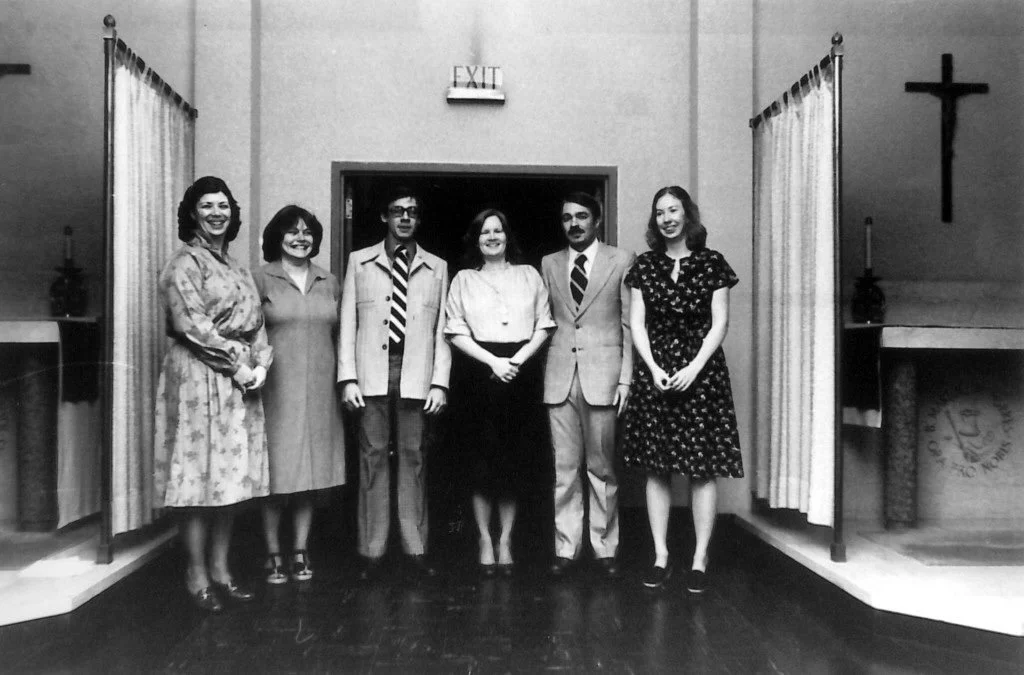
Maryknoll Lay Missioners orientation Class of Spring 1979 – Jean Donovan is third from the right.
Jean’s Journey to Mission: Westport to Ireland to Cleveland to Maryknoll to El Salvador
The part of Jean’s story that stands out to me is her questioning of why she—as she said “of all people”—had this desire to go to Salvador. Her calling was strong, but the reason for it remained a mystery to her. She answered the call, nevertheless. Salvador and the children became her life.
~~~
I have been in touch with three people who knew either Jean or all the women:
Jean’s middle school and high school classmate, Dan Woog, had many positive comments about her. He told me that he and Jean were friendly and that she was smart and pleasant. He also did say that “her life took a turn that none of us would have expected. She was not religious when I knew her.”
Dan occasionally includes stories about Jean in his Westport publication entitled: “06880”, the title of which is Westport’s zip code.
Here is one story about Jean that was written by John Suggs five years ago on December 2, 2020: Jean Donovan: Not The Westport Girl Next Door
~~~
Sofia Aguilar was living and teaching in El Salvador in 1980 and was working with the four women whom she described as fun-loving and usually happy. She fondly remembered the women playing cards together and enjoying each other’s company. Sofia’s own life became threatened in Salvador, primarily because she was a teacher of young children, and she fled to the U.S., ultimately landing in New York City.
An odd twist: Over 30 years later, Sofia’s daughter Bianca was a student in my religion class when I was teaching in Cathedral High School in NYC. As I was relaying the story of Jean and the sisters to her class, Bianca raised her hand and said the most improbable words to me: “My mother knew and worked with those women!”
What are the chances? Bianca’s mother, Sofia, agreed to come to Cathedral to speak to all the students, telling her story for the very first time amidst many tears—her own as well as those of the students and their teachers.
~~~
I found Jean’s friend, Cynthia Canty, on Facebook while researching the college Jean had attended in Ireland.
Cynthia hailed from Michigan in the U.S.and was in the same American group in Ireland in 1973 as Jean for their college junior year abroad. They both lived with local families in houses that were in close proximity to each other.

—Photograph courtesy of Cynthia Canty.
The two girls went on excursions together as part of their American group.
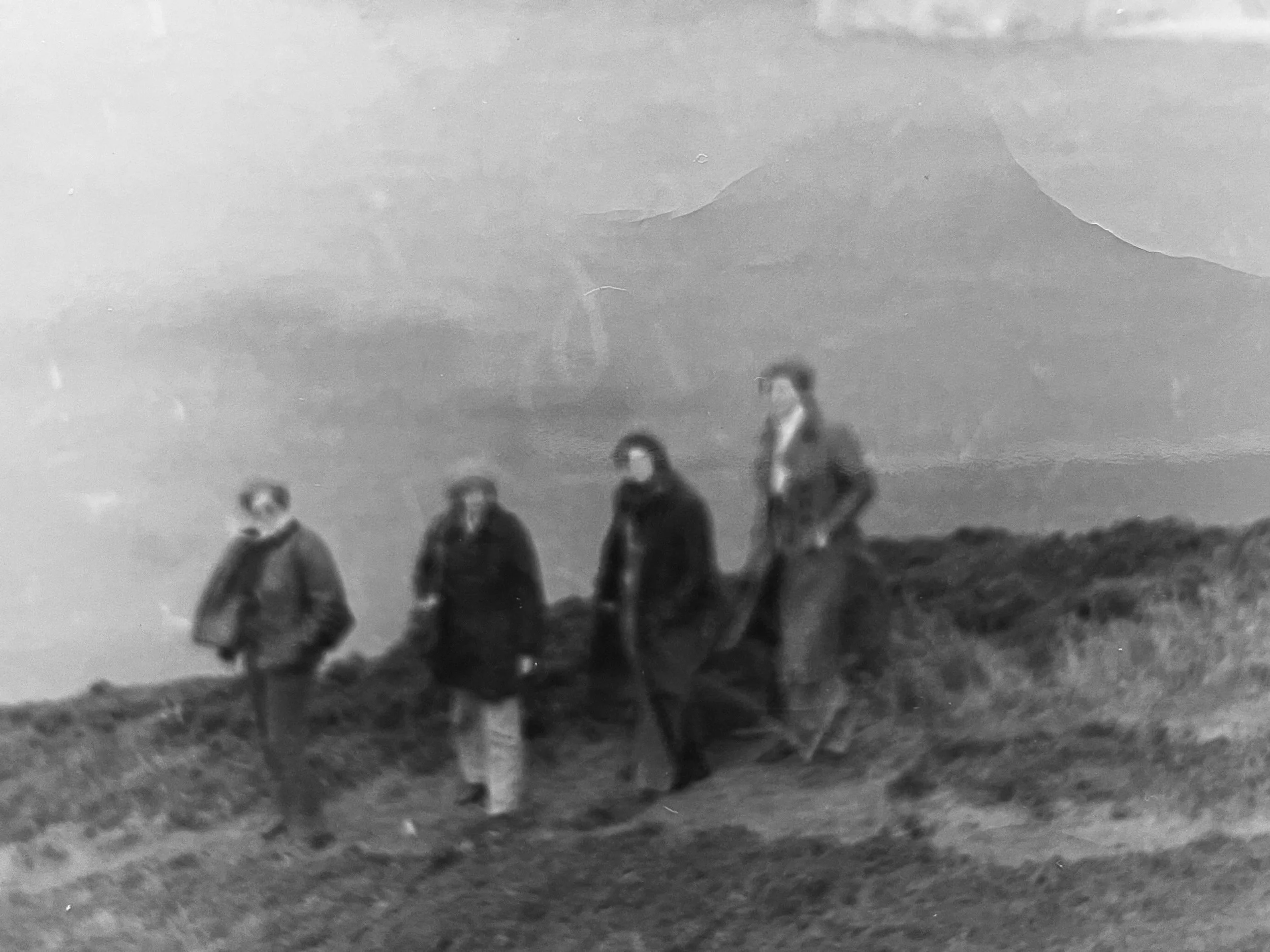
The photo above, also courtesy of Cynthia Canty, is of one of the group excursions. Jean is pictured on the left.
Jean and Cynthia knew Fr. Michael Crowley and they both appreciated his homilies at Sunday Mass.
In 2023, Cynthia gave a terrific talk via Zoom to my religion students from her home in Michigan. She offered us a real and wonderful glimpse into living and learning with the vivacious Jean when she was a teenager.
~~~
The story of the four women is a compelling one—theirs is quite a tale!
Here are some resources if you wish to know more:
FILMS:
—ROSES IN DECEMBER ( 2007 documentary),
Reviews: One of the best films of the year! A taut, exemplary piece of humane film making that avoids politically sentimentality [sic] and glib answers. --Time Magazine
The power of this documentary is that it may reshock us into remembering the United States' complicity in El Salvador: Our government arms a government that kills Americans. --Washington Post
Don't miss it. And have your teenagers see it too. --Catholic New York
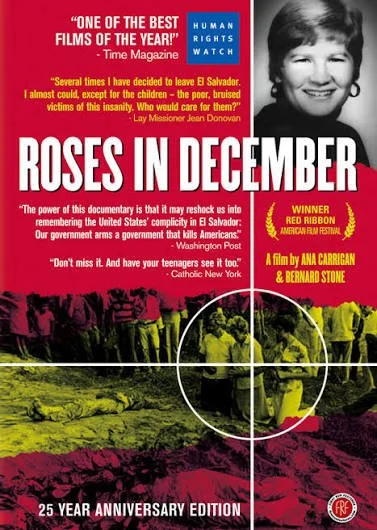
—CHOICES OF THE HEART (1983 Television film with Melissa Gilbert as Jean and Martin Sheen as the priest in Ireland). This film may only be available on YouTube.
—SALVADOR. Written and directed by Oliver Stone as his first major film — the character based on her life was played by Cynthia Gibb. Amazingly, she too is a Staples High graduate, exactly 10 years after Jean Donovan.
(From an article by John Suggs in Dan Woog’s Westport, CT publication “06880”.)
BOOKS:
Ita Ford: Missionary Martyr by Phyllis Zagano
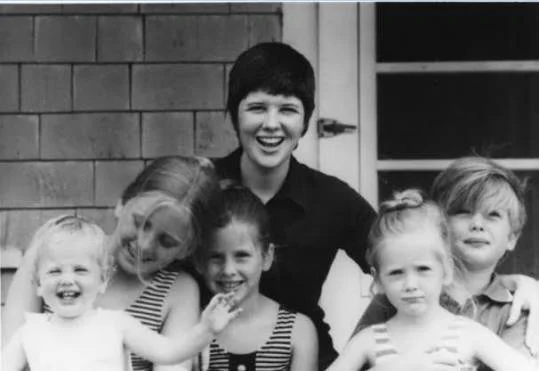
Ita Ford
~~~
Maura Clarke: A Radical Faith The Assassination of Sister Maura by Eileen Markey
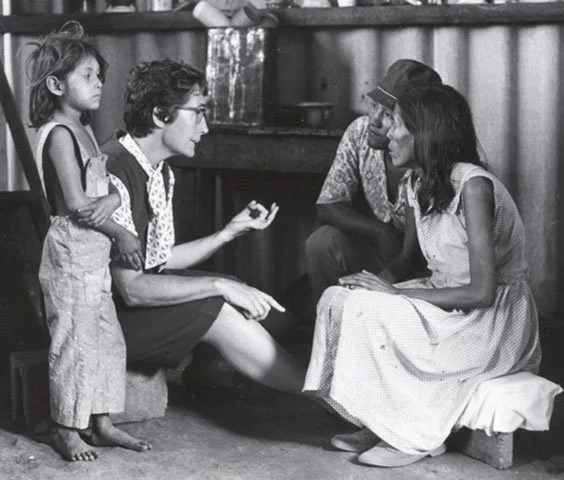
Maura Clarke
~~~
Dorothy Kazel: The Voice: A Missionary's Call to Give Her Life by Dorothy Chapman Kazel
Jean Donovan: Salvador Witness: The Life and Calling of Jean Donovan by Ana Carrigan
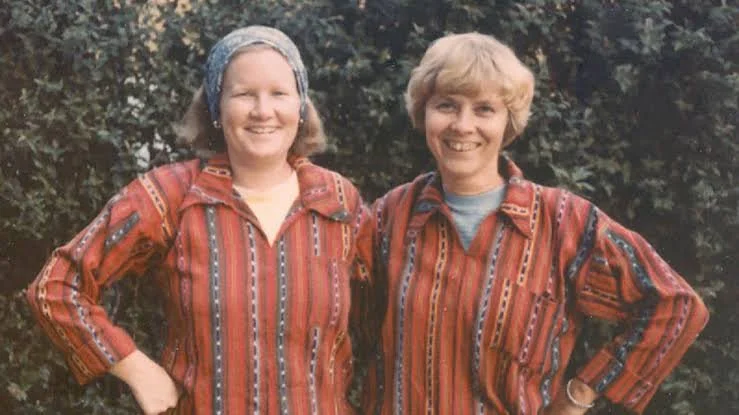
Jean Donovan (left) and Sister Dorothy Kazel (right) wearing matching red Guatemalan shirts.
~~~
Essays:
“The Life and Example of Jean Donovan” by John Dear. December 2005
My essay, which Eleanor Rae published on the front page of the Autumn 2013 edition of C:WED's quarterly newsletter “Weaving the Connections.”
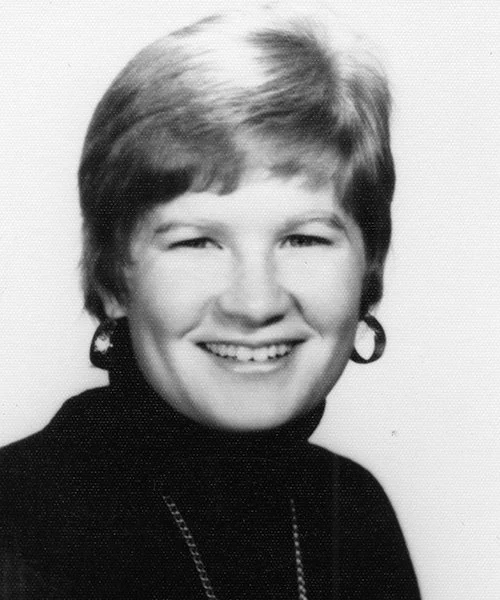
THE SAINT ON YOUR STREET
by Anne Andersson
Did the neighbors living on Long Lots Road in Westport, CT inthe 1960's have any inkling that God would call the girl next door one day to a dangerous mission serving the poor? Certainly not! But neither did the girl herself! Jean Donovan grew up in this affluent town, graduated from the local Staples High School, went on to college and grad school, landed an accounting job with a prestigious firmin Cleveland, and had much of the material goods life could offer. She was engaged to be married. A Staples H.S. classmate who graduated with Jean told me that "her life took a direction none of us would have predicted. Jean was sharp and friendly. She was NOT particularly religious when I knew her."
You may recall the news reports back on December 2, 1980 when it was reported that four women—Maryknoll sisters Ita Ford and Maura Clarke, and Ursuline sister Dorothy Kazel, along with lay missionary Jean Donovan—had been raped and killed in El Salvador. Reports labeled them as revolutionaries. This past April I had the opportunity to delve into their lives in preparation for a retreat for the girls in the Catholic high school where I teach religion. The retreat, scheduled for April 10th, was to include a live performance about these four women who, in actuality, had only been helping, feeding, and educating the children of the poor. A surprise for me was to learn that Jean had lived in a town that had been part of my life for about 15 years. Moved to walk in her literal footsteps, I spent a day in Westport where I stopped by her former home and found in the library a copy of her 1971 Staples High School Yearbook. At St. Luke’s R.C. Church, where Jean’s family celebrated weekly Mass, I met an expert of sorts on Jean Donovan who commented when she returned my phone call: “So you are looking for our Westport saint!” I kept wondering how a materially comfortable, outgoing young woman had moved from the ordinary to the extraordinary!
It came about this way: Jean studied abroad in Ireland during her junior year of college and there met Fr. Michael Crowley, a priest who lit the spark of inspiration by calling on his young charges in the student meetings of the Legion of Mary to consider the plight of the poor rather than being caught up in their own cozy lives. Fr. Crowley’s mentorship remained with Jean when later in Cleveland her eye caught a pamphlet about the diocese’s lay missionary program in El Salvador. Something moved within her—clearly the work of the Holy Spirit. She trained for missionary work before going in August1979 to La Libertad, El Salvador, where she initially was to balance the books using her accounting expertise. Jean was 26 years old. Quickly, she became enamored of the children and the needs of the people in a time of a government repression that translated into the disappearance, torture, and killing of thousands. She and the other sisters were inspired by the homilies of Archbishop Oscar Romero who was preaching about the plight of the Salvadoran poor and calling for an end to the repression. Each week after Mass Jean gave him her freshly baked chocolate chip cookies. Later, she and the sisters stood guard at his casket following his assassination on March 24, 1980.
Jean commented to friends and family, who were begging her to return to the states, that she did not really know why she felt the call to be down there—in great danger and away from safety—yet in solidarity with the poor. She did understand that this meant, at that time and place, to be subject to torture and killing. She had often questioned:“Why me?” And yet, she stayed. The bodies of the women were found in shallow graves two days later—on the morning of December 4th. Their rape and murder outraged the world. As a caveat for me, the high school retreat and performance that had been scheduled far in advance, occurred—as a surprise to us and to the actors—on the April 10th that would have been Jean’s 60th birthday!
Jean Donovan had queried God: “Why can’t I just be your little suburban housewife?” Why, indeed.
TRIBUTES
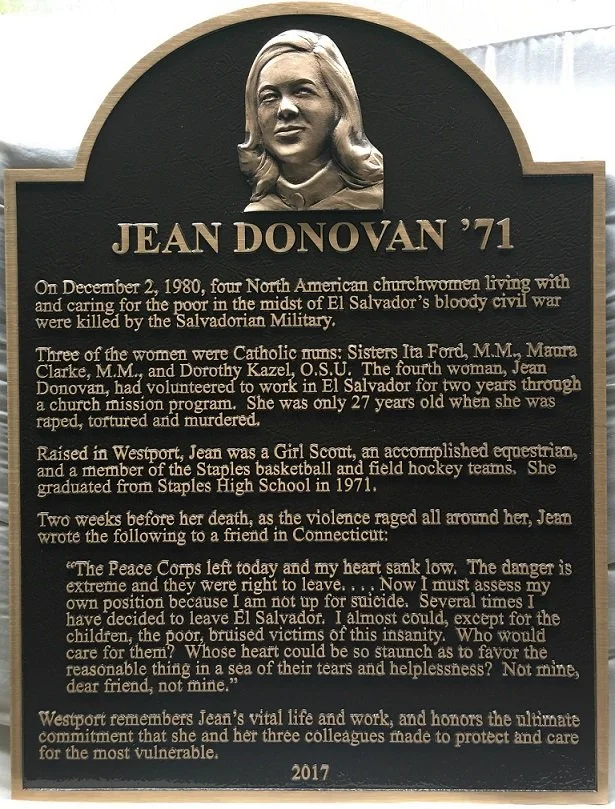
BRONZE PLAQUE — ASSUMPTION CHURCH, WESTPORT, CONNECTICUT
~~~
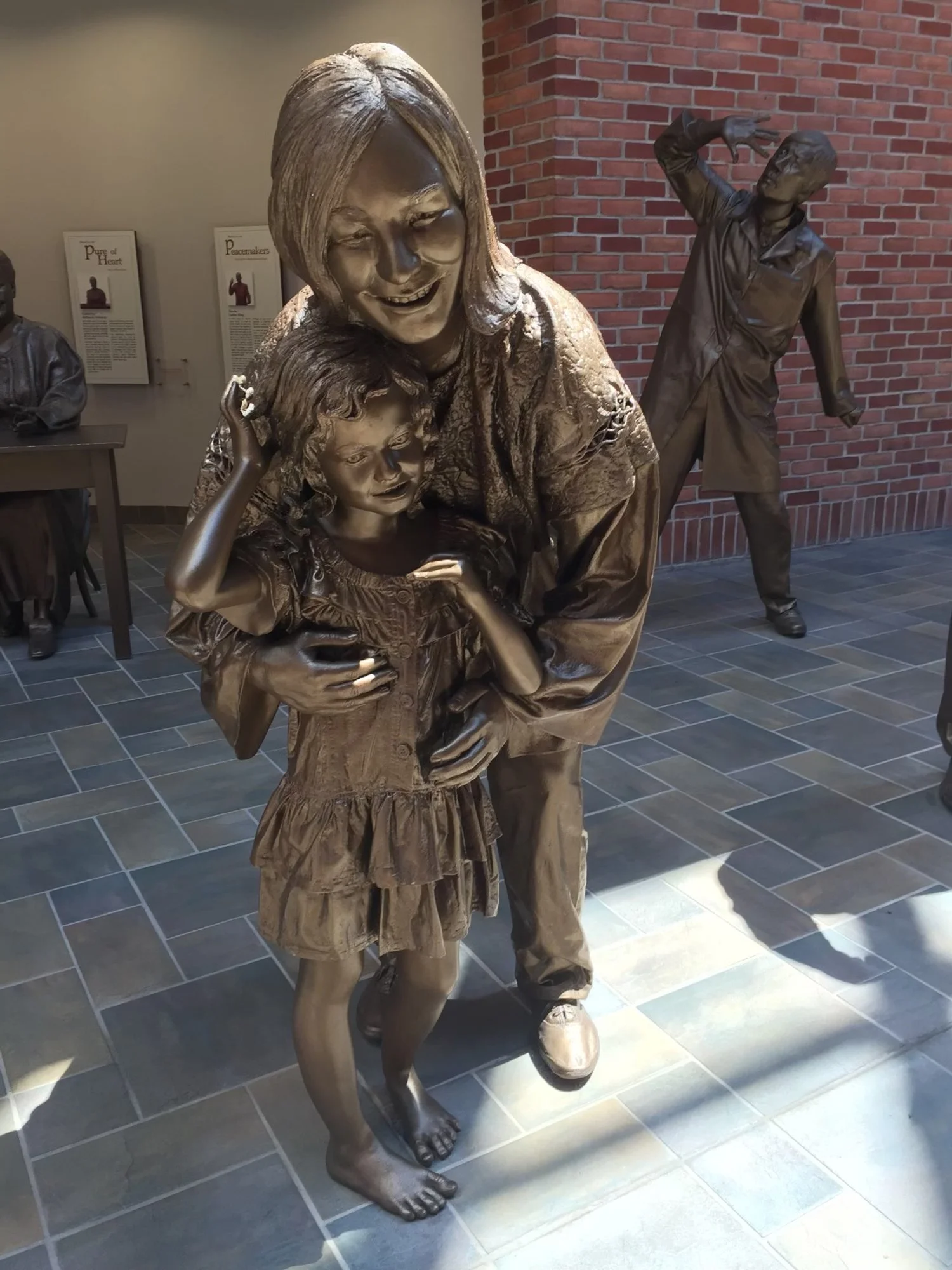
BRONZE STATUE OF JEAN WITH A SALVADORAN CHILD—The Solanus Casey Center at St Bonaventure Monastery in Detroit, Michigan
"I don’t know how the poor survive. People in our positions really have to die to ourselves and our wealth to gain the spirituality of the poor and oppressed."
—Jean Donovan
NOTES:
Wikipedia: “1980 murders of U.S. missionaries in El Salvador”
10. Larry Rother (April 3, 1998). "4 Salvadorans Say They Killed U.S. Nuns on Orders of Military". New York Times. p. 1.
14. Larry Rother (April 3, 1998). "4 Salvadorans Say They Killed U.S. Nuns on Orders of Military". New York Times. p. 2.
15. Preston, Julia (April 8, 2015). "U.S. Deports Salvadoran General Accused in '80s Killings". The New York Times.
23.Preston, Julia (9 January 2016). "Florida: Ex-Leader of Salvadoran Military Deported". The New York Times.
IN YOUR OWN WORDS:
Previous Post: “A Short Thanksgiving Reflection”
Written by Anne Andersson, November 21, 2025
—”Loved your Gratitude blog & the path to Bruns!!! I thought of the incredible things that brought me to G! How grateful we both are!!!!”—LC
“Dear Anne, Many thanks for your Thanksgiving greeting. I send my blessings back to you with love.”—BV
—Have a wonderful blessed Thanksgiving.❤️🙏🌹—PH
—”Thank you and happy thanksgiving to you too! Beautiful story about how you met Bruno!”—EE
—”Anne, I loved reading your story about your younger years and how you met Bruno. Things always happen for a reason! Love reading the articles that you and Eleanor write.Happy Thanksgiving to you both!” —Barbara
REMEMBERING THE SURVIVORS
There is a tragic parallel between the women who are survivors of the Epstein abuse in 2025 and the martyred women of Salvador in 1980.
The Epstein survivors are courageous in a way that is different, of course, from the four women of Salvador, but they are also facing similar life-threatening danger.
The survivors face danger for speaking out.
AND BOTH SPEAK FOR THE OPPRESSED AND VOICELESS!
Remember the Women Survivors in 2025:
As They Speak Out
Risking danger
Experiencing death threats
And fatal harm to their families
The martyred women were knowingly risking danger. Some who were close to them had been killed. But the women did not leave. They remained for the children.
The women today also have received death threats and fatal harm to their families.
But neither are they stopping.
They are calling out about the abuse that was done to them and to more than a thousand other young women and children by Epstein and Maxwell.
They are calling out to warn and protect the children of today and of the future.
This week’s highlighted survivor is: Sharlene Rochard
(This link opens in Facebook. Click the X to open.)
Sharlene agreed to a cable TV interview with Jen Psaki, former White House press secretary.
This interview was Sharlene’s first time speaking out and she was accompanied in the interview by Sky Roberts, the brother of Virginia Giuffre, and his wife Amanda.
Sharlene’s s fear is palpably visible—it is etched on her face and visible in her demeanor. She has received threats to keep her from speaking out. Jen Psaki asked Sky to explain to the audience the nature of Sharlene’s fear.
He explained that Virginia had received death threats to keep her from speaking out. He and his family have as well. “They could bring you to homelessness,” he said. He had seen Virginia sitting at a table in front of a person who pushed toward her a photo of her children with the clear implidation: we know where your children go to school.
Take a look at the interview (Youtube):
https://youtu.be/Yoi4aUZ0EDM?si=dpr6tYcBLOK5Xn-z
Recommended reading:
WE CAN HONOR THE MEMORY OF VIRGINIA GIUFFRE BY READING HER POSTHUMOUS MEMOIR:
Nobody’s Girl: A Memoir of Surviving Abuse and Fighting for Justice
(Published October 21, 2025 by Knopf).
Virginia Roberts Giuffre’s courageous fight against Epstein trafficking—whose decision to speak out helped send both serial abusers to prison.
Virginia died by suicide earlier this year.
~~~
Quote from Virginia’s Introduction, p.xxiii:
“Seeking to silence me, my powerful enemies have threatened to bankrupt me and even to have me killed.”
IF YOU WISH:
—REMEMBER THE WOMEN OF SALVADOR
JEAN, DOROTHY, MAURA, AND ITA
ON
THE 45TH ANNIVERSARY OF THEIR MURDERS: DECEMBER 2, 1980
BY
HELPING C:WED
ON
GIVING TUESDAY — DECEMBER 2, 2025
(note the odd coincidence of dates)
—YOUR TAX-DEDUCTIBLE CONTRIBUTION WILL HELP US GREATLY WITH OUR ONGOING TECHNOLOGY FEES TO ENABLE US TO CONTINUE BRINGING YOU STORIES ABOUT:
WOMEN, THE EARTH, AND THE DIVINE!
WE ARE SO VERY GRATEFUL FOR YOUR SUPPORT! 🩷