OUR FATHER?
THANK YOU TO JIM PHILIPPS FOR HIS COMMENT AND QUESTION.
FOLLOWING MY C:WED POST: “Quotes that Teach Us About the Image of the Divine,” JIM SENT THIS REFLECTION AND RAISED THE FOLLOWING QUESTION:
—The “Our Father”- This information about an earlier goddess worship that existed in Europe before the arrival of the Indo-European culture is really fascinating. Much of it I didn’t know.
Here’s my question, that perhaps could be the subject of a future column- In so many ways, the “Our Father” is a prayer of great spiritual value. Yet by reciting the words which frame God in a Patriarchal world view, are we doing more harm than good? Peace, Jim
Jim recently added this to his question:
One thought I had about the Our Father post- I once read about the common thread in Greek, Latin and Sanskrit—all languages derived from the Aryan peoples who descended probably from Ukraine or thereabouts.
All three languages have a designation of “God the Father” - Deus (Zeus) Pater in Greek; Jupiter (variation of Deus Pater ) in Latin. Can’t remember the designation in Sanskrit. So image of a supreme father came down with them all.
Jesus wasn’t descended from the Aryan peoples—he was Semitic—but the gospels of course translate his thinking through the Greek mind. “Abba” is Semitic….I wonder what Images were in Jesus’ mind when He referred to God by that name?
Doesn’t seem to be any equivalent in Hebrew as far as I know. (Which, when it comes to ancient languages, is not that far!) It’s true that Jesus spoke Aramaic.
There are images of God as mother in the Bible—which might suggest that Father God image was more fluid in the Hebrew faith? But I’m really going out on a limb now.To address Jim’s question, I took a look at the viewpoint of some theologians on this issue:
From Leonardo Boff in his book, The Lord’s Prayer: The Prayer of Integral Liberation (1)
Boff mostly defends the use of “Father” for God, emphasizing, though, that it is the compassion and communion nature of God that should be emphasized when the masculine term “Father” is used.
He does, however, address four “difficulties with using the masculine ‘Father’ for God.” In his fourth difficulty, he emphasizes that when Christians pray to God the Father, this is not in sexual terms, but rather refers to “an underlying Principle that is the original source of everything, which itself has no source.”
Boff holds that when we say ‘Father’, “we confess the ultimate mystery that penetrates and sustains the universe of beings, a mystery of love and communion.”
He further holds that what is “expressed by a paternal symbol could be expressed by a maternal symbol.” His reasoning is that “both refer to the same reality.”
The maternal symbol, for Boff, is adequate. He supports his belief by referring to the Old Testament reference to the maternal aspect of God in Isa. 66:13, and 49:15:
Isa. 66:13 “As a mother comforts her son, so will I comfort you;”
Isa. 49:15 “Can a mother forget her infant, be without tenderness for the child of her womb? Even should she forget, I will never forget you.”
He also specifically refers to Pope John Paul I who held that “God is Father and moreover Mother"
I (Anne) do remember when Pope Paul I made that comment when he first came out on the Vatican balcony immediately following his election as the new pope in 1978.
~~~
From Dorothee Soelle (Sölle) in her book, Theology for SKEPTICS: Reflections on God
Dorothee Soelle, like Boff, explains that “Our Father in the heavens" is not one of “flesh and blood.” She holds that “masculinizing God” by using “androcentric” language, which she accuses Christianity of doing in abundance, “always goes hand in hand with deification of the male.”
Referring to what she has experienced by having been born a woman and having “to live in a sexist society,” Soelle provides the example of her Christian tradition calling the female “defective.”
This refers to Thomas Aquinas who, following Aristotle, held the view that “Woman is defective and accidental…a male gone awry…the result of some weakness in the father’s generative power….”—Summa Theologica,13th century CE
Soelle feels strongly that we should not imprison God with concrete symbols. “Feminist theology," she says “does not deny that ‘father’ is one mode of speaking about God.” However, she holds that “when we are forced to make it the only mode, the symbol becomes God’s prison.”
Soelle bemoans the fact that when we do imprison God in this way, “all other symbols that people have used to express their experience of God” are deflated. They are “pushed down to a lower level on the hierarchy.”
Soelle, like Boff, also points to the words of Pope John Paul I when she refers to his having said “that God is at least as much a mother as a father.”
This statement of Pope John Paul I—”God is our father, but even more is God our mother”—seems to have deeply touched these theologians, Boff and Soelle.
I (Anne) not only remember Pope John Paul I saying that, but I also remember being totally awed—and thrilled—to hear it. And to see him smiling!
I believe it also holds an answer to the question Jim Philipps has raised.
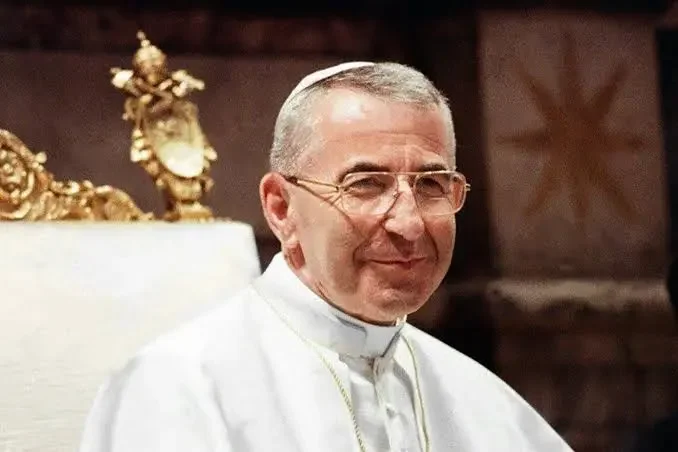
Pope John Paul I
Pope John Paul I, formerly Albino Luciani, was head of the Catholic Church from his election as pope on Augsust 26, 1978 until his death 33 days later on September 28, 1978 at the age of 65.
~~~
Anne Andersson: My Experience in Positano, Italy
And then there was my experience in 1983 when my husband Bruno and I, and our children, were visiting Positano, Italy.
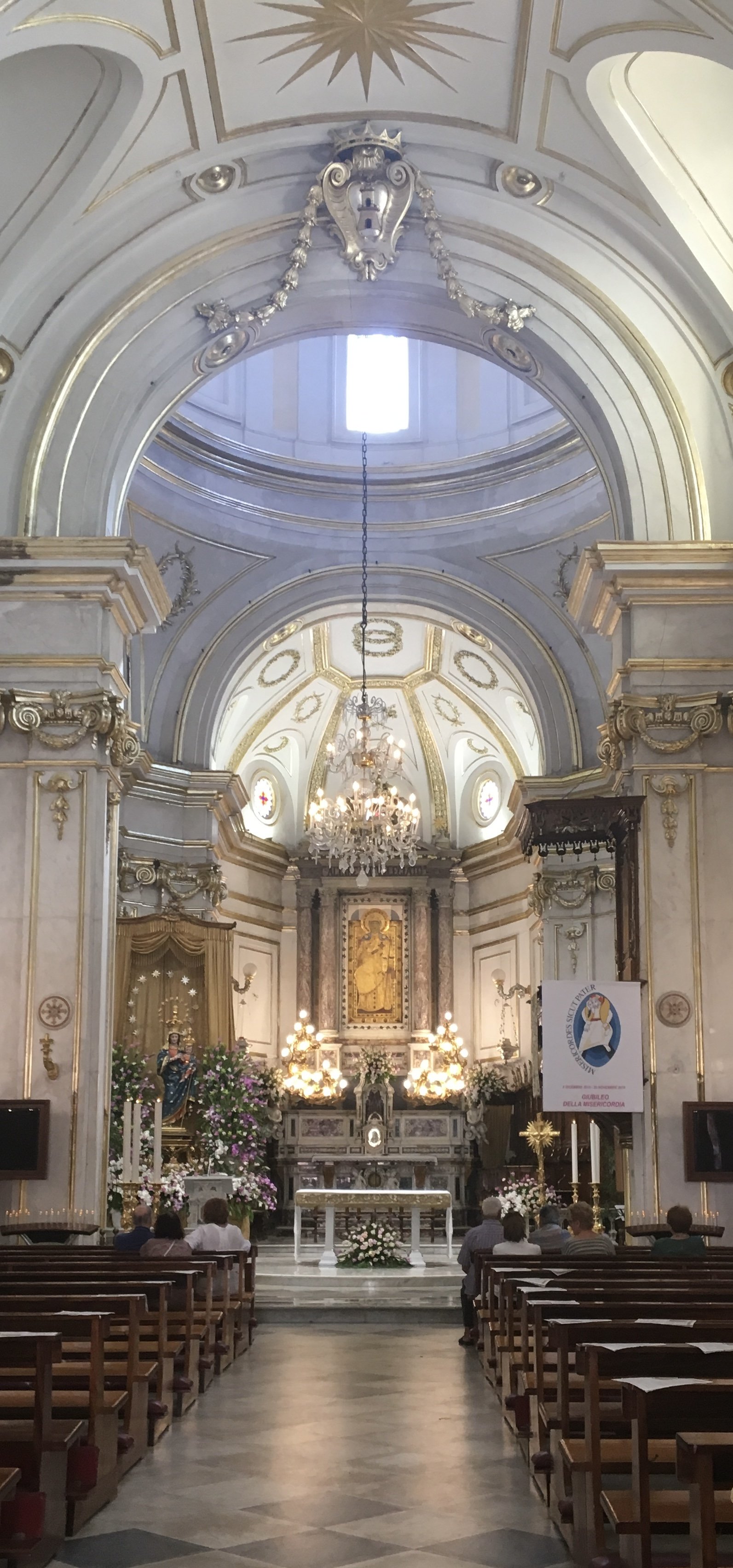
Church of Our Lady of the Assumption
(Chiesa di Santa Maria Assunta)
Positano, Italy
The Byzantine icon situated above the main altar was likely brought to Positano in the 12th century. (3)
Photo by Anne Andersson—taken on August 15, 2016
~~~
Nineteen eighty-three was the year after my paternal grandmother had passed. As she had been one of my closest friends, I was stilll in grief that year. I took to coping with my grief by keeping a sketch book and pen with me most of the time—and randomly sketching whatever happened to move me.
We planned a European trip that summer, which included Positano, the town where my grandmother had been born (my paternal grandfather as well). The Church of Our Lady of the Assumption was where she (they) had been baptized.
Fun Fact: My birthday is August 15th, which is the feast of the Assumption of Mary. What are the chances?
On one of the days while we were in the town, Bruno had taken our sons on a walk along the beach. I went down to the beach a short while later.
On the way, I stopped in at the church. As I entered the doorway, something happened. It felt like an electrical ray of energy shot out toward me from the direction of the image of the icon in the sanctuary.
The strange thing was that it was not the original icon that was in the sanctuary, but rather only a replica, as the original was in Rome under repair.
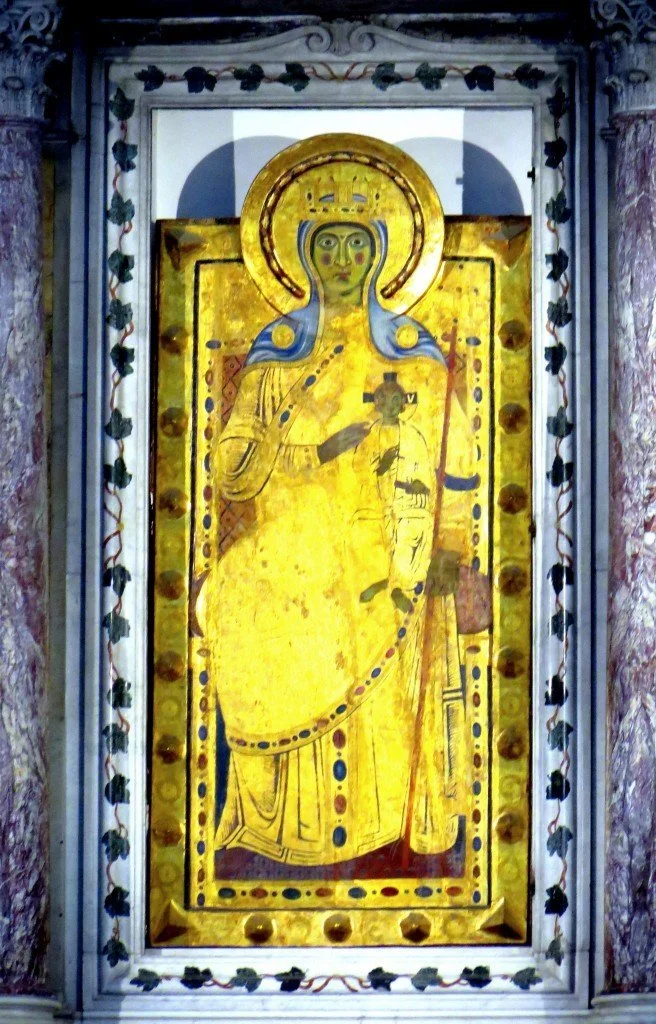
Photo of the original icon
Nevertheless, that zap felt very powerful and I had the distinct impression that it was of Divine origin. I left the church in a state of awe, walked the few feet to the beach, and sat down.
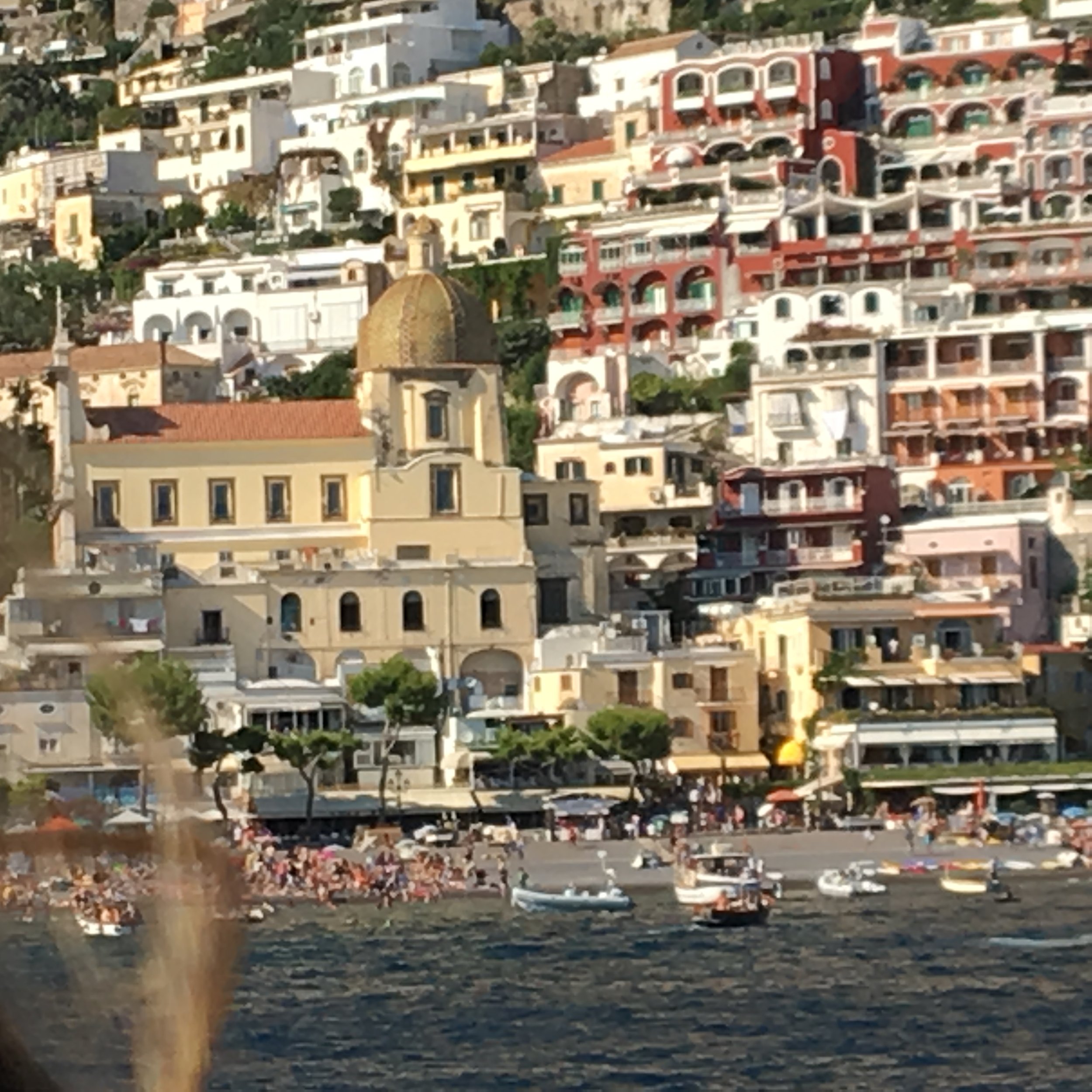
Positano beach and lower part of the town
Photo by Anne Andersson
Seated to the far left (beyond the frame of the photo above)—and facing the water, with the Church of the Assumption rising on the slope of the Positano mountain behind me high above my head, a prayer rose up within me as I sat and contemplated the power that had touched me in the church.
The following was the only way I could pray, and so I said:
Our Mother who art in Heaven….
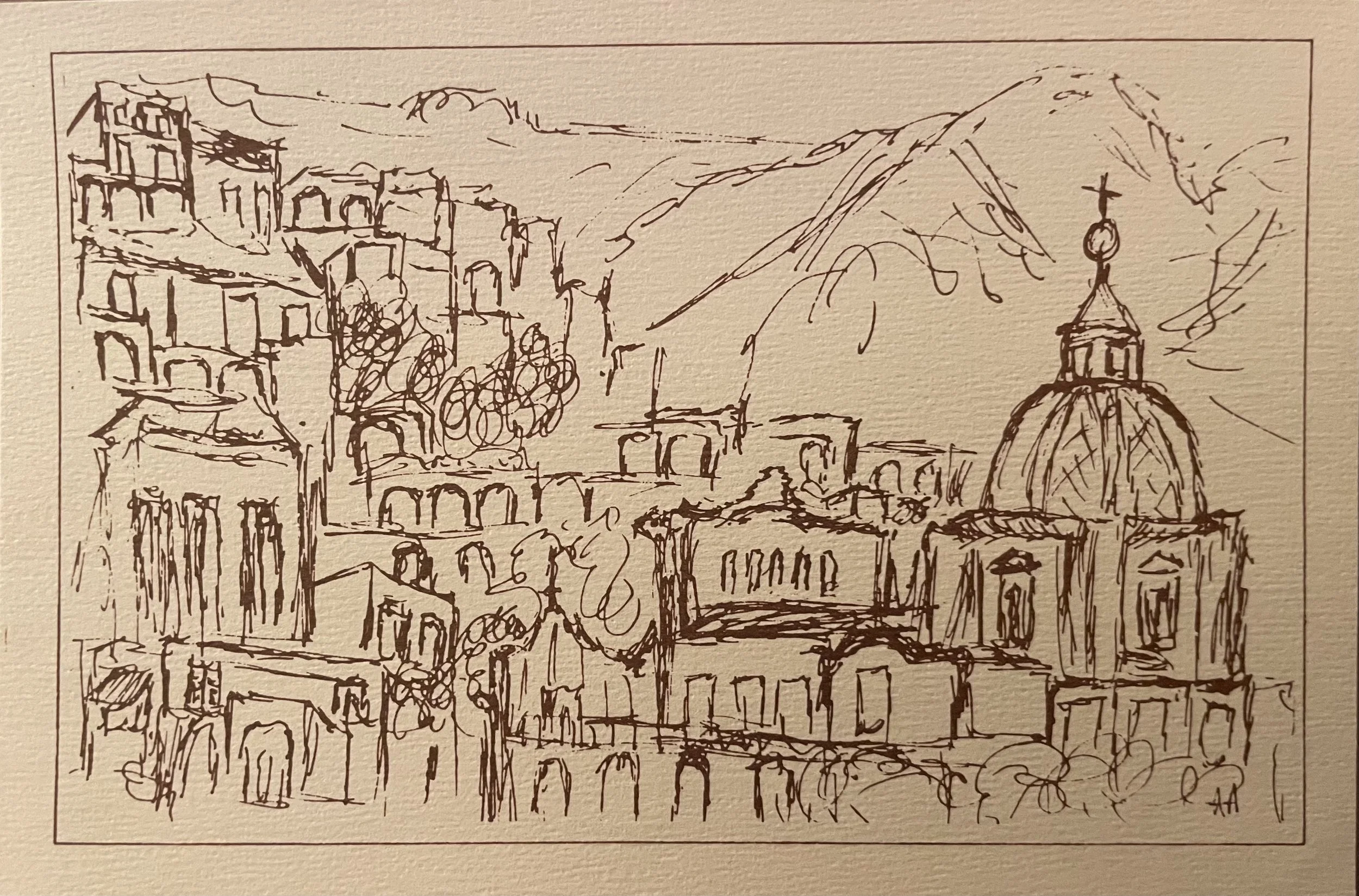
I drew the following sketch that afternoon in 1983 on the Positano beach. To this day, I do not know where it really came from because the lines came so easily in only one draft. When I returned home, I showed it to an artist friend who said: “The Spirit is there in your work!
A person working at a local printshop took to the drawing and created this sepia-tone reproduction from my original sketch. He entitled it:
View of Positano, Italy from seashore
In conclusion, and to address Jim’s question, I believe we could adequately pray in the following way, always recognizing the love and communion in the prayer:
Our Father and Mother,
(or alternatively: “Our Father/Mother” or “Our Parent”)
Who art in Heaven,
Hallowed be thy name.
Thy kingdom come.
Thy will be done
On Earth as it is in Heaven.
Give us this day our daily bread,
And forgive us our trespasses
As we forgive those
Who trespass against us.
And lead us not
Into temptation,
But deliver us from evil.
Amen.
NOTES:
Leonardo Boff, The Lord’s Prayer: The Prayer of Integral Liberatiion, pages 38-39. First published 1979 in Brazil; English Translation 1983, Orbis Books, Maryknoll, NY.
Dorothee Soelle (Sölle), Theology for Skeptics: Reflections on God, pages 23-27. First published 1992 in Germany; English translation 1995, Augsburg Fortress Publishers.
According to popular tradition, it was a miracle that the icon reached Positano.
It belonged to the cargo of a sailing ship from the East which, offshore Positano, was stopped by a dead calm. After unsuccessful attempts to continue sailing, the sailors heard a voice saying “Posa Posa”, that means, “Put me down, put me down!” (that’s the origin of the name “Positano”). The captain thought this miracle meant that the Virgin wanted to stop there and decided to head for shore. Right then, the ship began to sail again. The sailors disembarked the icon and gave it to the inhabitants of Positano, who chose the Virgin as their patron and built a church in her honor. —Assumption Parish of Our Lady, Positano
IN YOUR OWN WORDS:
Previous Post: “Jean and Mr. Tayer—An Unforgettable Story” Written by Anne Andersson January 1, 2025
—Ty girls. The best for 2026 for you also. Keep up another great year. Ty for all your information. —PH
—Wonderfully done! Thank you for all your research. Loved the picture of the bridge and Jean and her dog.New Year blessings! —MT
—Wonderful story, Anne. —NM
—Anne, It was a wonderful story! I guess the higher ups in the church were jealous of him.—EM
CONTINUE TO REMEMBER THE SURVIVORS
LISTEN TO THE WOMEN.
THEY HAVE YET TO BE CONSULTED AND HEARD IN BRINGING ACCOUNTABILITY TO THE PERPETRATORS.
TODAY’S FEATURED SURVIVOR: COURTNEY WILD
Note: When clicking the link above, to get to the video, click on the “X” to eliminate the Facebook request.
Courtney Wild speaks at the press conference with other survivors. —CBS News, September 3, 2025
https://www.facebook.com/share/v/17RttXGw8q/?mibextid=wwXIfr
For more than a decade, Courtney Wild, a Jeffrey Epstein survivor,…has been a driving force in the effort to hold the United States government accountable for its lenient treatment of the late financier, who was spared federal prosecution in 2008 after being investigated for alleged crimes against her and more than 30 other minor girls.
Epstein's death, [she says] shouldn't mean all the wrongdoing in this case is swept under the rug," Wild told ABC News. "People helped him commit these crimes. Everyone needs to be held accountable for the role they played in this."
C:WED WISH LIST:
We do have expenses in keeping this website operational.
These are monthly and annual technology fees.
We would so appreciate any help—however small.
Kindly click on this “DONATE” button to help us.
Be assured that our button is a safe click.