
Happy Birthday, Ferdinand! — What’s In a “Simple” Children’s Book?
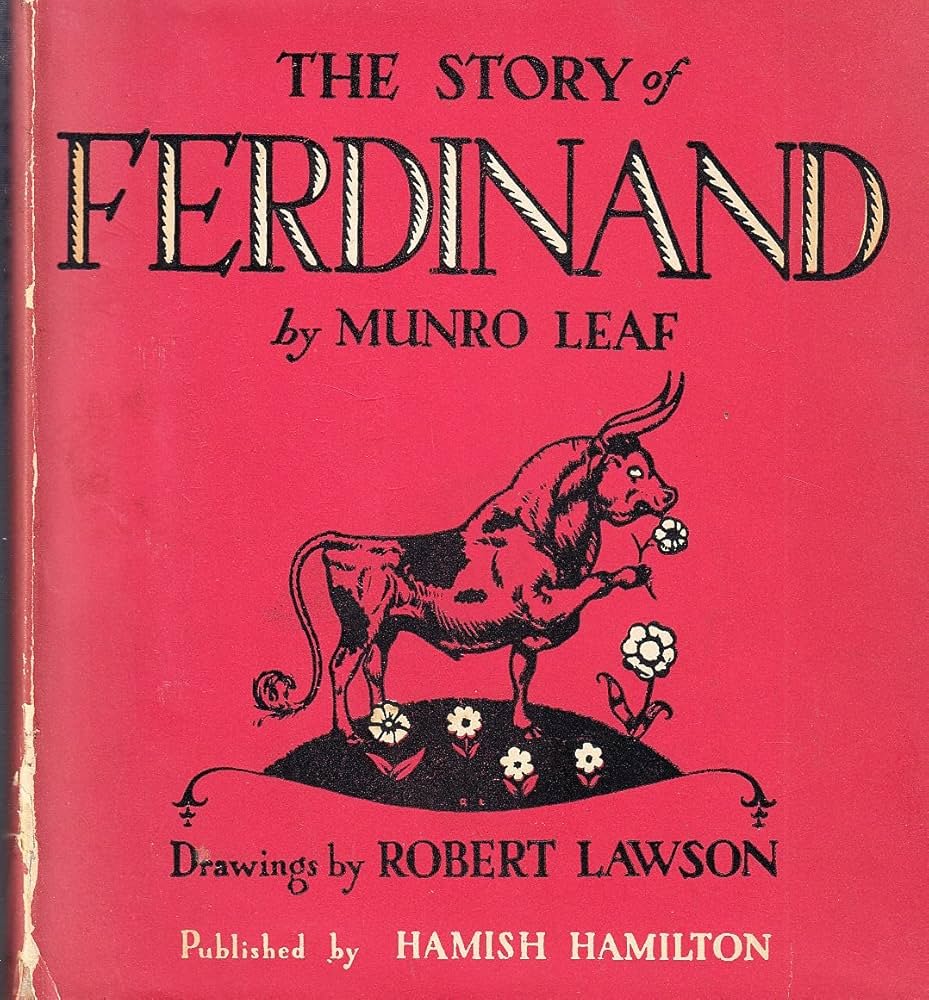
THE STORY of FERDINAND
TURNS 90!
The Story of Ferdinand by Munro Leaf and illustrated by Robert Lawson was published in September 1936 by Viking Press.
It has never been out-of-print!
What could be in a children’s book that would make it captivate readers, young and old, for 90 years;
and also
raise the ire of dictators and fascists;
and
become an award-winning Disney classic?
I DID NOT DISCOVER The Story of Ferdinand UNTIL I WAS INVOLVED IN THE FEMINIST MOVEMENT IN THE EARLY 1970s.
It was on a list of feminist books for children, so, as a parent and a teacher, I readily purchased it for my two young sons. They thoroughly enjoyed the story,
and I?
I immediately fell in love with the story of Ferdinand, the reluctant bull.
It is still one of my favorite books!
At that time in the 1970s—and even today (at least until I began research for this post), I saw this story in one dimension—as having a counter cultural message.
To me, it clearly was a parable of sorts, critical of the way society socializes boys and men to embrace toughness and violence as the way boys should be boys—and real men should be men.
Today, we would refer to this type of socialization as “toxic masculinity.”
~~~
Here’s a brief summary of the book:
The Story of Ferdinand is about a gentle bull who does not want to fight the way the other young bulls in his field do.
The story opens this way:
Once upon a time in Spain there was a little bull and his name was Ferdinand.
All the other little bulls he lived with would run and jump and butt their heads together,
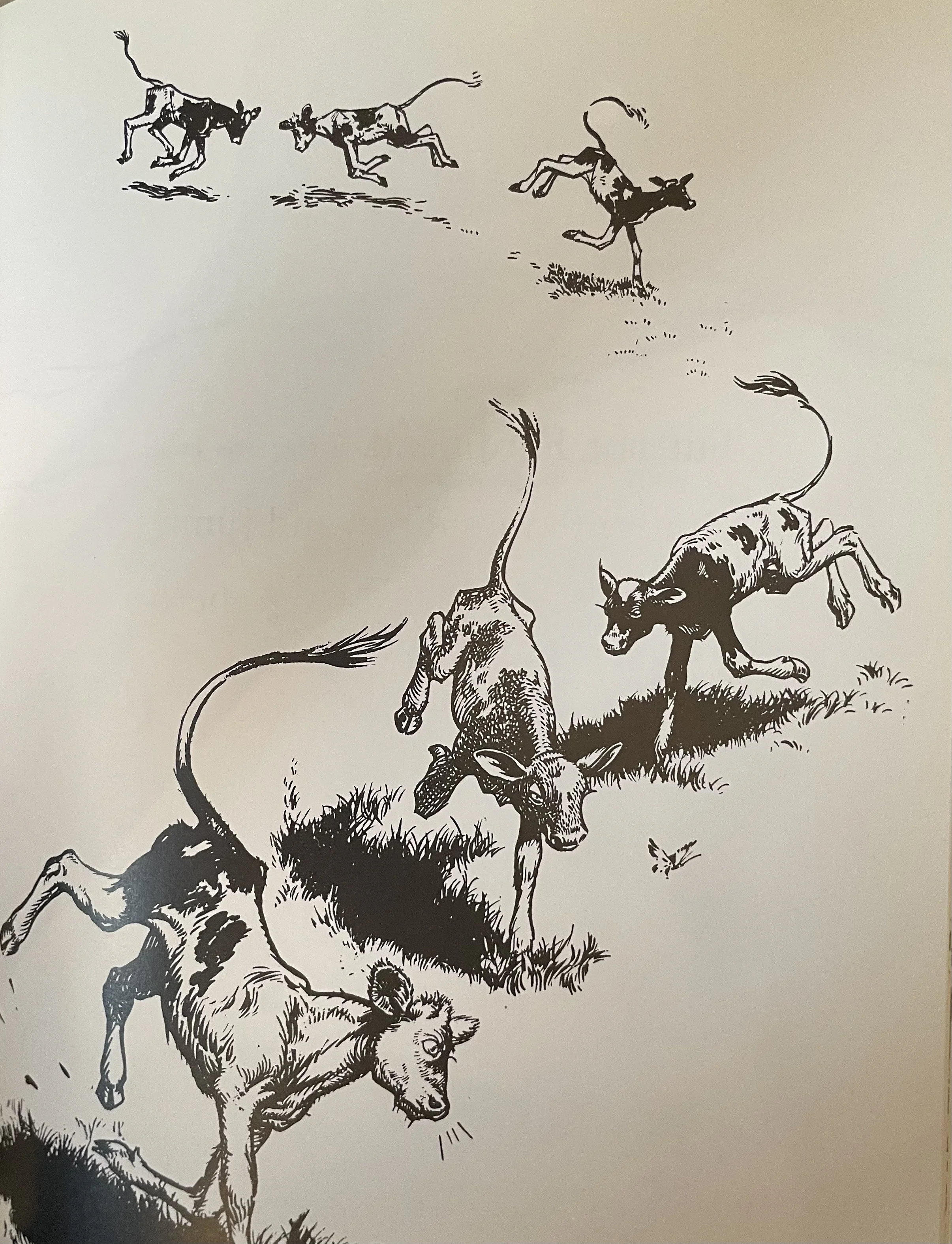
but not Ferdinand.
He liked to sit just quietly and smell the flowers.”
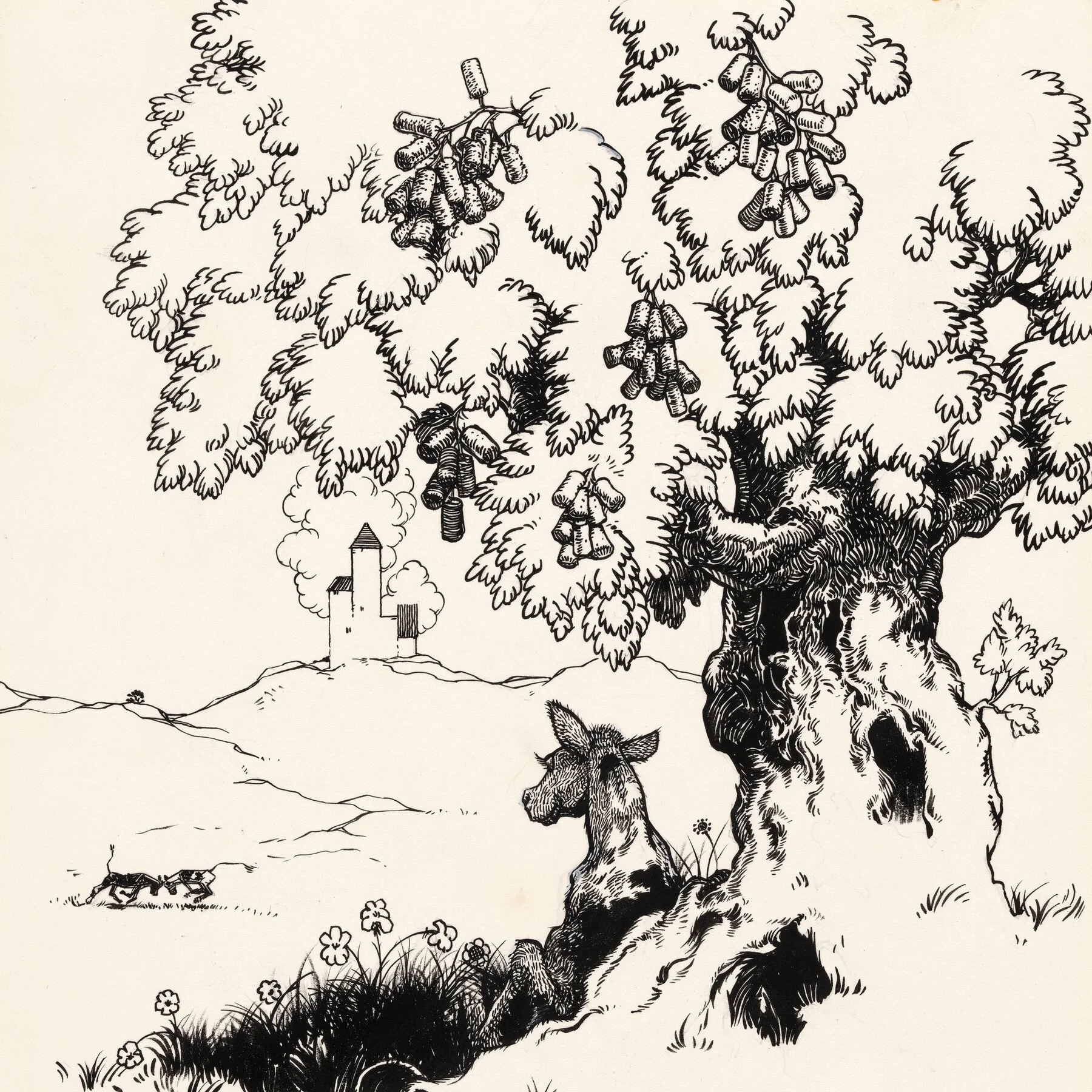
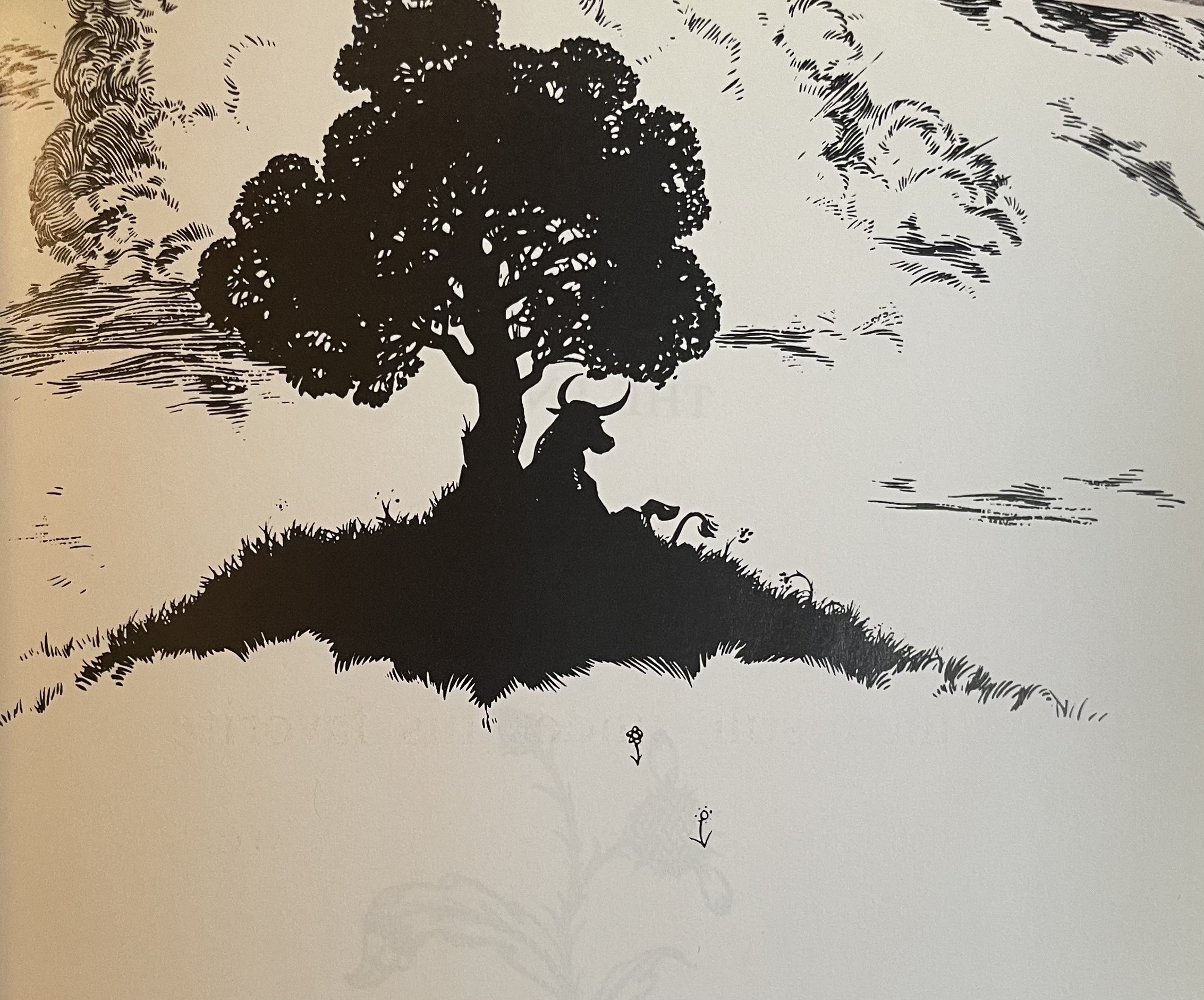
He had a favorite spot out in the pasture under a cork tree. It was his favorite tree and he would sit in its shade all day and smell the flowers.
Sometimes his mother, who was a cow, would worry about him. She was afraid he would be lonesome all by himself.
“Why don’t you run and play with the other little bulls and skip and butt your head?” she would say.
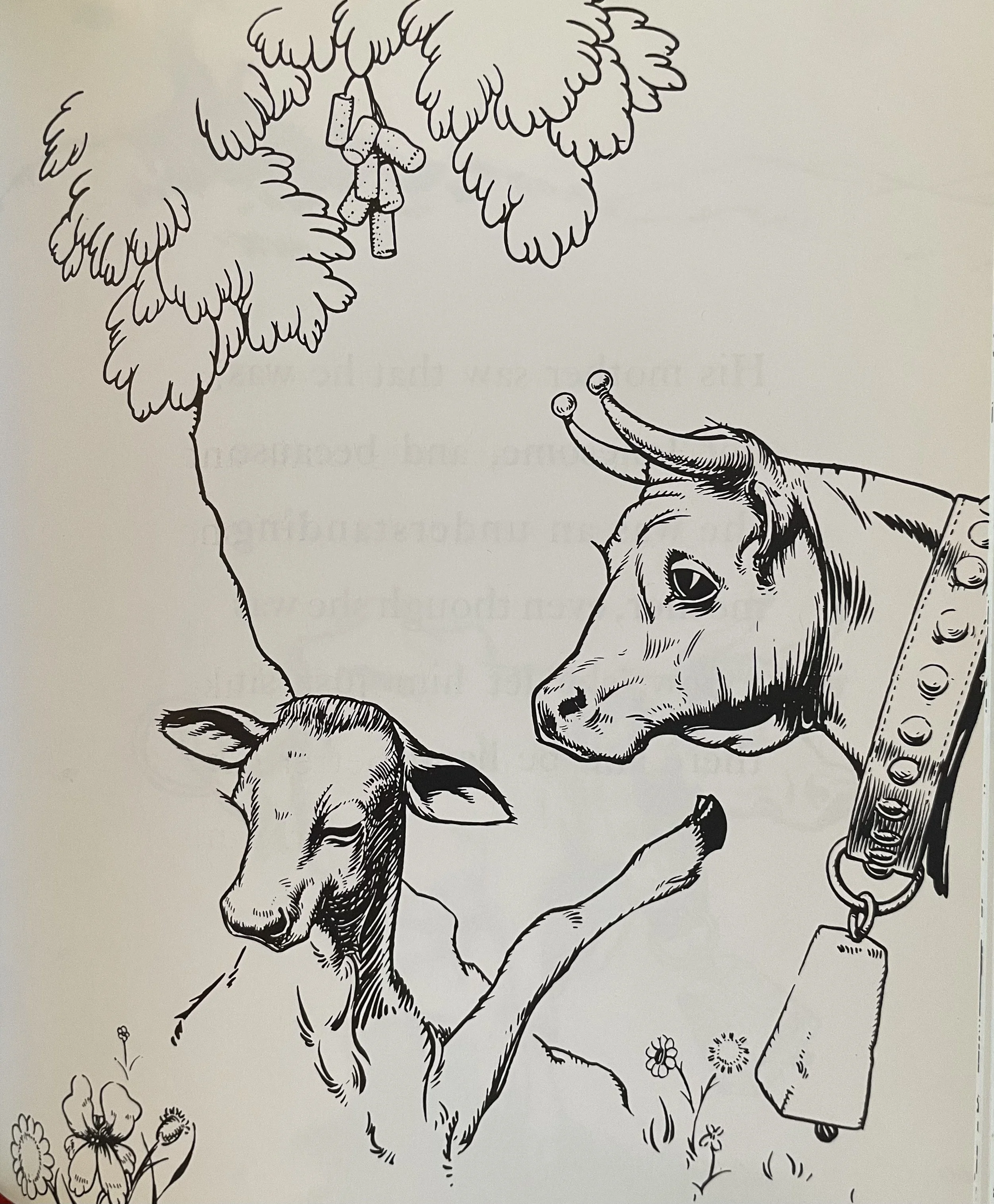
But Ferdinand would shake his head. “I like it better here where I can sit just quietly and smell the flowers.”
His mother saw that he was not lonesome, and because she was an understanding mother, even though she was a cow, she let him just sit there and be happy.
As the years went by Ferdinand grew and grew until he was very big and strong.
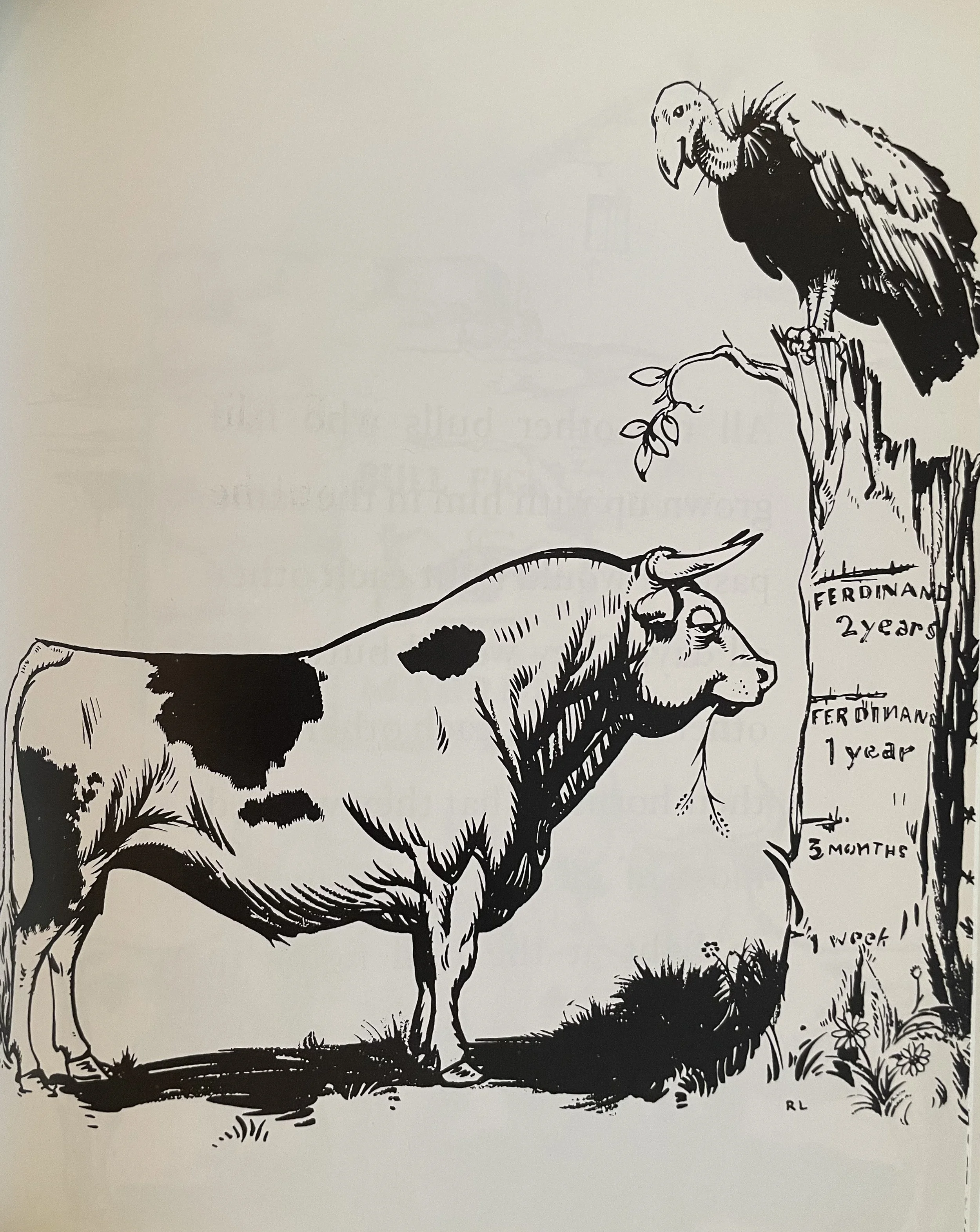
The story goes on to tell how Ferdinand never, ever, wanted to fight.
But when an unfortunate event occured—that event being stung by a bee—it caused him to have an over-the-top violent reaction in the sight of bull fighter recruiters who had come to choose the next most ferocious bull to be the one to face the matador in the bullring in Madrid.
The recruiters misjudged Ferdinand.
With his gentleness hidden under his violent response to the pain of the bee sting, he was perceived to be ferocious.
And so he was hauled off to the bull ring to fight.
The story takes us, the reader, into the bullring.
We meet the arrogant matador.
And, having been let in on the secret of Ferdinand’s true nature, we the readers have a heads-up on what happens next.
And so the story goes on:
“Then came the bull,
and you know who that was don’t you?
~Ferdinand.”
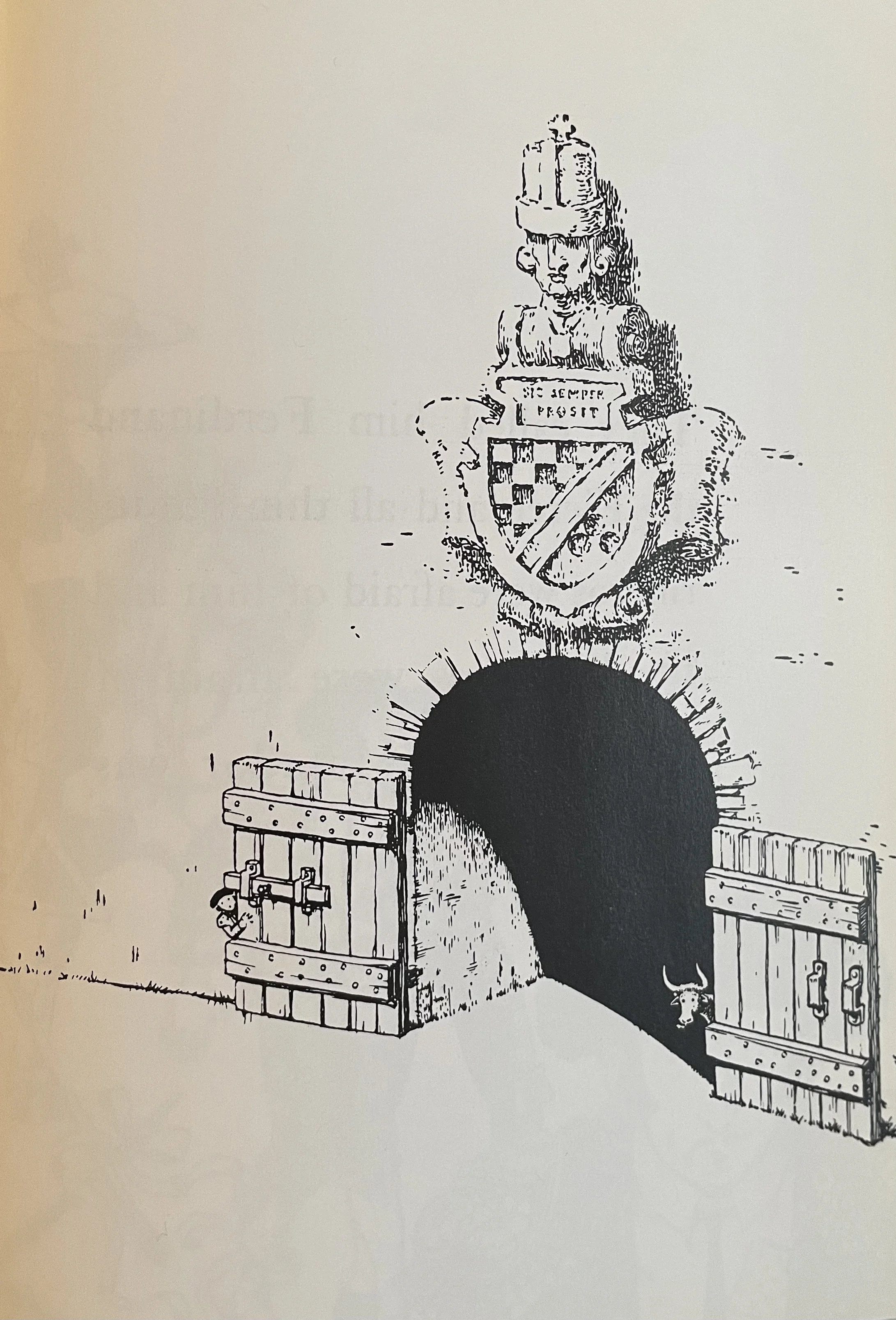
The true Ferdinand shows up in the bullring arena and he refuses to fight.
The matador breaks down and the bullfight becomes a fiasco.
And so, the fictional Ferdinand gets to go back home to his cork tree.
Munro Leaf writes in the final pages: “And for all I know, he is sitting there still, under his favorite cork tree, smelling the flowers just quietly.
He is very happy.”
Sad Fact: The tale is based on a real gentle bull, but one that did not have such a happy ending to his story.
A Wikipedia account tells us:
According to a documentary from Sweden, where the Disney film is shown every year on Christmas Eve [within a Disney special], the story has a basis in truth.
A peaceful bull named Civilón was raised on a farm outside Salamanca in the early 1930s, and the Spanish press campaigned for it to not have to meet its fate in the bull-fighting arena.
It was pardoned mid-fight, but when the Spanish Civil War broke out days later, it never lived to see its home.
On the occasion of the book’s 90th anniversary, The New York Times Book Review, on June 5, 2026, featured The Story of Ferdinand this way:
CHILDREN’S BOOKS
Ferdinand the Bull, Reluctant Culture Warrior
As the gentle giant who just wanted to live his best life turns 90, Munro Leaf and Robert Lawson’s classic fable is as apt as ever.
Sadie Steinwas the reviewer who raised this question:
What was it about this fable of a gentle giant who just wanted to live his best life — and was celebrated for it — that captivated readers?“
She ventured this analysis:
In the late 1930s, in the shadow of the Spanish Civil War and the growing clouds over Germany, a lot.
‘Ferdinand’, she stated, was a 1930s Rorschach test: sinister or benign, fascist or communist, subversive or patriotic. Or just a lovely story about animals and loners choosing their own paths.
Franco’s regime saw no ambiguity; it deemed the book…openly pacifist …and, as such, banned it until his death. Hitler, true to form, termed it “degenerate democratic propaganda,” and ordered that it be burned.
…Gandhi and Franklin and Eleanor Roosevelt, [among others, loved it].
Following the 1945 defeat of Germany during the Second World War, 30,000 copies of The Story of Ferdinand were quickly published and given out for free to that country's children.
In the United States, the book was so popular with the public in the 1930s that it was used in various commercial products.
The Disney animated short, which remained true to the story as it is in the book, became a classic, winning the 1939 Academy Award for Best Animated Short Film.
Eighty years later in 2017, a feature-length computer-animated movie, Ferdinand, was released by 20th Century Fox Animation and Blue Sky.
Now, while researching for this post, I found some other nuances to the story.
While there are some of these other themes, I believe that my initial take on the book—as a counter-cultural piece that addresses the damaging socialization of boys and men toward violence—is the major assessment of it.
Some salient other themes in the 1936 book, The Story of Ferdinand:
Nonconformity and Individuality: While Ferdinand is a non-conformist, he is so only because he prioritizes his inner joy over conforming to crowd pressure, the type of pressure that includes male expectations of toughness.
Pacifism and Nonviolence: Ferdinand refuses to participate in violence. The story quietly subverts the glorification of fighting, focusing on the bullfight. It denigrates the societal practice (most often found in the world of men) of praising cruel games and making them look exciting or brave.
Parental Acceptance: At first, Ferdinand's mother worries that he will be lonely because he acts differently, but, ultimately, she accepts him when she realizes he is happy being himself.
However, In the 2017 film, Ferdinand, the mother is gone, and in her place is a dad who dreams of being chosen for the bullfight in Madrid. When Ferdinand tells his father that this is not his dream, dad counsels him that he will change his mind one day.
Other views—similar to mine —that challenge the patriarchal socialization of boys and men:
Raising Ferdinands
Dec 21, 2017, by Payson Schwin
Podcast: Medium
…I expose my son to all the right lessons about manhood. Through the gentle Ferdinand, we learn it’s about having the confidence to be different, being brave enough to remain peaceful within a violent culture, and showing the strength to remain true to your beliefs despite the cost.
Men are behaving badly these days. Sure, this has been the case for most of human history, but lately a whole new level of masculine misbehavior has been exposed.
Pine Reads Review
Blog
2.Cut the Bull, and Express Yourself!
March 28, 2018
PRR Writers, Sierra Jackson and Cheyenne Lopex
…now it’s time to talk about why boys can’t cry. More importantly, it’s time to talk about being true to yourself. Our protagonist, Ferdinand …has no problems breaking societal norms…when he chooses smelling flowers over fighting in the ring.
Being different causes [him] a lot of problems, and those problems are rooted mainly in toxic masculinity.
Short and sweet to the point, toxic masculinity is the driving force behind the idea that boys shouldn’t cry. It’s the idea that boys and men should strive to be alpha-males….
At the end of the day, it is [Ferdinand’s] self-acceptance of who he is, of staying true to himself, that wins the crowd and the matador over, and saves his life that day in the ring.
3.Open Dissertation
THE END OF PATRIARCHY: MANIFESTO FOR A NEW MYTHOLOGY
by Jean C. Ballantyne
Doctoral Dissertation for PhD degree in Human Science
Saybrook University
San Francisco, California
April 2015
First and last paragraphs
In this theoretical dissertation, the author identifies social problems that arise from patriarchy and that are attributed to what is called gender culture, which exists as a consequence of the gender polarization required for patriarchy.
Cultivating a new mythology will support what the author believes is the evolutionary movement away from systems of oppression and towards democracy, not only for the sake of gender justice, but for the sake of earth justice and peace as well.
90th ANNIVERSARY EXHIBIT AT THE ERIC CARLE MUSEUM
The special 90th-anniversary exhibition, UNDER THE CORK TREE: THE STORY OF FERDINAND is currently on view at The Eric Carle Museum of Picture Book Art in Amherst, MA. It opened on May 9 and will run through November 8, 2026.
Exhibits:
The 40-Minute Manuscript: It has been said that Munro wrote the story in 40 minutes on a yellow legal pad for his friend, the artist Robert Lawson.
Original Masterpieces: Robert Lawson’s complete suite of 37 delicate, original black-and-white pen and ink drawings.
Disney & The Ferdinand Craze: The exhibit features animation cels from Walt Disney Studio’s 1938 Academy Award-winning short film, alongside vintage 1930s merchandise like wind-up toys, board games, and memories of the giant Ferdinand balloon from the Macy's Thanksgiving Day Parade.
My Conclusion:
If Ferdinand could make it to 90 and the book has never been out of print…well, then, that is saying something!
It is saying something about the character value that Ferdinand evokes—be it courage to be your own person, having the stamina to not cave in to the crowd (such as, males always like violence and fighting), favoring peacefulness, anti-violence, and gentleness.
If so many generations and cultures have loved Ferdinand for the sweetheart that he is in the story—and that dictators saw fit to ban the book—then, I dare say that there is hope for all of us now in the dark days, in which we are now living globally.
The main message of Ferdinand is to stay true to yourself and choose gentleness over violence.
Our Mission
We explore the parallels, under patriarchy, that exist among the imaging and treatment of women and of the Earth and how images of the Divine are related to these parallels.
Help Sustain Us
We are actively continuing our fundraiser.
Please join us in this vital educational work
with a one-time donation
or
by becoming a sustaining monthly contributor.
🩷