Girls’ Voices on Justice-Mini-Series #2
“Girls’ Voices: Without Us, No Justice”
Every March since 2012 (with the exception of the pandemic years), I have had the privilege of bringing a group of teen girls to the United Nations in New York City to participate in the UN Commission on the Status of Women (CSW).
The girls are members of their Catholic high school’s chapter of the World Youth Alliance (WYA), a school club of which I have been a co-moderator for all these years.
WYA is a worldwide youth organization devoted to the dignity of the human being (https://wya.net).
Over the years, partnering with The Grail (1), the WYA club members have been graciously assisted in navigating the CSW process by Mary Kay Louchart, a dedicated social worker who is a representative of the Bronx Grail and a U.S. delegate to the Grail International Council.
WYA members and I, along with my co-moderator, have attended many of the Grail’s parallel events that have been held during CSW.
Mary Kay has sometimes afforded one of our girls a place on the Grail’s CSW event panel. This year in March 2026 for CSW70, she offered two of our girls the wonderful opportunity of serving—one as a co-moderator and the other as a panelist—on the Grail event panel, Girls’ Voices: Without Us, No Justice.
This post, and several to follow in C:WED’s second anniversary mini-series, will highlight the talks of five of the panelists and the two co-moderators.
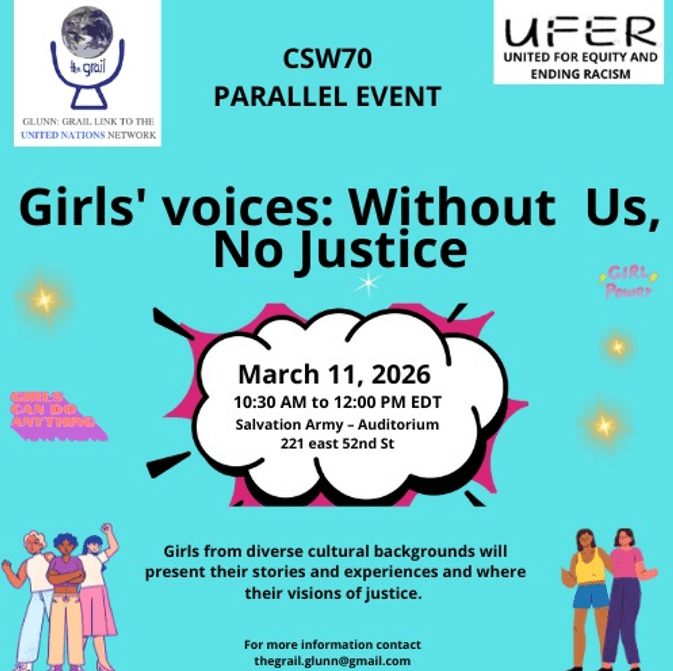
United Nations Commission on the Status of Women (CSW70 2026)
Grail Parallel Event
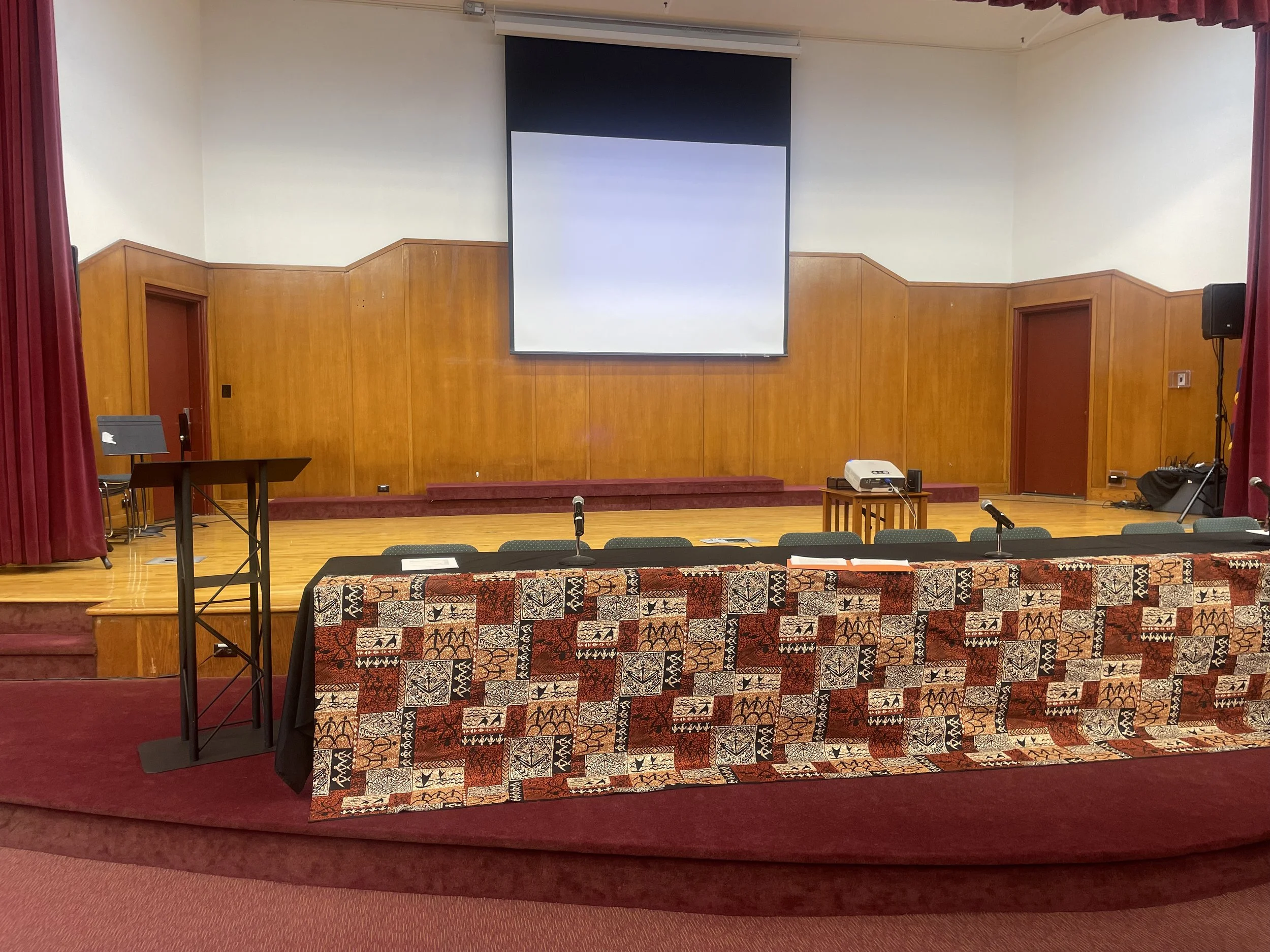
This CSW parallel event was co-sponsored by The Grail and United for Equity and Ending Racism (UFER) (2), which are both non-governmental organizations (NGOs), each with the special UN ECOSOC standing.
The panel was set up to address the priority theme of CSW70:
Priority theme: Ensuring and strengthening access to justice for all women and girls, including by promoting inclusive and equitable legal systems, eliminating discriminatory laws, policies, and practices, and addressing structural barriers.
The panel addressed the theme from the perspective of a diverse group of girls.
For historical background on the United Nations Commission on the Status of Women and on its overseer agency UN Women, please check out our Second Anniversary post of April 11, 2026:
“Girls’ Voices: Without Us, No Justice”
https://cwed.org/blog/girls-on-fire
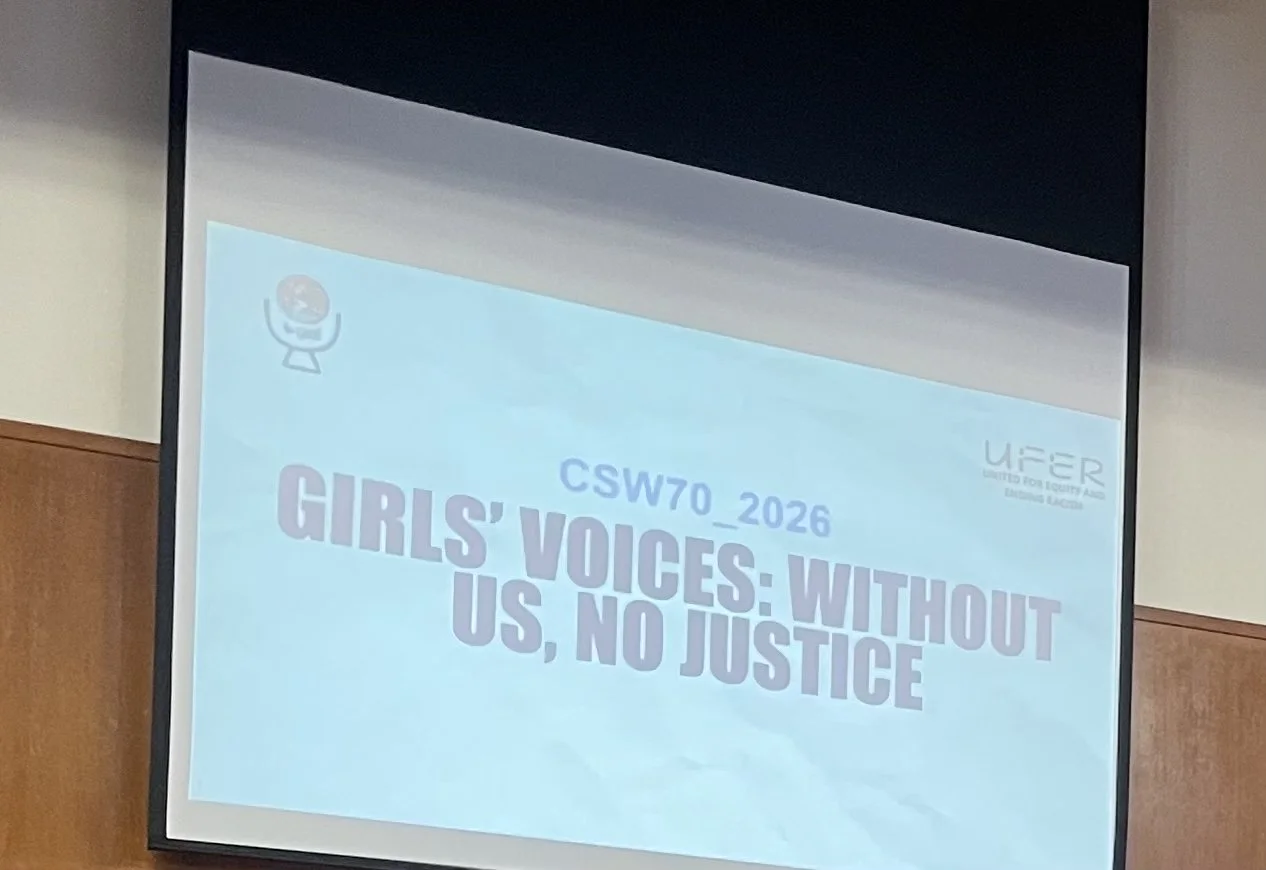
The panel consisted of eight teens: six panelists and two co-moderators.
This post begins with the introductions by the two moderators,
Amelia and Quinn.
One panelist’s views are in this post and four others will follow in subsequent posts.
Enjoy!
~~~
Solidarity
[The panel began the event by leading the audience in song with:
“This Little Light of Mine.”
The audience joyously joined in!
“This little light of mine, I’m gonna let it shine….
Let it shine, let it shine, let it shine.]
The moderators presentations:
AMELIA:
Thanks to all who had the courage to sing with us.
Now, let’s take a moment to acknowledge the girls who should be here today, but cannot be with us due to systemic barriers, conflict, or lack of access. We stand in solidarity with them and reaffirm our commitment to making spaces like this that are inclusive, accessible, and safe for all.
QUINN:
This event is co-sponored by The Grail and UFER. The Grail is an international Women’s Movement which began in the Netherlands 100 years ago and spread to 22 countries in Africa, Oceania, Asia-Pacific, the Americas, and Europe.
Called by its spiritual values, The Grail envisions a world of peace, justice, and renewal of the earth brought about through education and action, with girls and women working together as changemakers.
AMELIA:
The Grail has been involved in the United Nations since the 1950s. The 51st CSW session in 2007 was the first time that The Grail started to bring girls from all over the world to attend the CSW and has continued to do so throughout the years.
It was an exciting moment as girls got involved in events which allowed them to have the space to stand and speak out rather than having Grail women speak for and about them:
Nowadays, we get to hear the voices of girls speaking up for themselves.
Within the past few years, The Grail asks girls to develop Back Home projects so that what they experienced wasn’t just a two-week adventure at CSW, but something that they carried into their lives.
We’ve now seen 19 years of amazing work done by amaz'ng girls.
INTRODUCTION
AMELIA:
Access to justice is a fundamental human right and an essential part of achieving gender equality.
Yet for many girls around the world, justice remains difficult to reach. Even where laws exist to protect girls’ rights, many girls still face barriers when they try to seek justice.
Some fear they will not be taken seriously. Others simply do not know where to turn for help. As a result, many girls grow up feeling that justice systems are not designed with them in mind.
But there is another important truth.
Girls are not just facing these challenges—they are also leading change.
Around the world, girls are speaking out, organizing in their communities, and advocating for systems that are more fair, inclusive, and responsive to their realities.
QUINN:
Girls are not only beneficiaries of rights. They are rights-holders.
And they are powerful agents of change.
They want systems they can trust.
They want access to information about their rights.
They want safe and confidential ways to report abuse.
They want legal support that is accessible and affordable.
And they want to see more women and girls represented in leadership and decision-making.
Girls also remind us that justice is not only about changing laws.
It is also about changing attitudes, norms, and expectations within our communities.
Girls’ rights, voices, actions, talents, and dreams are the foundation of the world we all want and deserve.
AMELIA:
Today’s event is entitled Girls’ Voices: Without Us, No Justice.
Our panel brings together six remarkable girls from diverse cultural, social, economic, and political contexts.
Each of them brings unique perspectives and experiences from their communities and countries.
They will share what justice means to them, the barriers girls face when seeking it, and the changes they believe are necessary to create systems that truly work for girls.
QUINN:
During this event, our girl speakers will reflect on the progress that has been made, but also on the gaps and challenges that remain.
They will speak about issues such as:
gender equality,
safety,
violence against girls,
education,
health,
and
the role that digital technology plays in their lives today.
Most importantly, they will share their own voices and visions for change—because meaningful justice cannot exist without listening to the people most affected.
Today is about creating space for girls’ perspectives, recognizing their leadership, and learning from their experiences.
And as the title of our event reminds us: without girls, there is no justice.
FIRST PANELIST PRESENTATION:
Introduction by co-moderator Amelia:
Our first speaker is Esmeralda who’s is 17 years old from The Bronx, New York.
She is currently attending [a Catholic high school]. She serves as a leader of a diversity club at her school where she spreads cultural awareness and creates a safe place for students to freely discuss issues on discriminatory practices that hinder girls’ representation, voices, and their rights.
As a student at an all-girls Catholic high school and a young girl of Catholic faith, Esmeralda is passionate in ensuring that girls, especially girls in underrepresented communities, have the support and the ability to advocate for themselves. Esmeralda will speak about barriers like adultification and harassment that prevent girls, especially Black and Latina girls, from feeling safe and reporting abuse.
Esmeralda, the floor is yours!
Esmeralda
Imagine a world without justice. How would you be able to keep yourself and your loved ones protected in society? Sadly, you wouldn’t. When we hear the word justice, we often think about courts, sending people to prison, or punishing someone through legal action. But where is the other side of justice? The part where everyone receives the good they are due—where it’s not about how much money you win in a lawsuit or how many years someone is sentenced, but about how people treat you, empathize with you, and recognize the good you do. At the end of the day, that is the justice we all yearn for—the kind that comes from our shared human nature.
Growing up in the Bronx, I’ve seen many structural barriers that prevent girls from seeking justice. Specifically for Black and Latina girls, a common barrier I have noticed is adultification—in other words, assuming that we are more mature, stronger, and less innocent because of our gender or our family background. This leads to less protection for girls and causes us to be seen as less vulnerable in difficult situations.
Because of adultification, I grew up realizing that when reporting abuse or assault, girls may have difficulty doing so out of fear of being blamed or not believed. Since young girls are assumed to be more mature than their peers, they often receive backlash instead of empathy or help. Many times when girls report abuse, especially in New York City, we see comments like, “Why didn’t she fight back?” or “She’s just playing the victim.” These expressions cause other young girls—especially girls of color—to avoid reporting abuse. Society expects us to be invulnerable in one of the most vulnerable moments of our lives.
An important factor in preventing these situations is ensuring safety for girls, both emotionally and physically. I believe I can speak for many girls when I say that safer public transportation is something we would significantly benefit from. A report from the NYU Rudin Center for Transportation states that 75% of women reported experiencing harassment or theft while using public transportation in New York. From what many of us see every day on the train or bus, a large number of those women are girls on their way to school—somewhere they cannot and should not stop going.
None of the issues I have mentioned can be solved without support for justice, which I believe is lacking. Although we have school programs, teachers, and guidance counselors—which are valuable and should never be denied—it can sometimes be difficult for someone from another generation to fully understand the experiences girls face today. No one is necessarily to blame for that; times change. However, this is why more peer support groups are needed—spaces where girls can speak to others their age with similar experiences and feel a true sense of sisterhood, reliability, and confidence. Organizations like Mount Behavioral Health provide peer support services throughout all five boroughs of NYC, allowing girls to connect with people who truly understand their experiences.
This world isn’t perfect, and there will always be difficulties for everyone. What matters is that girls like me, who are able to use our voices and speak to an audience, continue speaking out about what we can improve in our society and how we can use available resources to do so. If you take anything from what I’ve said today, let it be this: justice is not only about punishment—it is about protection, empathy, and respect for human dignity. When girls are listened to and given justice, it becomes something we can trust instead of something we fear.
Notes:
The Grail is an international movement of women founded in 1921 in Holland by a Jesuit priest and five Catholic lay women. Its mission is focused on social transformation, spiritual search, environmental sustainability, women's empowerment, and global solidarity.
The International Grail has been a registered non-governmental organization (NGO) at the United Nations since 1953, with Special Consultative status through ECOSOC since 1998. It works on issues such as the Commission on the Status of Women (CSW), anti-racism, and sustainable development.
Headquartered at Granville in Loveland, Ohio, the Grail operates in roughly 22 countries, with a significant presence in the USA.
Grail in the USA:https://www.grail-us.org/
International Grail Movement:https://grailmovement.net/
2. United for Equity and Ending Racism (UFER) has worked to eliminate all forms of racism, xenophobia, discrimination and related intolerance since its founding in 1952.Through representation as a non-governmental organization (NGO) at the United Nations in New York and Geneva, UFER collaborates with other international actors to promote policies for racial equity at the global level, while condemning the transatlantic slave trade and colonial genocide of indigenous peoples as flagrant crimes against humanity.
UFER’s mission is to build a peaceful world free of all forms of racism, casteism, inequity and injustice where all members of one human race enjoy full health, dignity and well-being in a context of freedom, equality and justice protected by universal human rights principles.
UFER International: https://ufer.international/
IN YOUR OWN WORDS:
Previous Post: “Girls’ Voices: Without Us, No Justice” Written by Anne Andersson, April 11, 2026
— “Loved your blog & happy anniversary! Two years is remarkable!! 👏👏 “ —LC
—”Dear Anne, The more I read in your Posts the more I learn who you are! Such a remarkable woman of many facets. Thank you for keeping me on your list as I'm learning so much. Blessings of the Easter Peace to you and Eleanor.”—Maryanne
Prayers Needed!
Consider and pray for our world today.
While world events are extremely serious, they do also cause media distraction.
Recall the girls who are the survivors of the Epstein human trafficking ring.
Pray for them and for the perpetrators.
Pray for JUSTICE.
C:WED Wish List:
REMEMBER TO CONSIDER THE EARTH,
ESPECIALLY ON THIS COMING WEDNESDAY:
EARTH DAY APRIL 22, 2026
🌱
Please help us in any way you can.
Every little support enables us to maintain access to the website technology we need.
We so appreciate any help you can give us!
And always feel free to send us ideas on topics you might want us to investigate—or, perhaps, you might have some solutions or ideas of your own.
We would love to hear from you!
If you are able to lend support, in any amount possible, please do click this very safe button: