
Thank you Louise Connors for suggesting that C:WED report on and tackle the complicated topic of the Cornell 7 civil case brought against Cornell University by the accuser known only as Jane Doe.
Thank you Chris Andersson for alerting me to the October 15, 2026 episode of WNYC’s Brian Lehrer Show, a radio broadcast airing on 93.9 FM (820 AM) in New York City, and Lehrer’s interview with Cornell philosophy professor Kate Manne.
The Brian Lehrer interview episode is entitled :“Cornell’s Feminist Philosopher on the “Jane Doe’ Case.”
https://www.wnycstudios.org/podcasts/bl/articles/cornells-feminist-philosopher-on-the-jane-doe-case
Shortly thereafter, I found Katie Couric’s interview with Kate Manne on October 20, 2026. This interview is available on YouTube at:
Kate Manne is an Australian philosopher, author, and professor at the Sage School of Philosophy at Cornell University. Her work focuses on moral, social, and feminist philosophy, as well as metaethics and moral psychology.

Kate Manne
Kate is the author of the Substack newsletter More to Hate, and of many books, including Down Girl: The Logic of Misogyny (Oxford, 2019) and Entitled: How Male Privilege Hurts Women (Crown, 2021).
This C:WED post will focus on some of Kate Manne’s views on the broader issues of male mob mentality and gang rapes of women in relation to the recent Cornell 7 civil suit.
The post is set up in interview style and will focus on three of Kate’s theories regarding the Jane Doe/Cornell 7 case, and the mechanism behind gang rape in fraternities.
A fourth theory will be covered in Part Three, the final post in this series.
The Brian Lehrer Show Interview October 15, 2026:
WNYC Brian Lehrer introduced his interview by saying.
“The alleged Cornell gang rape case is more than about Cornell.”
Lehrer: It is about a national culture inside fraternity houses on campuses across the country, Ivy League and not, that keeps producing cases like this one, and institutions that keep responding the way Cornell did and didn’t.
[Quick Recap of the case];
A former student of Cornell University alleged that she was drugged and sexually assaulted by seven students at Cornell's Chi Phi fraternity house in October 2024. She reported it to campus police in November 2024, and the Tompkins County district attorney declined to bring the case to a grand jury.
In September 2026, the accuser—suing as Jane Doe—filed a civil lawsuit against Cornell, Chi Phi, seven fraternity members, her sorority (Delta Delta Delta), and others.
New York State has taken over the case. As of November 2026, New York AG Letitia James is leading a reopened criminal investigation into the 2024 Chi Phi fraternity allegation. In early November 2026, Letitia James brought in former federal civil rights prosecutor and Cornell alumna Jacqueline Kelly to serve as outside counsel leading the day-to-day investigation.
Cornell has announced a comprehensive review of its Greek life system. The university has halted all fraternity parties for the remainder of the year and announced plans for mandatory in-person consent training in spring 2027.
Previously, Cornell's internal Title IX process resulted in the expulsion of two students, the suspension of two others, and the permanent removal of the Chi Phi chapter—though newly surfaced documents revealed the university had engaged in stalled negotiations to potentially reinstate the chapter by 2030 or 2031.

Chi Phi Fraternity House
[Back to the Brian Lehrer Interview]:
Lehrer: Cornell has a history wth this. The phrase sexual harassment is believed to have been coined on its campus in 1975 by a former Cornell instructor named Lin Farley who told Newsweek in October, 2026 in regard to the Jane Doe case, that she was not surprised and expects nothing to change.
Farley says, “It was a fact of life at Cornell. If you understand what the fraternities do, Cornell supports that 100%.
Manne: None of this is unusual. Fraternity houses are, across the culture, hotbeds of rape culture . I have spent a decade studying the system that produces them.
In 2017, when the #MeToo movement broke out, I published a book called Down Girl: The Logic of Misogyny , which is about how misogyny works on campuses and everywhere else, not as hatred of women but as a system.
Cornell is the rule, not the exception.
Manne: It is a recognized problem on university campuses. A government report from 1985 called “Campus Gang Rape, Party Games” summarizes it as ‘a pattern they found in 50 cases.
The scenario is basically the same:
A fraternity holds a party where, in many cases, but my no means all, a young woman often has had too much to drink or too many drugs.
Therefore, she may be unaware that the “friendly persuasion of the brothers” is actually a planned pursuit of easy prey.
By the time she recognizes her prdicament, her confusion has changed to fear and escape seems impossible. She is unable to protest or her protests are ignored. Anywhere from two to eleven or more men rape her.’
The government report found that, in many campuses, ranging from Ivy League institutions to small liberal arts colleges to large public state schools, they were happening on an almost weekly occurrence.
Unfortunately this is an old pattern and one that we have failed to do anything about.
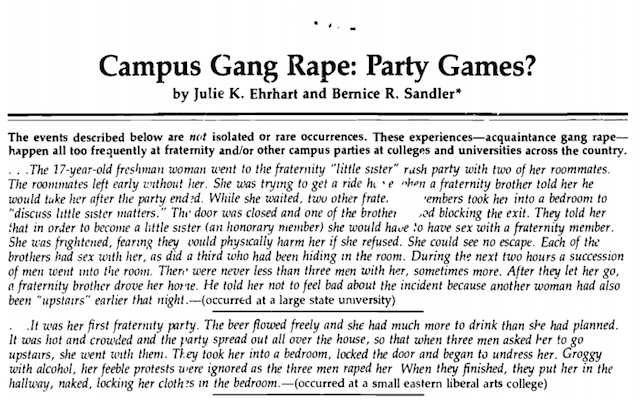
From the first page of “Campus Gang Rape: Party Games?” (1985), Julie K. Ehrhart and Bernice Resnick Sandler, Project on the Status and Education of Women, Association of American Colleges (ERIC, U.S. Department of Education)
Lehrer: People may be surprised to learn that this behavior emerged from Cornell in particular—an Ivy league school that only admits people who were very good students in high school and that these universities would have a population that is a little more enlightened than however they may perceive other schools and other populations.
Manne: We should reserve the right to forever be morally shocked. I am so shocked by what has happened to Jane Doe and so many other victims (and my heart goes out to them).
In fact, it was in speaking to female students who were subject to sexual assault when I first got to campus in 2013 that really radicalized me.
It made me want to think carefully about misogyny because it frankly seemed so unfair that women were at an elevated risk for sexual assault and that the world is so much less safe for women than it needs to be.
Manne: Rape culture is endemic; it is ubiquitous. [It is always happening; and it is everywhere.]
And sometimes it is a facet of male privilege. Some of the people who perpetrate sexual assault come from very privileged backgrounds and there can be associated with that background, a sense of impunity, a sense of entitlement and really a sense of a right to get away with it, partcularly in college.
The idea that a prestigious institution like ours, Cornell, is somehow antithetical, just the opposite, to these kinds of crimes and forms of sexual misconduct is unfortunately a myth.
Manne: There is always a risk for women under patriarchy where rape culture is endemic, constantly present.
The world is a dangerous place for women across the board.
The elevated rapes in fraternities are a particular problem.
In the fraternities, there are groups of men—all male groups— and there is an enormous amount of impunity and pressure on the brothers to participate in activities that many of them, as individuals, would not choose to participate in, or initiate on their own.
But once there is a group of men, the rule seems to be that there is a code where, if one brother initiates or proposes doing something illegal or immoral, other brothers are morally obligated to go along with it.
Manne: I call this the “bro code.”
Then there is also a real culture of protection after the fact rather than trying to intervene.
None of the frat boys intervened to help Jane Doe.
Lehrer: A listener is asking a question:
Female Listener: “Where are the men? Where are the fraternity brothers who could show up and speak up and reflect together on this cultural situation and take responsibility and use the “bro code” for good?
I am surprised that we haven’t seen an outpouring of all the good men we have out there.”
Manne: “Brian, you are the first prominent male host of a radio show or podcast who has invited me to have this conversation compared with dozens of women who are prominent in the media who have been all over this case and wanting to have this conversation.
Manne: I spoke to a former student of mine, who had been a frat president, about what he would have done as a conscientious participant.
He thought about it and was embarrassed to tell me that the bonds of loyalty between fraternity bothers are so great and so strong that he said, “I would have to protect my brothers and defuse the threat rather than be a good person.
A brother does not turn another brother in.”
Manne’s Theory: “Himpathy,” a term she coined.
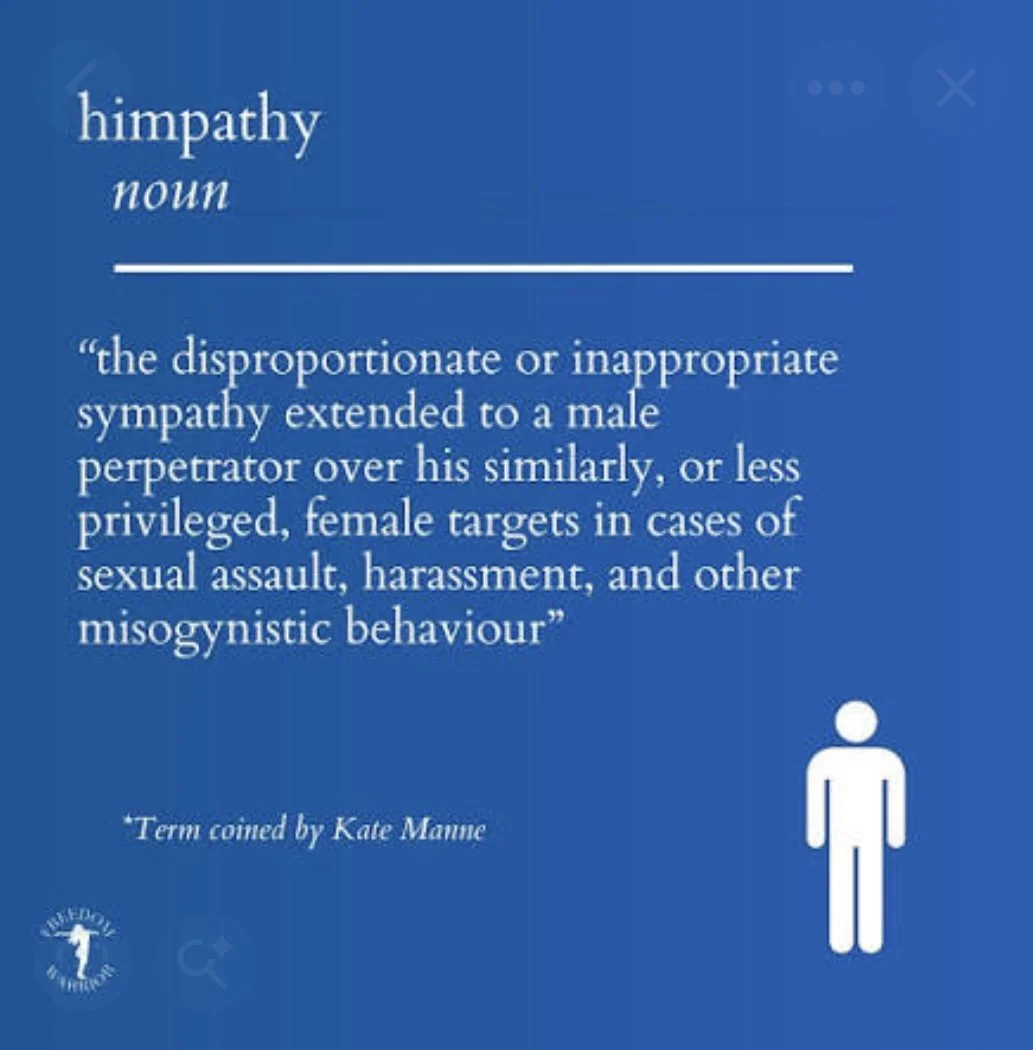
Manne: the crisis of gang rape in fraternity houses is part of the systemic architecture of what I call “himpathy. “
Himpathy is the disproportionate sympathy sometimes extended to men accused of wrongdoing, at the expense of concern for the women who report harm by those same men.
Himpathy describes the protective sympathy particularly extended to privileged male perpetrators to save their "bright futures," while the lives of their victims are utterly discarded.
Victims’ futures are not seen as worthy to be saved.
Himpathy is a helpful term as it offers a clear lens for examining how a society distributes compassion, credibility, and protection. It addresses the question: Whose Suffering Matters?
Manne: The illuminating concept of himpathy is not an argument against fairness or due process. Those principles are indisputable.
Himpathy is an invitation to notice how compassion is distributed.
Himpathy asks these questions:
Whose future are we most worried about?
Whose reputation?
Whose education?
Whose opportunities?
And whose suffering is treated as an unfortunate complication?
Manne: How many women have sought safety, recognition, or justice only to find themselves standing at the threshold of institutions that are unwilling or unable to respond adequately?
These unresponsive institutions are recognizable as: universities, religious communities, family courts, or organizations entrusted with the care and dignity of human beings.
[For C:WED, whose work has long joined concern for women’s dignity with a spirituality of justice and compassion, these questions are profoundly important.]
Kate Manne’s Second Theory:
Her unique definition of mysogyny and the myth of the uneducated boy
Misogyny
Manne: Misogyny is not simply hatred of women.
Although, we do commonly think of misogyny as hatred of women, we need to look more deeply.
Misogyny Is much more than hatred of women
It can operate, rather, as a system that upholds male entitlement and punishes women whose autonomy challenges that entitlement.
Manne: Misogyny is not merely a personal prejudice or an emotion like hatred.
It can function as a system of social enforcement, maintaining expectations that women should serve men’s needs, desires, comfort, and interests.
When women resist those expectations, or when their autonomy challenges male privilege, they may encounter punishment, hostility, disbelief, or exclusion.
This distinction matters enormously.
It means that we cannot understand sexual violence simply by asking why particular men behave cruelly.
We must also ask what social arrangements permit such behavior, what attitudes normalize it, and what institutions fail to challenge it.
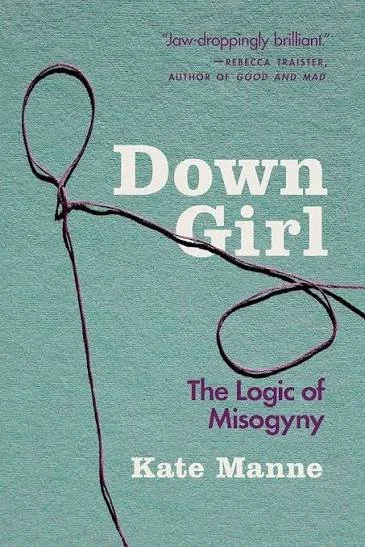
Lehrer: In her book, Down Girl: The Logic of Misogyny, Professor Manne offers an important way to understand the persistence of violence against women.
Lehrer: Professor Manne, who teaches at Cornell, has spoken publicly about the case and criticized what she regards as the university’s inadequate response.
She has also described the larger culture of sexual violence and institutional indifference that she believes universities must confront.
Manne: The allegation at Cornell has raised questions extending well beyond the conduct of the individuals involved.
What responsibility does a university bear for the safety of its students?
How do fraternity cultures shape expectations about women’s sexual availability?
What happens when a woman reports sexual violence and finds herself confronting not only the alleged perpetrators but also the institutions around them?
These questions deserve attention regardless of the eventual legal outcome.
Manne: No woman can be considered expendable. No person’s body can rightfully be treated as the property of another. No institution’s reputation should outweigh its obligation to protect human dignity.
The Myth of the Uneducated Boy
Manne: What also happens when campus assault headlines break is that the cultural reflex is immediate and predictable: a flood of articles lecturing mothers and fathers on "how to raise good boys.”
We treat systemic atrocities as if they are merely individual parenting failures, comforting ourselves with the belief that a few more household lessons on “basic consent” (having someone’s agreement to participate in an act with you) will heal a broken society.
Manne: Our young men do not need another polite seminar on right and wrong.
They already know the rules of consent.
We must stop pretending that the members of a toxic fraternity or digital group chat are simply confused.
They are, in actuality, hyper-aware, highly resourced, and fully cognizant of the harm they inflict.
They operate with brutal efficiency because they have been conditioned to believe that their social currency shields them from consequences.
The mob doesn't form because individual boys weren't taught manners at the dinner table.
It forms because our institutions actively signal to them that their collective status, their pedigree, and their pleasure matter more than the humanity of the vulnerable.
The Sacrificial Altar of Reputation
Manne: When a university administration, or a Title IX office, hands down a slap on the wrist to a high-status perpetrator, they are practicing weaponized himpathy.
The institution instinctively aligns itself with the powerful.
It views the perpetrator's potential as something worth saving, while treating the victim as a transactional liability to be silenced and pushed outside the gates.
Manne: the machine protects its own, and generic “consent education” (educating boys about what consent means) does absolutely nothing to disrupt that machine.
A Radically Dangerous Way to Raise a Son
Manne: If parents truly want to dismantle rape culture, they must stop raising boys to be merely polite, compliant citizens of a corrupt system.
Polite boys stay silent in the group chat to keep the peace.
Compliant boys look the other way to protect their friendships.
We must raise sons who are willing to commit social suicide within their male peer groups, which often demand unquestioned loyalty to the group.
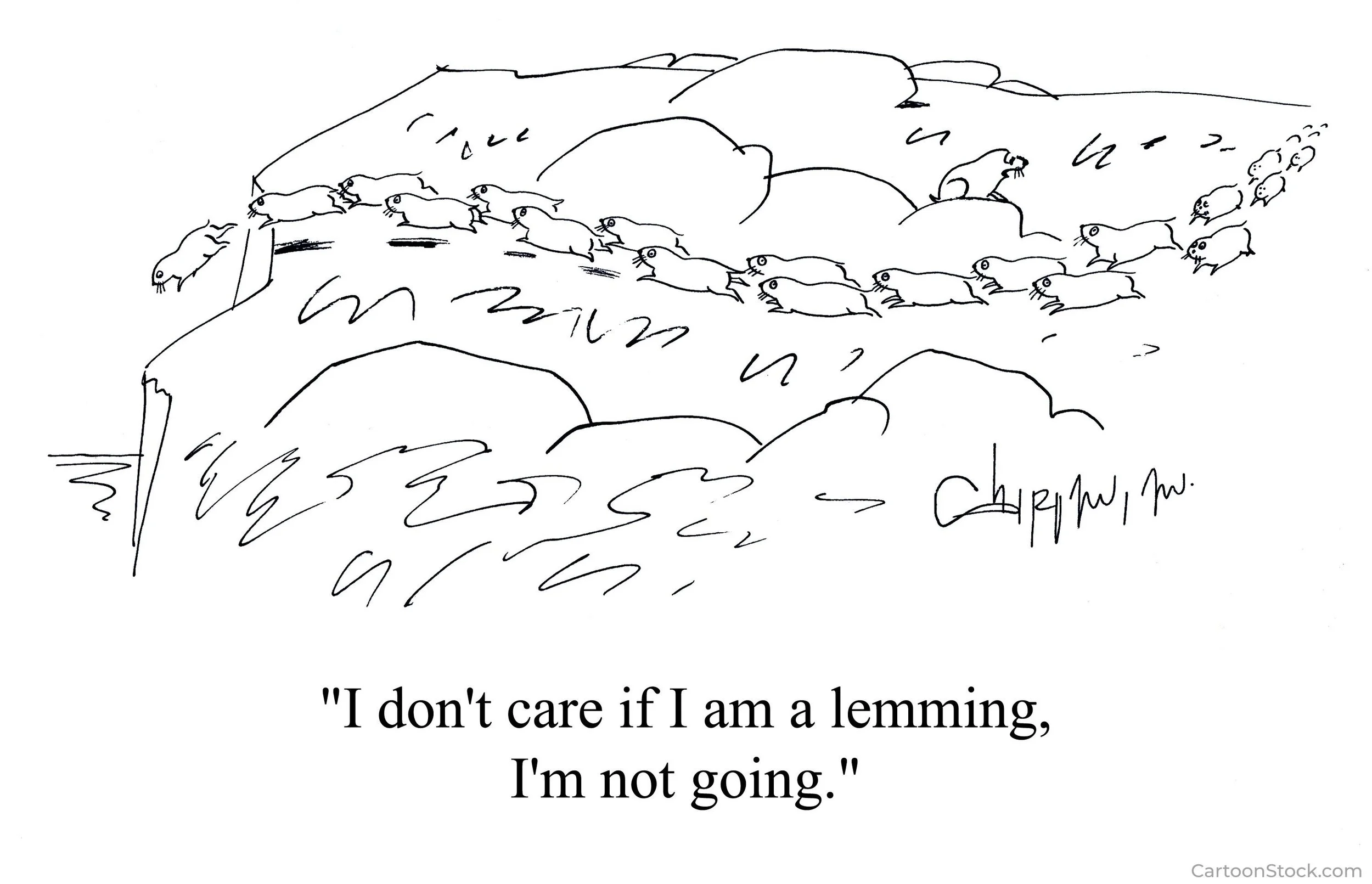
True accountability requires raising boys who will look at a toxic all-male subculture, recognize its inherent violence, and choose to blow it up from the inside rather than remain comfortable in the security of the pack.
If our sons are not prepared to sacrifice their own social status to protect someone else, then we have not raised them to be good.
We have merely raised them to be complicit.
We must look beyond the mob itself and look to the institutions that protect them!
~~~
Katie Couric’s interview:
Couric: Women are “himpathetic” too. They worry about his future; they don’t worry about her future.
Part of what may be operating with women’s “himpathy” is the thought that: “We can keep ourseves safe because ‘I would never put myself in that position.’"
Couric: How do we change the culture?
How do we help young men appreciate and know the difference between right and wrong.
How to we change the way parents talk to their sons?
Manne: “Consent education“ is necessary in age-appropriate ways. Boys should definitely hear what consent is and what it means.
But, I do not buy that older boys or young men do not understand what consent is all about.
I believe they just don’t care or perhaps they want to violate a woman.
Couric: What about talking to your kids?
Parents play such an important role in the conversations they need to have with their children.
One thing I hear a lot from mothers of sons (I wish more fathers were having these conversations with their sons) is this:
“We need to teach boys what consent is; they need to express their emotions freely and not be inside the weird masculine norm of keeping emotions to themselves.”
Manne: Those are good measures and a necessary part of the conversations, but they are not sufficient.
What I want to hear more from the parents of sons is: anti-entitlement education.
I do hear that from some, but it is not enough of a widespread movement yet.
Manne: Parents can tell their sons this:
“Look, as a man you will be subject to all sorts of bad messaging about being entitled or driven, almost obligated, to violate a woman’s body.
And actually that is the opposite of the truth.
You respect everyone.
You care for everyone.
You have the job—you are tasked with—being a caregiver in the world because:
Caregiving is the antidote, in the end, to rape culture.
It is the way that we show that we regard the body as fundamentally inviolable and morally sacrosanct;
The body as something to be honored such that the kind of person we should be raising (man, woman, nonbinary person, or whatever) is the kind of person who would, when contemplating the possibility of violating someone’s consent, finds that action absolutely anathema to the whole way they think about it.
It strikes them as a monstrous and as also almost an unintelligible thing to do to another human, because “why would you do that as opposed to being kind, caring, and helping people get what they need?”
Manne: This is a more radical conversation that just “what is consent.”
And the institutions could follow this radical kind of thought.
They could listen to the victims carefully before making cliched judgments about what she was wearing or how much she drank.
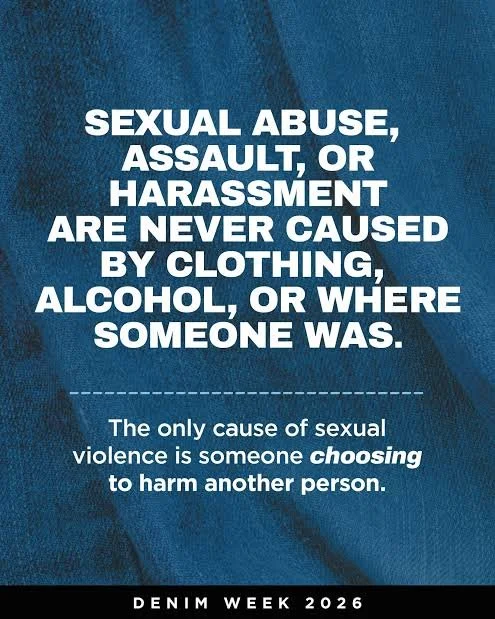
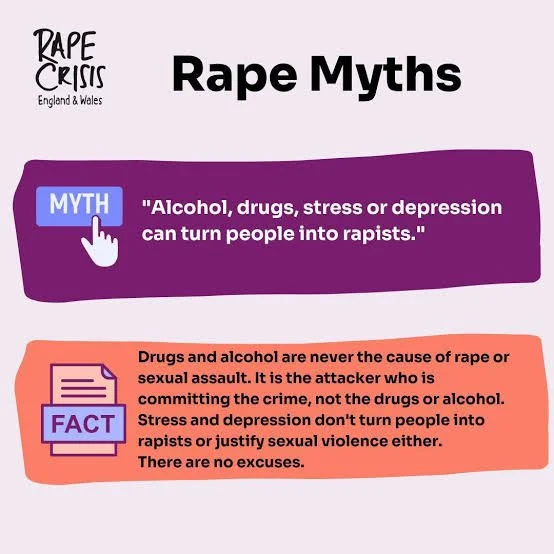
There is never a situation that justifies sexual violence toward another person.
There are no excuses!
COMMENTS
PREVIOUS POST: “Stonehenge of America,” written by Anne Andersson, October 16, 2026.
—On your report on the mounds, I will never be able to look at Ohio in the same way again! Thank you. Wonderful work. —EA
PREVIOUS POST: “The Cornell 7: Part One—From the Ancient Mob to the Modern Group Chat: the Deep Roots of Rape Culture,” written by Anne Andersson, November 7, 2026.
— Regarding your C:WED post: Possibly my favorite one! 😊 The biblical stories are so effective but so obscure, it’s amazing to learn that they exist in the Bible! It is a post about violence and assault and potentially very triggering, but you present it in a way that is informative and fascinating which protects the reader, I feel at least, from becoming too activated. Well done!!! 👏👏👏💕💕💕🥰🥰🥰—MA
—Thank you for this presentation. We, as a society, need to read and learn these stories; otherwise we are condemned to repeat them. If we elect female legislators, we may have an opportunity to stop repeating history.—RE
—BE SURE TO REMEMBER THE CURRENT WOMEN WHO ARE EPSTEIN RAPE AND TRAFFICKING SURVIVORS!—
WE ARE:
THE CENTER FOR WOMEN, THE EARTH, THE DIVINE
C:WED
Dismantling patriarchy and reimagining the Divine to restore and heal the Earth
We explore the parallels that exist between the imaging and treatment of women and of the Earth under patriarchy, and how images of the Divine are related to these parallels.
~~~
HAVE A BLESSED THANKSGIVING.
WE ARE SO VERY GRATEFUL FOR YOUR SUPPORT!
AND WE ARE THANKFUL FOR THOSE WHO ARE ON THE SIDE OF JUSTICE AND HEALING FOR THE OPPRESSED.
Join us in support of our work!
❤️