
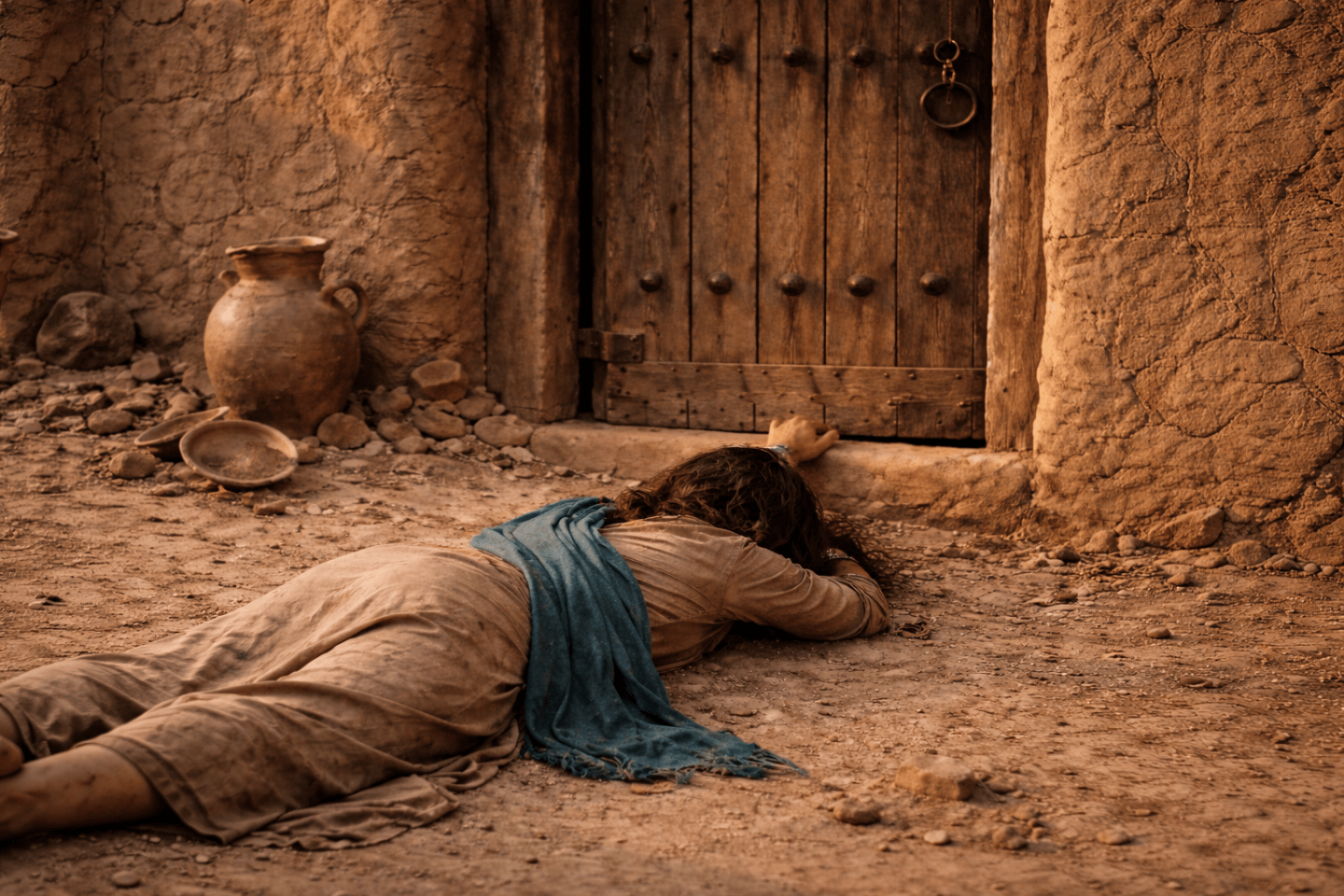
“The Woman at the Door”
From an Ancient Biblical Horror to Cornell University
Part One:
a C:WED series on sexual violence, misogyny, and women’s dignity
When campus assault headlines break, our reaction is a visceral mixture of fury and heartbreak.
We demand to know how group behavior can devolve into calculated cruelty, and how institutions fail so fundamentally to protect the vulnerable.
However, if we stop for a minute and take a look at the architecture of these scandals, we can see:
—pack mentality,
—institutional silencing,
—digital normalization of harm.

The Chi Phi Fraternity House at Cornell in Ithaca, NY
And we can also see that these horrors are not modern aberrations.
They are ancient blueprints repeating in real-time.
How does an ancient biblical story explain today’s campus rape culture?
It will help if we look at certain stories as they are, as ancient origins of institutional protection.
Two Hebrew Testament accounts serve as terrifying historical mirrors for modern rape culture.
These are the total abandonment of women in Sodom (Genesis 19) and the gang-rape and murder of the Levite’s concubine in Gibeah (Judges 19).
The Levite and His Concubine
Judges 19:20–28
This is the closest match to a story involving a group of men "building" or acting as a mob in a town.
The Situation: A traveling Levite (a member of the Israelite priestly tribe) and his concubine (secondary wife) stop for the night in the town of Gibeah, belonging to the tribe of Benjamin. An old man offers them hospitality and brings them into his house.
The Mob: A crowd of wicked men from the city surround the house, pounding on the door. They demand that the host bring out the male guest (the Levite) so they can abuse him sexually.
The Offer: The old host begs the crowd not to do such a wicked thing. To protect his male guest, the host offers the crowd his own virgin daughter and the Levite’s concubine instead, telling the mob to do with them "whatever you please."
The Outcome: The crowd refuses the host's daughter, but the Levite grabs his own concubine and pushes her out the door to the crowd. The mob abuses and rapes her all night. By morning, she collapses and dies at the threshold of the house.
Lot in Sodom (Genesis 19: 1-11)
This is a nearly identical parallel story, although occurring much earlier in the Hebrew Bible. It is in Genesis, the Bible’s first book.
The Situation: Two angels disguised as men visit the city of Sodom. A man named Lot insists on giving them shelter in his home.
The Mob: The men of the city surround Lot’s house and demand that he bring the two male guests out so they can rape them.
The Offer: Lot steps outside to protect his guests. He begs the crowd to stop and says, "Look, I have two daughters who have never slept with a man. Let me bring them out to you, and you can do to them whatever you please. But don’t do anything to these men, for they have come under the protection of my roof."
The Outcome: The mob refuses Lot's daughters and tries to break down the door to get to the men. The angels step in, strike the mob with blindness, and rescue Lot and his family before destroying the city.
Historical & Cultural Context: The Law of Hospitality
In the ancient Near East, hospitality (xenophilia) was not just a courtesy. It was a strict, sacred code of survival governing a harsh desert landscape.
The Sacred Duty of the Host: When a traveler was brought into a home, an absolute covenant of protection was established. The host assumed complete responsibility for the guest's physical safety. To allow a guest to be harmed under one's roof was considered an ultimate, unforgivable sin against both society and the gods.
The Low Status of Women: Ancient Israelite society was deeply patriarchal. Legally and socially, women, especially daughters and concubines (secondary wives), were largely viewed as the property of the male head of the household.
The Cultural Values: In a crisis, the extreme cultural pressure to protect a male guest outweighed the protective duty toward female dependents. Giving up a guest meant total social disgrace and spiritual cursing, whereas sacrificing the women of the household, while horrific, was viewed by these specific individuals as a lesser violation of cosmic and social order.
The Literary Critique: Biblical scholars note that the author of Judges 19 explicitly includes these details to shock the reader. The narrative intentionally mirrors the Genesis 19 Sodom story to show that the Israelite town of Gibeah had become just as corrupt, lawless, and morally degraded as Sodom.
By holding these ancient texts against today’s headlines, we can uncover the unsettling truth that:
We are dealing with a deeply entrenched, multi-millennial lineage of systemic violence.
Certainly, the parallel with Judges 19 is not that the events are identical.
They are not.
Rather, the comparison invites us to consider a recurring moral danger.
This danger is that the protection of women as persons whose safety and autonomy are at risk, may be subordinated to the desires, loyalties, or reputations of men.
Feminist theologians refer to biblical narratives, such as those mentioned above, as "Texts of Terror.”
Reading Scripture Through Women’s Eyes
In her groundbreaking book Texts of Terror, biblical scholar Phyllis Trible examined stories of women subjected to suffering, exploitation, and violence in the Hebrew Bible.
Rather than explaining away these troubling passages, Trible insisted that readers confront their horror.
This is an important task for people of faith to take on because Trible is advising that the faithful need not defend every action recorded in Scripture.
Nor must people of faith imagine that every biblical character embodies the values associated with the Divine.
Sometimes the sacred text presents us with a human reality that demands moral resistance.
What Phyllis Trible is basically saying is:
Scripture Can Be “Descriptive,” Rather than “Prescriptive.”
The two stories are examples of Scripture being descriptive, informative, and aimed at igniting action, rather than being plainly prescriptive.
The stories are meant to serve as catalysts for the occurrence, in those who hear or read them, of a reaction such as I described at the start of this post, that is, a visceral mixture of fury and heartbreak at the extent to which human nature can extend its harmful ways.
What are the Contemporary Allegations in the Cornell Case?
In September 2026, a former Cornell University student, publicly identified as Jane Doe, filed a civil lawsuit alleging that seven men associated with the Chi Phi fraternity sexually assaulted her in October 2024.
The complaint alleges that she was incapacitated and unable to consent. It also describes an electronic message allegedly inviting other men to participate.
The accused men have denied or disputed the allegations. No criminal charges have been filed as of early November 2026, and the allegations remain subject to legal investigation and adjudication.
~~~
Anatomy of the Mob
In Judges 19, a crowd demands access to a male guest.
To comply with the strict hospitality codes, and to resolve the conflict with the demanding mob, the host offers his guest’s concubine. She is pushed out the door and the door is locked.
The unnamed concubine in Judges 19 is then tortured and gang raped by the collective crowd.
This violence was entirely collective, and was executed by a community operating under a shared, unchecked pack mentality.
"Conflict among males can be solved by the
sacrifice of females."
— Phyllis Trible
Key Characteristics of the Mob
Today, the mob has migrated from physical streets to digital spaces.
In such campus scandals, the private group chats, Snapchat threads, and online forums are weaponized to coordinate access to, objectify, and humiliate incapacitated victims.
The digital crowd functions exactly like the ancient mob. It dilutes individual conscience, eradicates personal guilt, and normalizes atrocities through group consensus.
For your convenience, here are the actual Scripture passages:
Judges 19:20–28 (NRSV)
20 The old man said, “Peace be to you. I will care for all your wants; only do not spend the night in the square.”
21 So he brought him [and his concubine] into his house, and fed the donkeys; they washed their feet, and ate and drank.
22 While they were enjoying themselves, the men of the city, a perverse lot, surrounded the house, and started pounding on the door. They said to the old man, the master of the house, “Bring out the man who came into your house, so that we may have intercourse with him.”
23 And the man, the master of the house, went out to them and said to them, “No, my brothers, do not act so wickedly. Since this man is my guest, do not do this vile thing.
24 Here are my virgin daughter and his concubine; let me bring them out now. Ravish them and do whatever you want to them; but against this man do not do so vile a thing.”
25 But the men would not listen to him. So the man seized his concubine, and put her out to them. They wantonly raped her, and abused her all through the night until the morning. And as the dawn began to break, they let her go.
26 As morning appeared, the woman came and fell down at the door of the man's house where her master was, until it was light.
27 In the morning her master got up, opened the door of the house, and when he went out to go on his way, there was his concubine lying at the door of the house, with her hands on the threshold.
28 “Get up,” he said to her, “ we are going.” But there was no answer. Then the man put her on the donkey; and the man set out for his home.
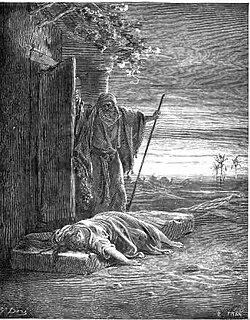
“Misogyny belongs to every age, including our own... Woman as object is still captured, betrayed, raped, tortured, murdered...
To take to heart this ancient story, then is to confess its present reality."
— Phyllis Trible
Genesis 19:1–11 (NRSV)
1 The two angels came to Sodom in the evening, and Lot was sitting in the gateway of Sodom. When he saw them, he rose to meet them, and bowed down with his face to the ground.
2 He said, “Please, my lords, turn aside to your servant’s house. You can wash your feet and spend the night; then you can rise early and go on your way.”
They said, “No, we will spend the night in the square.”
3 But he urged them strongly; so they turned aside to him and entered his house, and he made them a feast, and baked unleavened bread, and they ate.
4 But before they lay down, the men of the city, the men of Sodom, both young and old, all the people to the last man, surrounded the house.
5 And they called to Lot, “Where are the men who came to you tonight? Bring them out to us so that we may know them.”
6 Lot went outside to meet them and shut the door behind him
7 and said, “No, my friends. Don’t do this wicked thing.
8 Look, I have two daughters who have never slept with a man. Let me bring them out to you, and you can do what you like with them. But don’t do anything to these men, for they have come under the protection of my roof.”
9 “Get out of our way,” they replied. “This fellow came here as a foreigner, and now he wants to play the judge! We’ll treat you worse than them.” They kept bringing pressure on Lot and moved forward to break down the door.
10 But the men inside reached out and pulled Lot back into the house and shut the door.
11 Then they struck the men who were at the door of the house, young and old, with blindness so that they could not find the door.
~~~
Institutional Self-Preservation
In the ancient texts, patriarchs made a transactional sacrifice, based on the moral hospitality codes in those times. They threw vulnerable women to the voracious men to preserve institutional "honor" and protect their households.
The safety and survival of these women were utterly secondary to protecting the status and legacy of the house.
This transactional sacrifice is precisely what sparks intense public outcry during modern university investigations.
When administrations issue lenient punishments to protect the institution's reputation, their endowment, or the futures of privileged sons, they push the victim outside the door of justice.
The message remains unchanged across millennia.
That message is:
the preservation of the system matters more than the safety of the individual.
~~~
The Total Erasure of Autonomy
In Judges 19, the concubine is never given a name, and she never speaks a single word.
She is entirely spoken for, acted upon, and treated as a disposable object to resolve a conflict between men.
That conflict rests on the demand by the men outside for access to the male visitor, and their request being confounded by the host’s protection of his guest.
This total erasure of voice is the ultimate denial of consent.
Today, it manifests most clearly in cases involving intoxication and incapacitation.
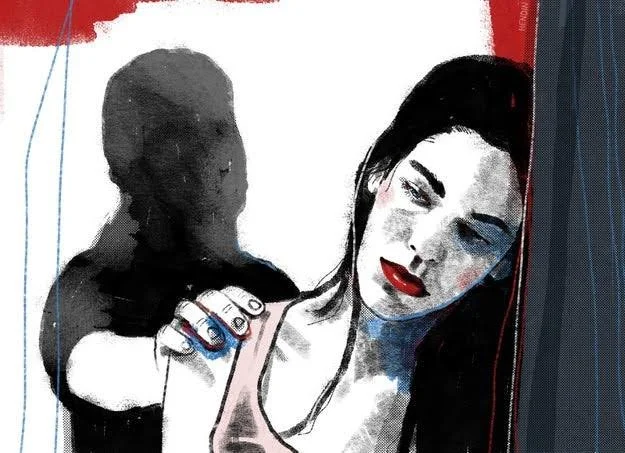
When a victim is incapacitated, their voice and capacity to choose are stripped away.
Yet, a pervasive cultural entitlement allows perpetrators to view an unconscious person not as a human being with agency, but as a passive, available object.
~~~
Breaking the Silence
Dismantling rape culture requires us to look past individual headlines and ruthlessly examine the environments that allow these ancient patterns to repeat.
Whether it is a fraternity house, or a digital group chat, or an administration building, the underlying structures of complicity remain active.
Progress will not be achieved through polite university statements.
It requires a radical, prophetic cultural shift.
This shift must be one where we fiercely refuse to sacrifice the vulnerable for the sake of institutional reputation.
It must be a shift where we finally break the silence surrounding the actions of the mob.
~~~
In the biblical story, the host and the Levite are not simply passive witnesses to violence.
Their decisions place a woman (the Levite’s concubine) in danger. Her bodily autonomy is subordinated to the perceived obligation to protect men.
Her consent is never sought.
Her voice is never heard.
The woman in Judges 19 was never named.
In the Cornell case, the alleged victim has no identifiable name. She is anonymously known as Jane Doe, an identifier chosen to protect her privacy as she seeks justice.
While the circumstances in the Cornell story and the biblical stories are profoundly different, both accounts challenge us to consider:
— whose voices are heard,
— whose humanity is recognized, and
—what we are prepared to do when those with power fail in their responsibilities.
Perhaps our task is not simply to condemn the violence of the ancient world.
It is also:
—to recognize all the assumptions about power and entitlement that still survive in our own time,
—to offer hospitality to any woman who is a victim of the male rape culture.
…to be continued.
COMMENTS
PREVIOUS POST: “Follow the Yellow Brick Road!,” written by Anne Andersson, October 31, 2026.
—Just read your post! Really interesting and informative about a subject I really love! 💕🦁🥰 —MA
—Just finished your blog. Fascinating. I loved it. —NM
—BE SURE TO REMEMBER THE CURRENT WOMEN WHO ARE EPSTEIN RAPE AND TRAFFICKING SURVIVORS.—
WE ARE:
THE CENTER FOR WOMEN, THE EARTH, THE DIVINE
C:WED
Dismantling patriarchy and reimagining the Divine to restore and heal the Earth
We explore the parallels that exist between the imaging and treatment of women and of the Earth under patriarchy, and how images of the Divine are related to these parallels.
Join us in support of our work!
🩷