Researching the life of feminist Gloria Steinem can lead to the most amazing surprises! I happily share this one with you!
Here’s how it went:
I was searching for the written source of this comment by Gloria about a 19th century suffragist, abolitionist, and advocate for Indigenous rights whom Gloria greatly admired:
“the woman who was ahead of the women who were ahead of their time.” [1]
Gloria Steinem
was referring to
Matilda Joslyn Gage.
Never heard of her?
There is a reason for that.
There is a term for that type of omission and erasure of women.
It is called
The Matilda Effect*
(named specifically for Matilda Joslyn Gage)
It refers to the reporting of women’s heroic or creative actions being deliberately suppressed or their due credit given to men.
(The “Matilda Effect” is explained at the end of this post.)
We do know about the other women to whom Gloria was referring as “ahead of their time.”
They were the 19th century feminists, Elizabeth Cady Stanton and Susan B. Anthony, who had fought for the rights of women, particularly for suffrage, the right for women to vote.
Elizabeth, Susan, and Matilda were a feminist triad.
However, Matilda was frequently considered the most radical of the three because her activism extended far beyond the vote. [2][3]
While other feminists of that time were focused almost entirely on the right to vote, Matilda fought against deep institutional structures, speaking out:
—against the sex trafficking of women,
—advocating for Native American rights, and
—analyzing how patriarchal religious institutions oppressed women. [1][4]
Susan B. Anthony, following conservative-leaning feminists, broke with Matilda and forced her to the margins of the feminist movement because of her deeply critical views of cherished institutions.
~~~~~~~~~~~~
Hang on to your hats!
A cyclone is coming!
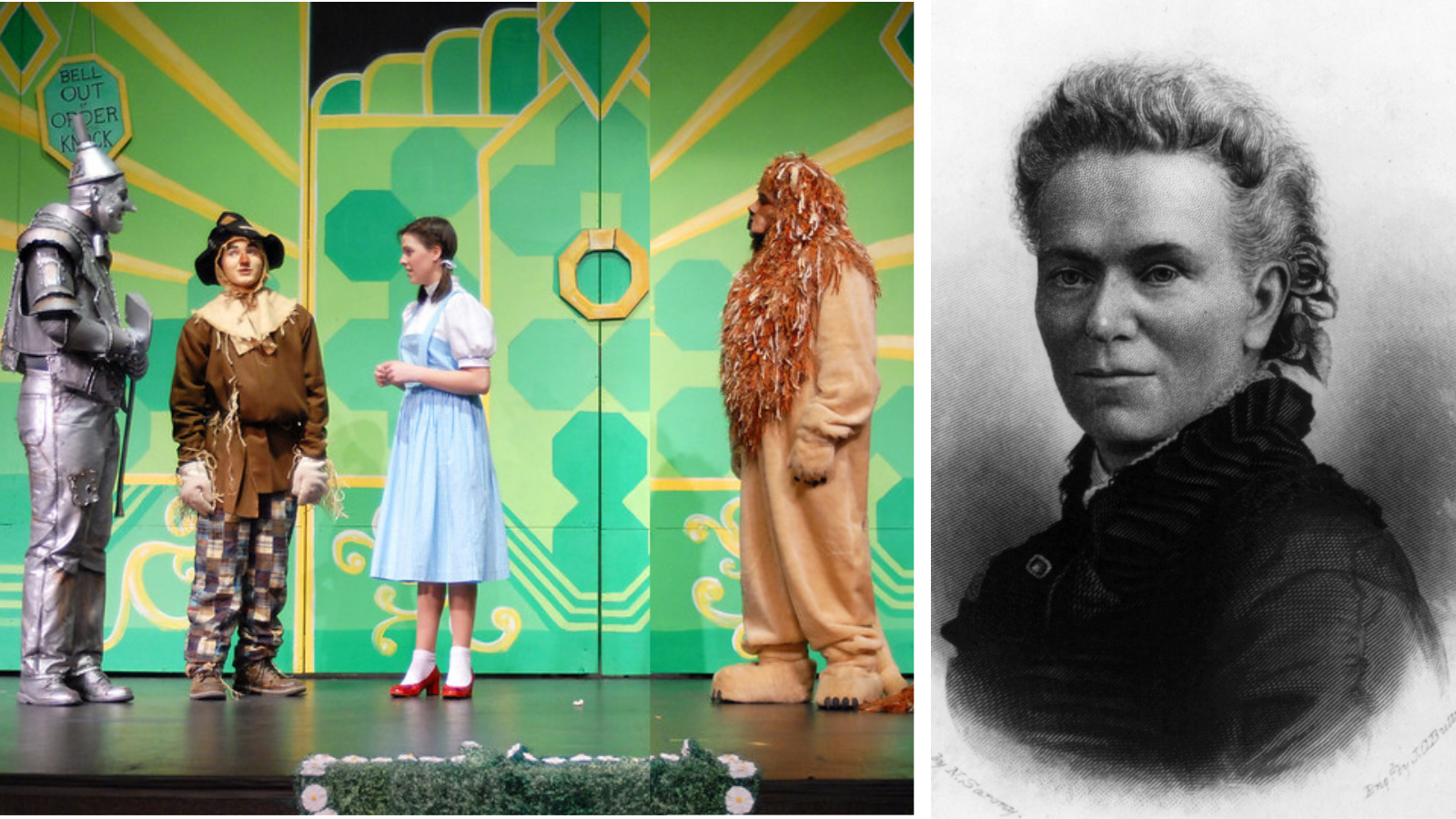
Matilda Joslyn Gage
1826 -1898
Matilda Joslyn Gage wrote a major book entitled Woman, Church and State (1893), which is now considered an essential feminist treatise.
It was a blistering critique of patriarchy.
AND HERE IS WHERE HER VIEWS AND A FICTIONAL STORY INTERSECT IN A MOST SURPRISING WAY.
Breaking News!
(for most of us, at least)
The radical feminist, Matilda Joslyn Gage, was the mother-in-law of L. Frank Baum.
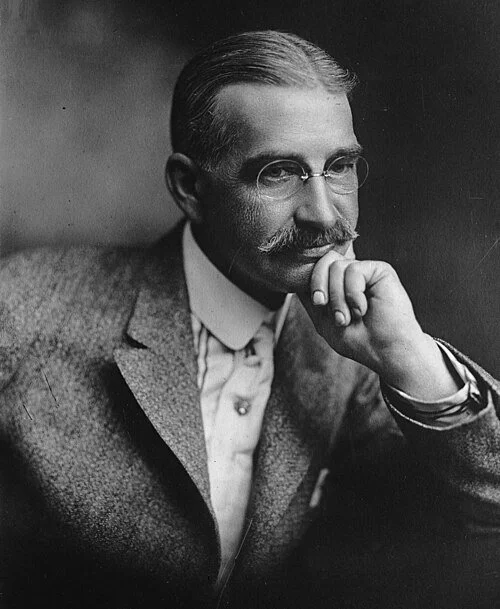
Lyman Frank Baum
1856 - 1919
L. Frank Baum was the author of:
The Wonderful Wizard of Oz. [5][6]
Family Ties
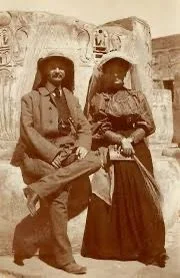
Matilda’s youngest daughter Maud and L. Frank were married in 1882.
l
L. Frank and Maud
After Matilda's husband Henry died in 1884, she frequently lived with her daughter and son-in-law. [5]
A significant fact:
L. Frank Baum and his mother-in-law had a wonderful relationship.
Frank loved and respected Matilda.
He valued her guidance and was deeply influenced by her feminist views, especially as he was writing The Wonderful Wizard of Oz.
Matilda could see that her son-in-law was a gifted storyteller. She urged him to write down the bedtime tales she heard him spinning, not only for his own children (her grandchildren), but also for the children in their neighborhood who flocked to the Baum home to catch the tales.
She made suggestions.
One was putting a cyclone into a children’s story.
Matilda was the inspiration for much of the story about Oz.
Historians have said that without her, there would have been no WONDERFUL WIZARD of OZ.
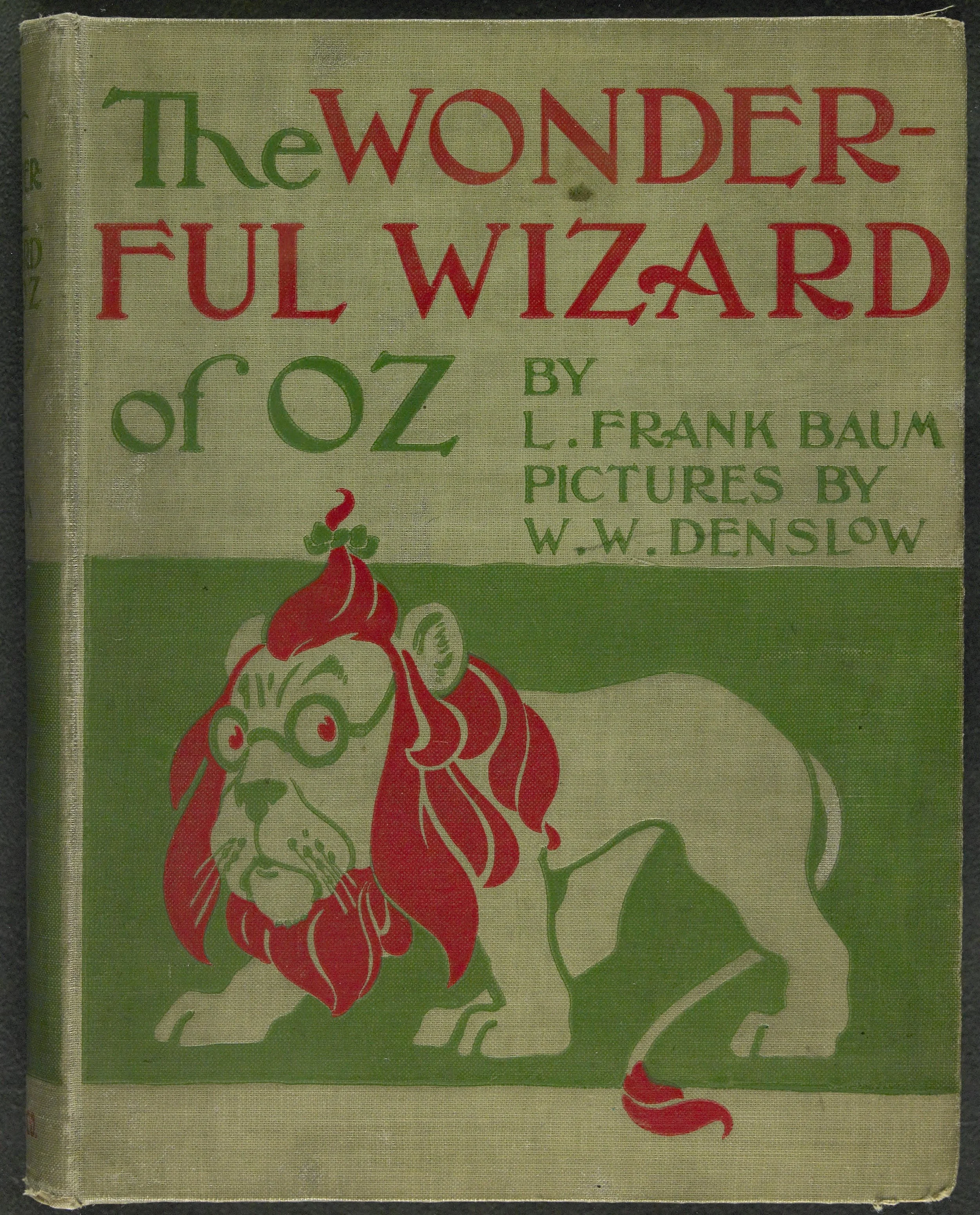
Photo: Library of Congress
Frank absorbed the political ideas Matilda had raised in her book Woman, Church and State.
However, Frank did not just absorb her views.
He actively sought her out as his primary source of creative inspiration, imagination, and artistic energy.
The radical feminist was truly L. Frank’s mentor.
Yet, most of us have likely not heard of Matilda Joslyn Gage.
Even if we had known of her connections to the 19th century feminists, we certainly did not know that her ideas informed the writing of our beloved tale of Oz.
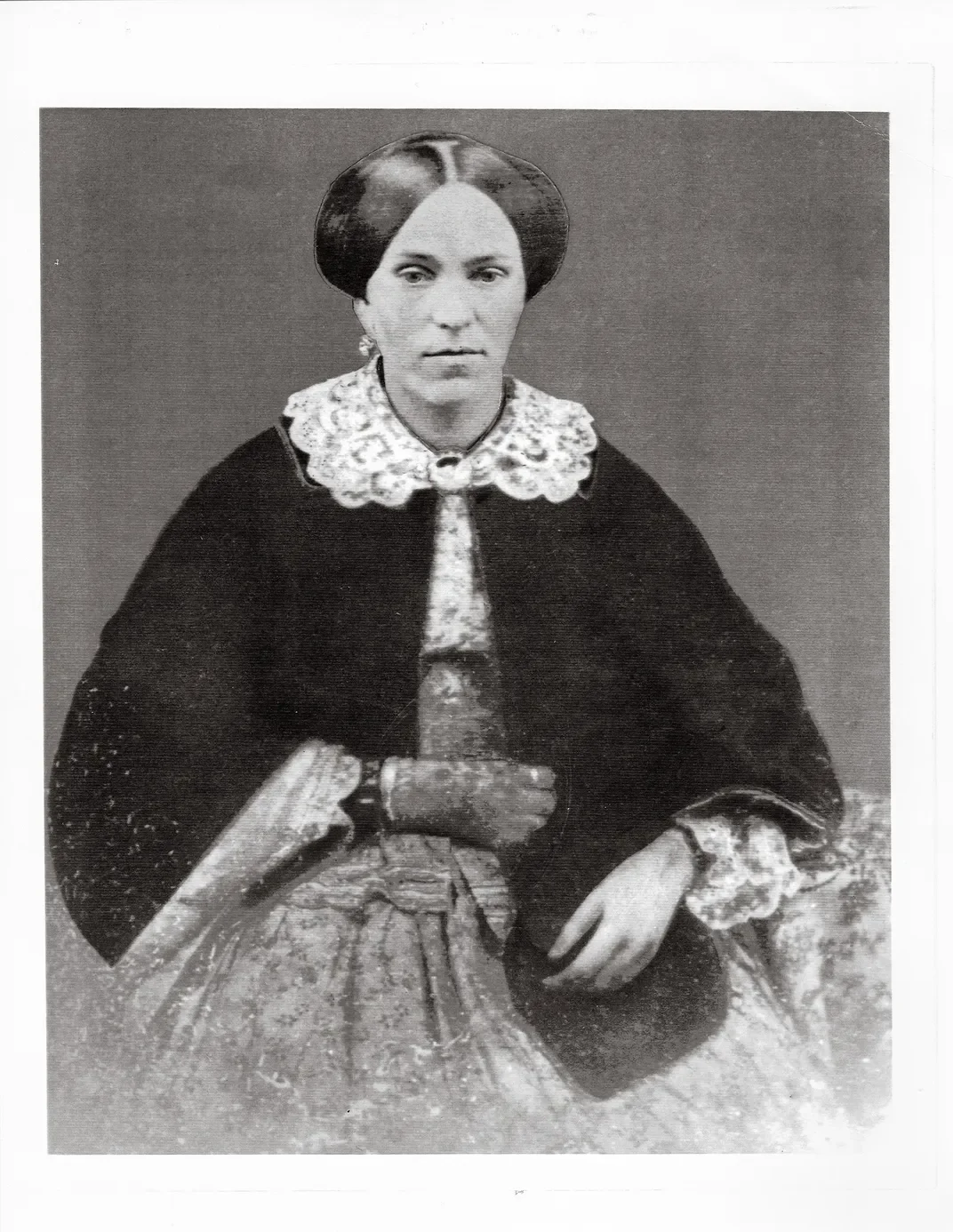
Matilda Joslyn Gage Photo taken during the 1850’s.
And so:
This radical suffragist, abolitionist, and freethinker, shaped L. Frank Baum's worldview and heavily influenced the society and characters in Oz. [6][7]
FUN FACT: The meaning of “radical” is simply “root.” Matilda moved directly to the root of issues, finding that root in patriarchy and its institutions.
So, truth be told, The Wonderful Wizard of Oz is a feminist story!
It is also an abolitionist tale of freedom from tyranny!
The original Wizard of Oz book, which was published on May 17,1900, is widely considered by literary historians to be the first feminist American children's book.
This is because:
—its focus is on a self-reliant young girl.
—“The Land of Oz,” in the original story and in official sequels, features a world governed almost entirely by powerful women, a setting that was revolutionary for 1900. [8]
~~~~~~~~~~
How Matilda’s Ideas Shaped Specific Characters in Oz
The Witches of Oz
Matilda Joslyn Gage completely reimagined the concept of a "witch." [8][9]
In her foundational 1893 feminist treatise, Woman, Church and State, Matilda wrote about how society historically persecuted and demonized independent women as "witches.” [4]
The Holocaust of Women
She dedicated an entire, massive chapter in her book to the history of the European and American witch trials, which took place mainly between 1300 and 1750, with a major peak from 1580 to 1630.
The American witch trials occurred mostly in colonial New England during the 17th century. The most intense and well-known outbreak were the Salem witch trials which occurred in colonial Massachusetts from February 1692 to May 1693 .[10]
Matilda asserted that those women who were killed were not evil. [11][12]
What effect did Matilda’s assertions have on the witches in the story of the World of Oz?
Before L. Frank Baum, Western folklore almost exclusively portrayed witches as ugly, evil crones.
Matilda’s definition of a witch as a wise, knowledgeable woman directly inspired L. Frank Baum's depiction of both benevolent and wicked witches. [13]
A Break with Tradition
The Duality of Witches in the Oz Story
Because L. Frank was greatly influenced by Matilda’s view of witches as "wise women," he fractured the archetype of ugly, evil witches by introducing the Good Witches, showing that female power itself was not inherently evil. [2][14]
A Significant Subversion
What L. Frank Baum did was to subvert centuries of fairy-tale archetypes by adopting Matilda Joslyn Gage’s view and creating powerful women who wielded magic.
Who Were the Original Witches of Oz?
In the book, The WONDERFUL WIZARD of OZ, there are four witches, each corresponding to one of the four Cardinal Directions of the compass. [15]
Two of the witches, those who live in the North and South, are good witches. The two who dwell in the East and West are wicked.
Following are the four witches of the original story.
Photos: Library of Congress, public domain, L. Frank Baum, The WONDERFUL WIZARD of OZ [25]
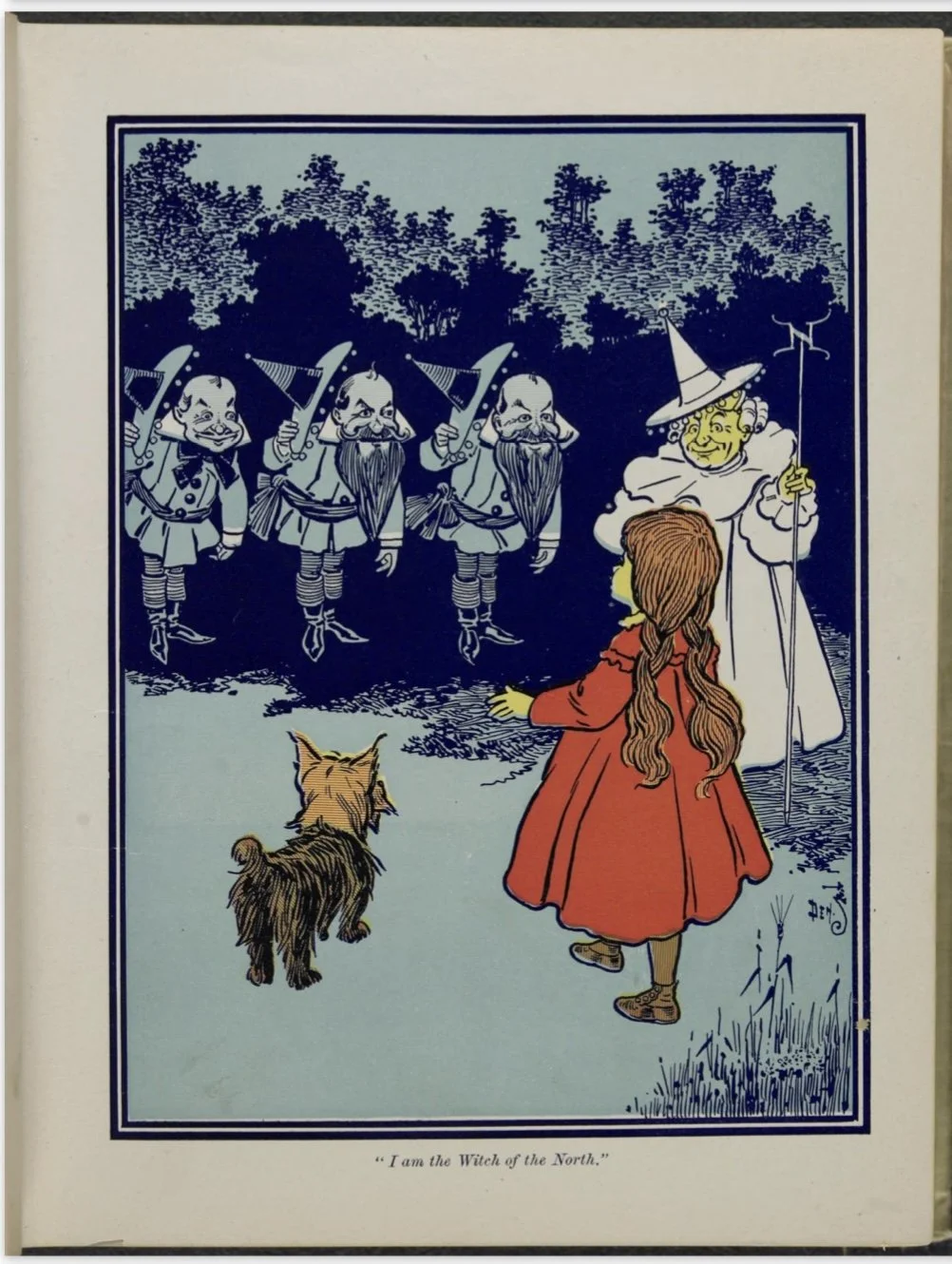
The Good Witch of the North: the kind, elderly witch who greets Dorothy in Munchkin Country and gives her the protective kiss on the forehead.
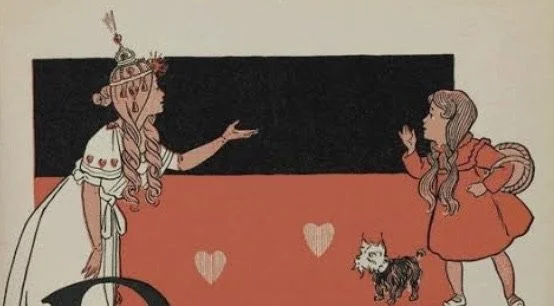
The Good Witch of the South (Glinda): the beautiful and highly powerful witch who shows Dorothy how to use the silver shoes to get home. (Dorothy’s shoes are silver, not red, in the book.)
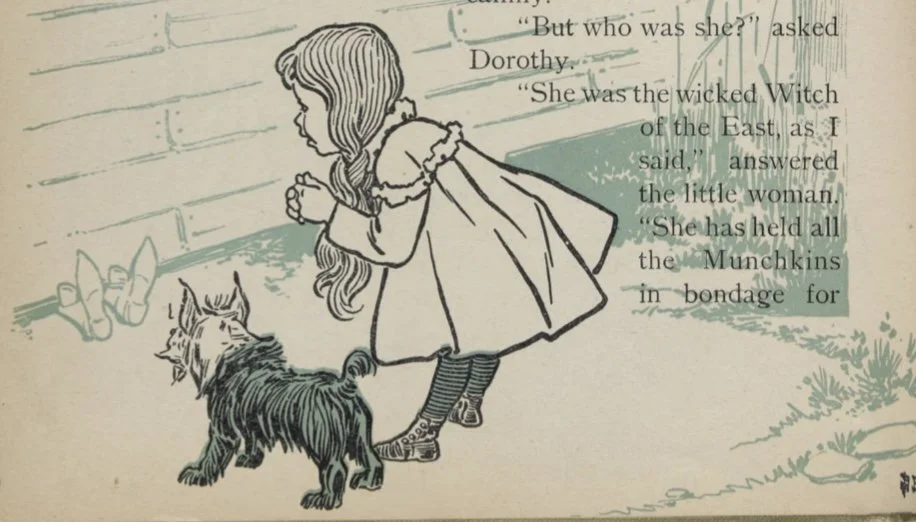
The Wicked Witch of the East: the tyrant who enslaved the Munchkins until Dorothy’s house accidentally lands on her and kills her.
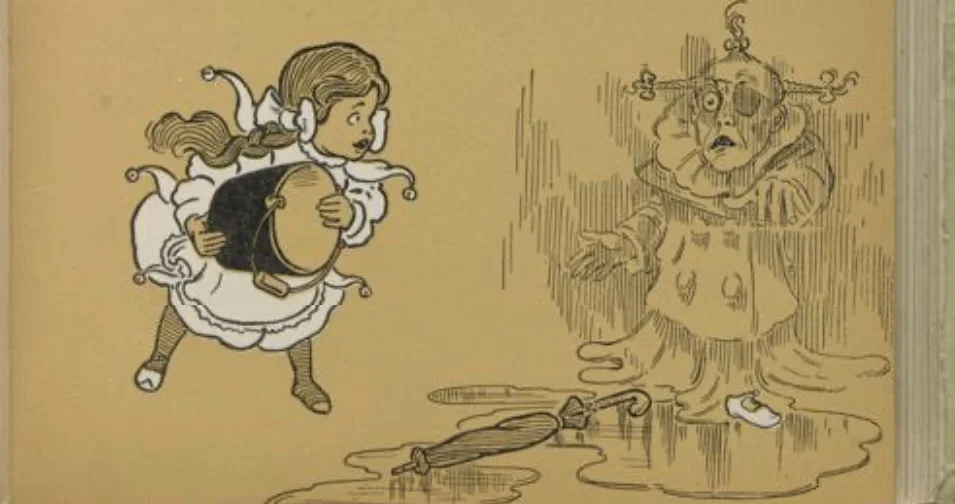
The Wicked Witch of the West: the main villain who commands the winged monkeys, and melts when Dorothy throws water on her. [15][16]
How the 1939 Movie Changed the Witches
In the classic 1939 Metro-Goldwyn-Mayer film adaptation, filmmakers simplified the story by conflating the four witches into only three.
Filmmakers combined the two good witches into one character, Glinda, who is referred to as the Good Witch of the North instead of the South.
Glinda represents the idealized version of Matilda’s "wise woman" archetype who rules with wisdom and compassion.
FUN FACT #1: Glinda
L. Frank Baum modeled the character of Glinda, the Good Witch in large part on his mother-in-law Matilda Joslyn Gage.[8 ]
FUN FACT #2: ”The Wiz”
The 1975 Broadway hit play “The Wiz,” the creative, culturally specific reinterpretation of Baum’s original story, brought back the four Cardinal witches, and gave them names:
Addaperle, the Good Witch of the North.
Evvamean, The Wicked Witch of the East, a cruel tyrant who terrorized the munchkins, and on whom Dorothy’s house lands.
Evillene, the Wicked Witch of the West, a tyrannical boss who commands the flying monkeys and demands total submission from her slaves.
Glinda, the Good Witch of the South, the ultimate elegant, powerful beacon of maternal love.
FUN FACT #3: ”Wicked”
How the book, play, and film, “Wicked,” by Gregory Maguire are deeply connected to the views of Matilda Joslyn Gage:
In Gregory Maguire’s 1995 novel, “Wicked: The Life and Times of the Wicked Witch of the West,” upon which the play and film are based, the themes of Matilda Joslyn Gage’s feminist treatise Women, Church, and State are intertwined.
Gregory Maguire brought back Matilda’s original arguments in full force in his novel.
In her own book, Matilda had raised the radical historical argument that witch hunts were intentionally weaponized by the church and state to systematically strip independent, intelligent women and female healers of their societal power.
The entire premise of the book,Wicked, is a political and philosophical exploration of how an authoritarian, patriarchal state (the Wizard's regime) intentionally manufactures a "Wicked Witch" scapegoat to suppress a politically active, intelligent woman (Elphaba) who is fighting for the rights of marginalized populations.
~~~
Before Oz, children's stories typically featured passive heroines who needed to be rescued.
Dorothy's Autonomy
Dorothy, instead, is a fiercely independent, self-reliant, though ordinary, girl who embarks on a hero's journey, makes her own alliances, slays tyrants, and rescues her friends.
She is an active protagonist.
Unlike classic fairytales where princesses wait around to be rescued by a prince, The Wonderful Wizard of Oz completely flips traditional fairy tale roles by having an ordinary young girl act as the savior who rescues three male figures.
Dorothy does not wait to be rescued. Instead, her three male companions rely heavily on her courage, emotional intelligence, and quick thinking to survive their journey.
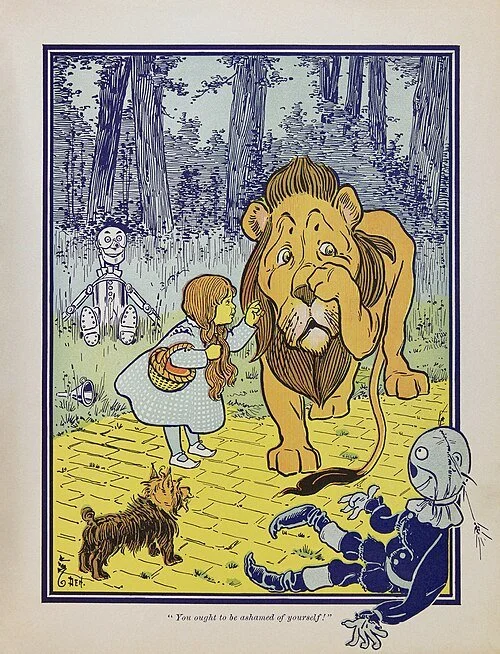
Dorothy ultimately saves herself, using her own hidden potential. [8]
Her independence is a direct reflection of Matilda Joslyn Gage's progressive ideals regarding the liberation of girls and women.
~~~
The Wizard
In L. Frank Baum’s book, the Wizard is exposed as a charlatan who forces people to wear green-tinted spectacles, coercing them into seeing a reality that does not actually exist.
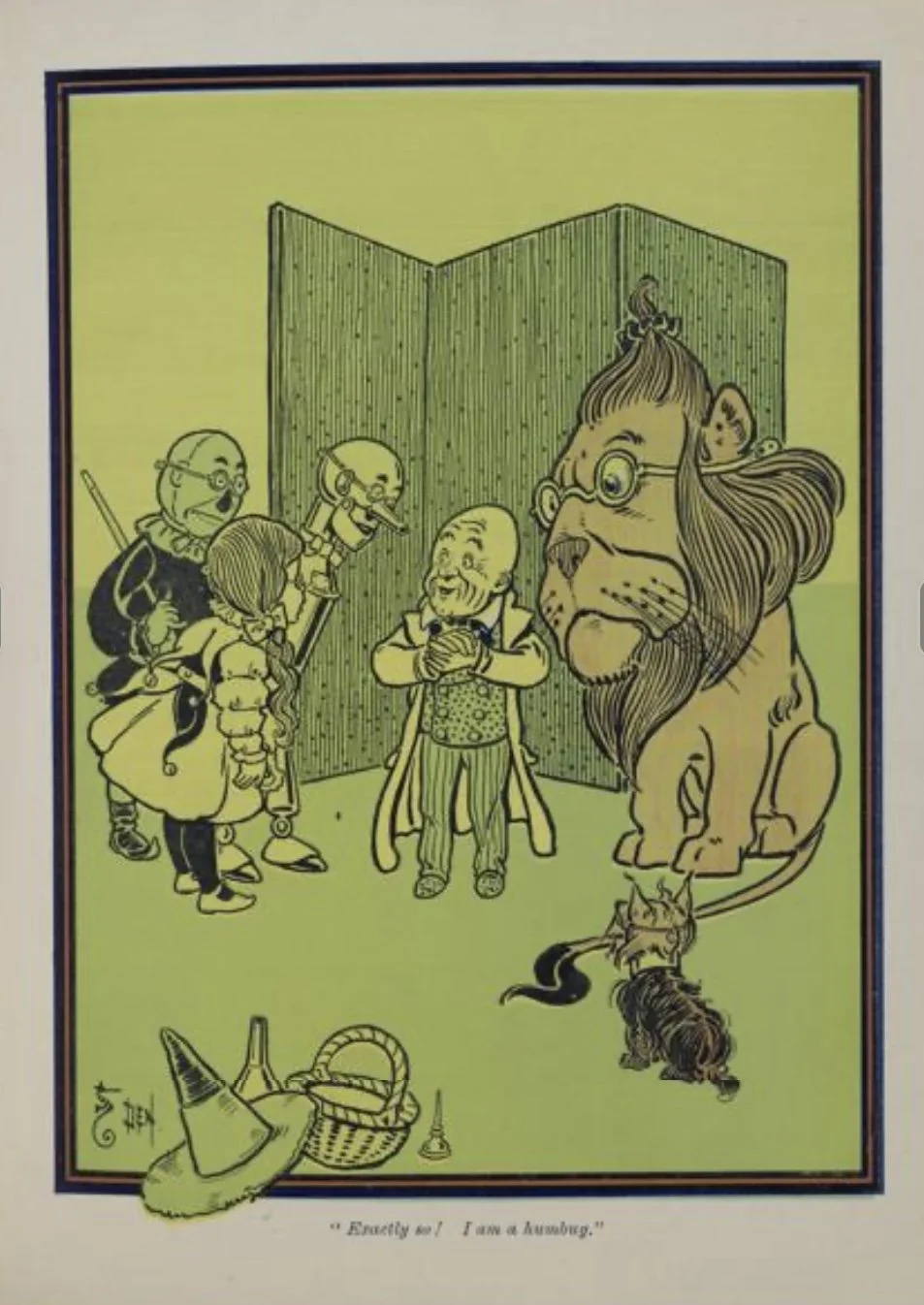
In Baum's universe, the traditional patriarchal figure of authority, who is the Great and Powerful Wizard, is revealed to be a total fraud, a "humbug" who hides behind a curtain because he has no real power.
~~~
The Land of Oz
How the 1939 MGM Movie Stripped Out the Feminist Framework
In L. Frank Baum’s original book, the magical Land of Oz is not a hallucination or a dream (which was an invention of the 1939 MGM movie). It is a very real, tangible place separated from Kansas by a natural, spiritual barrier—the Deadly Desert.
Dorothy is a classic hero who travels to a foreign land, overthrows tyrants, makes her own treaties, and claims her own power.
The Ultimate Narrative Betrayal in the 1939 Film:
"It Was All a Dream"
By turning the entire journey into a delirious fever dream brought on by a bump on the head, the 1939 movie completely invalidated Dorothy's accomplishments.
L. Frank Baum’s novel, The Wonderful Wizard of Oz, was a radical, counter-cultural fairy tale heavily inspired by Matilda Joslyn Gage's matriarchal ideals.
When Metro-Goldwyn-Mayer (MGM) adapted the book into the iconic 1939 film, Hollywood systematically stripped away the book's progressive, feminist framework to align the story with conservative, mid-century American domestic norms. [14] [17]
~~~
The Wonderful Land of Oz
Envisioning A World Without Patriarchy
The Need for a Feminist Perspective
Some Background Context:
Matilda had fought alongside Elizabeth Cady Stanton in 1848 at the Women’s Rights Convention in Seneca Falls, NY against:
The Patriarchal Laws of Coverture
Coverture Laws held that no female person had a legal identity. At birth, a female baby was covered by her father's identity, and then, when she married, by her husband's.
The husband and wife became one, and that one was the husband. As a symbol of this subsuming of identity, women took the last names of their husbands.
Coverture was the legal doctrine that treated a married woman’s possessions, wages, body and children as property of her husband, available for him to use as he pleased.
Coverture gave husbands total control—from finances and place of residency to wife-beating and marital rape. A wife, as Elizabeth Cady Stanton wrote, was “compelled to promise obedience to her husband, he becoming, to all intents and purposes, her master.”
NOTE: If you wish to learn more about coverture laws and the restrictions they placed on women, check out these two of my previous blogposts:
“PAGES OF OUR LIVES: Women Became Aware,” Written by Anne Andersson, February 10, 2025
“UPON WHAT LAW? What was the legal source of coverture?” Written by Anne Andersson, February 14, 2025
DISTURBING FACT: Coverture laws have ended, but not by a single law or on a single date. Instead the laws were slowly dismantled, piece by piece, through a series of state and federal reforms from the mid-19th century into the late 20th century.
The legal action that removed the last remnant did not occur until 1993 when it criminalized marital rape across all 50 U.S. states.
Seeing a World Without Patriarchy
Matilda Joslyn Gage’s inspiration regarding the Land of Oz came from her association with her Indigenous neighbors.
The Haudenosaunee Model
Living in Cicero and Fayetteville, New York, Matilda was neighbors with the Haudenosaunee (Iroquois) Confederacy.
She observed that Haudenosaunee women enjoyed full legal, political, and social equality.
They controlled their own property, held veto power over going to war, and held the sole authority to select, and depose, clan chiefs. [1][2][18][19]
For Matilda, the Haudenosaunee provided living proof that a matriarchal, egalitarian society was not a utopian myth, but a historically successful reality.
This concept heavily inspired the female-led societies that L. Frank Baum created in the Land of Oz, especially in the sequels. [13][20]
FUN FACT: Adoption into the Wolf Clan
In 1893, Matilda’s deep respect for and defense of Indigenous treaty rights led to her being honorably adopted into the Wolf Clan of the Mohawk Nation.
She was given the name Ka-ron-ien-ha-wi, meaning "Sky Carrier" or "She who holds the sky". [3]
~~~~~~~~~~~~
The Spiritual Path
Theosophy

Rather than a Christian framework of heaven, hell, and sin, Oz is built entirely on Theosophical metaphysics. [21]
The Theosophical Connection
To replace the traditional religious structures they had rejected, both Matilda and Frank turned to Theosophy, an esoteric spiritual movement founded in 1875 by Madame Helena Blavatsky.
Theosophy blended Eastern religions (like Hinduism and Buddhism) with Western mysticism, science, and philosophy.
The Path to Enlightenment
(The Yellow Brick Road)
In Theosophy, the human soul must embark on a "Perilous Journey" or pilgrimage through the material world to attain higher spiritual evolution.
The Yellow Brick Road represents this spiritual path. [21][22]
The Triad of the Soul
(Scarecrow, Tin Man, Lion)
Theosophy teaches that the human ego must harmonize different spiritual attributes to achieve wholeness.
In a Theosophical interpretation:
The Scarecrow represents the Manas (Intellect/Mind).
The Tin Woodman represents the Buddhi (Heart/Soul/Compassion).
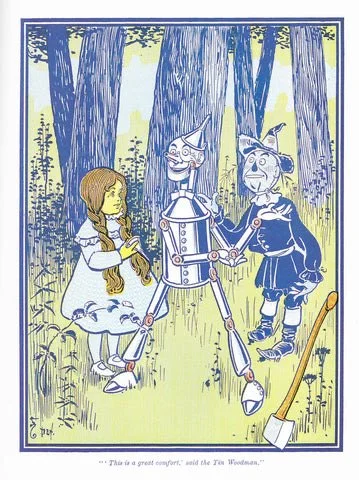
The Cowardly Lion represents the Kama (Willpower/Courage to overcome base desires).
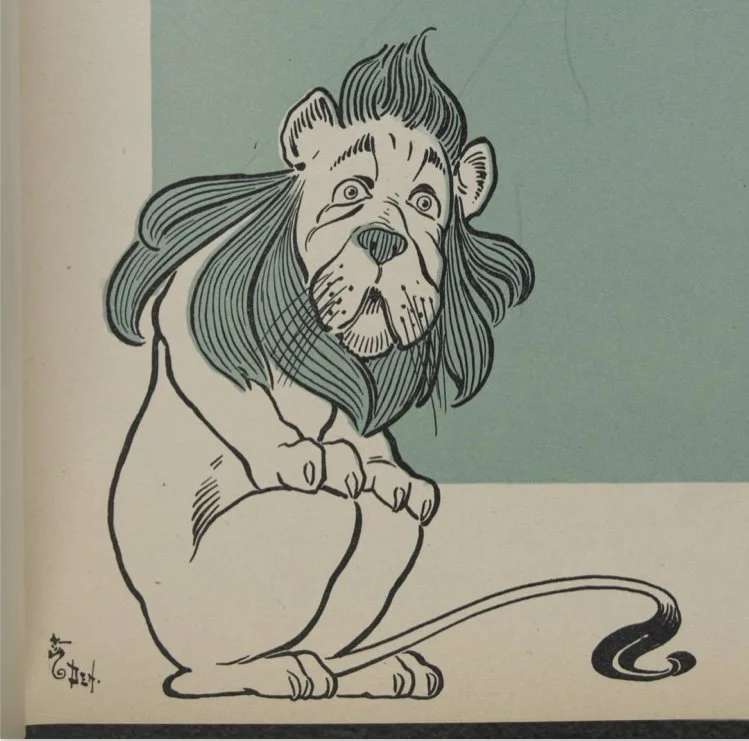
Dorothy cannot ascend or find her way "home" until she integrates all three facets of her spiritual self. [22]
Because L. Frank Baum was a dedicated member of the Theosophical Society, the entire story is widely analyzed as a spiritual allegory for the soul's journey toward enlightenment.
Toto
In a Theosophical interpretation, Dorothy’s dog Toto represents the inner voice of intuition, instinct, and uncorrupted consciousness.
Within the framework of Theosophy, Toto represents the primitive, instinctual part of the psyche that is closest to nature.
Toto is never fooled. He is the one who senses danger, barks at the scarecrow, and ultimately pulls back the curtain to expose the Wizard as a fraud.
In Theosophy, this symbolizes how pure intuition can easily pierce through the false authority of the material world. [23]
~~~
Rejection of a Male Image of God
Theosophy taught that the Divine was a genderless, universal spiritual principle, rather than an angry, patriarchal old man in the sky.
This perfectly aligned with Matilda’s feminist critique of that image in Christian circles.
This same critique was reiterated 80 years later by radical feminist philosopher and theologian, Mary Daly, in her 1973 book, Beyond God the Father: Toward a Philosophy of Women’s Liberation.
Although Matilda Joslyn Gage was active during first-wave feminism and Mary Daly during feminism’s second wave, Daly explicitly recognized Gage as a pioneering foremother of radical feminist theology.
Mary Daly synthesized the dynamic of the male God into this simple, but profound phrase:
"If God is male, then the male is God."
A personal digression that I cannot resist sharing:
The Wizard of Oz story has been a favorite of my family and family friends. It holds a special place in our collective heart.
When our middle son Michael was in Weston High School in CT, the school drama club, “Company”, of which he was a member, put on a rendition of the Broadway play “The Wiz” in 1986.
Michael was cast as the Cowardly Lion.
Two of Michael’s very close friends—then and now—were also cast in the significant roles of the Scarecrow and Glinda.
This was a talented cast of high school kids: Today Kyle (the Scarecrow) is an Emmy-award winning comedy writer, actor, and stand-up comedian. Karen (Glinda) shares her beautiful voice to weddings and other events. Michael (the Cowardly Lion) does solo vocal performances at a Manhattan cabaret spot, as well as solo charitable benefit performances.
A Coincidence That One Could Not Invent
Ten years after the three friends performed in “The Wiz” in Weston High School, Michael’s younger brother David, who is 16 years his junior, was in a drama summer camp in Westport, CT when he was nine years old.
In 1996, the camp directors put on a rendition of The Wizard of Oz, casting David as the Scarecrow!
Coincidentally, the directors chose Weston High School as the performance space for the campers.
So, David, to use theatre lingo, “walked the boards,” (or to state it more accuratedy, “danced the boards”) as the Scarecrow on the very same stage where his older brother Michael had performed as the Lion 10 years earlier.
One cannot make up these coincidence stories!
As for me (Anne), I am thrilled to learn that The Wizard of Oz story is, in truth, a feminist and an abolitionist tale.
I am especially grateful to learn of its development by L. Frank Baum, in collaboration with his mother-in-law, radical feminist Matilda Joslyn Gage, yet I am disappointed that her contributions have remained virtually invisible all these years.
I am pleased that Gloria Steinem was, and Matilda’s descendants are, actively working on righting that wrong.
I am amazed at the political expertise of Gregory Maguire’s novel, “Wicked” in bringing back Matilda’s views as she expressed them in her feminist treatise Women, Church and State.
I plan to read Maguire’s book more thoroughly, and head to Broadway to see the play Wicked again with new eyes.
~~~~~~~~~~~~
Gloria Steinem made it a mission to restore Matilda to her rightful place among the women of the feminist movement who fought for women’s rights and for the dismantling of the laws of coverture. Gloria personally and actively supported the Matilda Joslyn Gage Center in Fayetteville, NY.
*The "Matilda Effect"
and
Gage's Historical Erasure
Matilda Joslyn Gage argued in her lifetime that women’s intellectual, scientific, and political achievements were being systematically buried by men.
In 1883, Matilda published a groundbreaking essay entitled "Woman as an Inventor." [26]
In it, she documented how women invented or heavily contributed to civilization-shifting technologies (like the cotton gin) but were denied patents, stripped of credit, and written out of textbooks. [24]
A century later, history proved her entirely right by erasing her, as well.
The Coining of the Term:
In 1993, Dr. Margaret W. Rossiter, a prominent historian of science, noticed a persistent bias where female scientists' discoveries were routinely credited to their male colleagues.
To describe this systemic suppression, Rossiter coined the term "The Matilda Effect" naming it directly in honor of Matilda Joslyn Gage.
It wasn't until Matilda Joslyn Gage's induction into the National Women's Hall of Fame in 1998, combined with the popularization of Rossiter's "Matilda Effect," that historians began recovering her vital legacy.
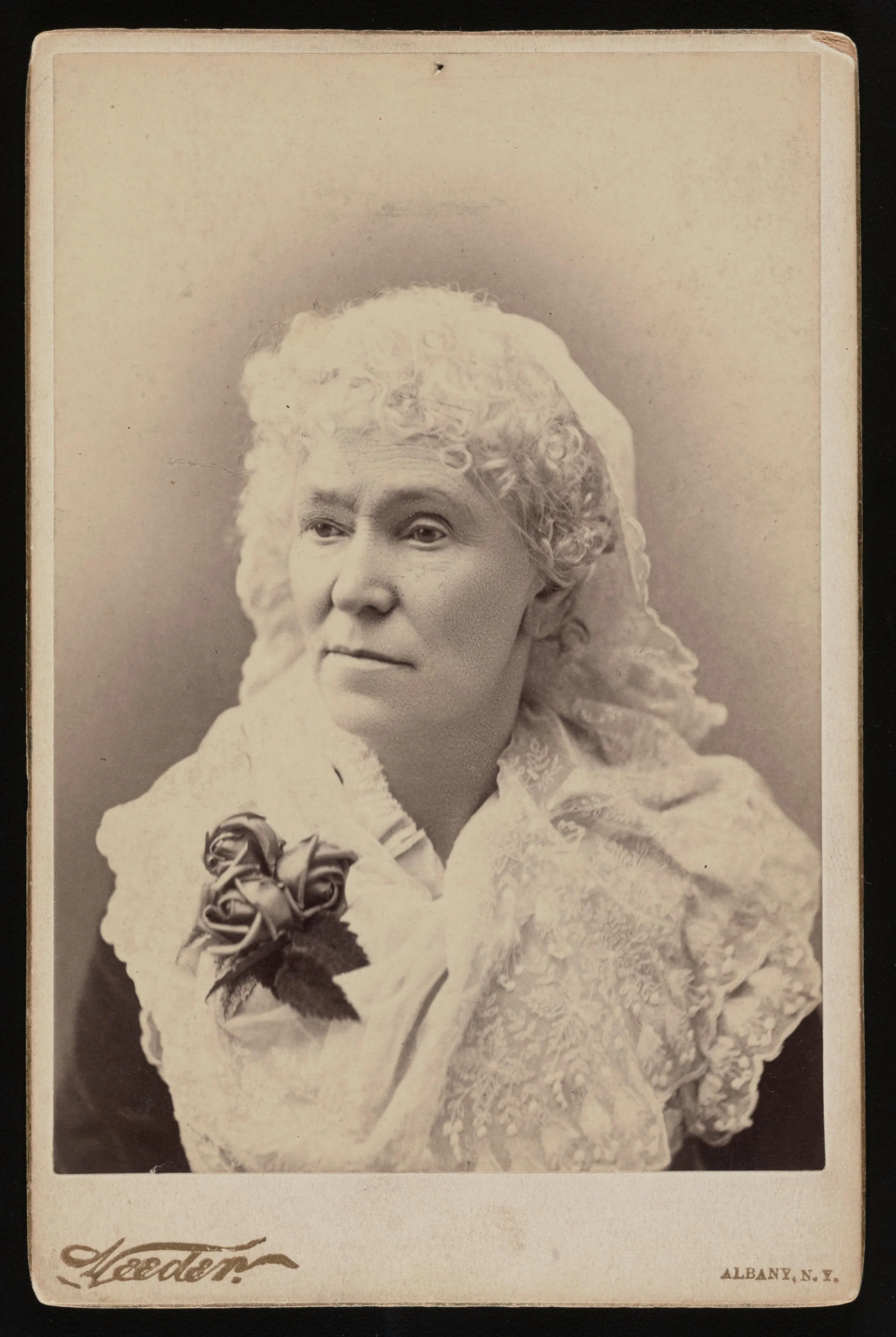
This photo was taken around 1892. Matilda was approximately 66 years old.
RESOURCES
National Park Service, Sally Roesch Wagner, “How Native American Women Inspired the Women’s Rights Movement.”
https://www.nps.gov/articles/000/how-native-american-women-inspired-the-women-s-rights-movement.htm; Also: Ms. Magazine 8/18/2020
The New York Historical, Central Park West, New York City, March 1, 2023, Staff, “The Feminist of Oz” https://www.nyhistory.org/blogs/the-feminist-of-oz
National Trust for Historic Preservation, Where Women Made History, September 28, 2017, Sally Wagner, “Telling a Different Story on the Anniversary of Women’s Suffrage.”
https://savingplaces.org/stories/telling-a-different-story-on-the-anniversary-of-womens-suffrage
Ms. Magazine, March 29, 2021, Jamie Jordan, “The Radical Feminist Behind the Curtain.” https://msmagazine.com/2021/03/29/wizard-of-oz-matilda-joslyn-gage-suffrage-feminist/
Advance Media New York, December 30, 2024, originally published in 2010, Sue Boland, Matilda Joslyn Gage Center, “Wicked influence: Meet the Central NY woman who inspired the witches from Oz. https://www.syracuse.com/living/2024/12/wicked-influence-meet-the-central-ny-woman-who-inspired-the-witches-from-oz.html
National Park Service, Ella Wagner, Cultural Resources Office of Interpretation and Education. “Matilda Joslyn Gage.”
Video, “Matilda Joslyn Gage’s Influence on L. Frank Baum,”OzCon’s Dina Massachi moderates a discussion with biographer Angelica Carpenter and Matilda’s descendant Gita Morena on how radical suffragist Matilda Joslyn Gage, mother-in-law to the creator of Oz, influenced his life and work.
History News Network with partner project Bunk at the University of Richmond, June 24, 2018, David B. Parker, “Was the “Wizard of Oz” a Feminist Tract?” https://www.hnn.us/article/was-the-wizard-of-oz-a-feminist-tract
Smithsonian Magazine, December 2024, Evan I. Schwart, “The Feminist Who Inspired the Witches of Oz.” https://www.smithsonianmag.com/history/the-feminist-inspired-witches-of-oz-180985334/
UC Berkely Law, The Robbins Collection Research Center, “Witch Trials in Early Modern Europe and New England.” https://www.law.berkeley.edu/research/the-robbins-collection/exhibitions/witch-trials-in-early-modern-europe-and-new-england/
FEMINISM AND RELIGION, Mark I. West,”The Connection between Matilda Joslyn Gage’s Woman, Church and State and L. Frank Baum’s The Wonderful Wizard of Oz.”https://feminismandreligion.com/2024/08/22/the-connection-between-matilda-joslyn-gages-woman-church-and-state-and-l-frank-baums-the-wonderful-wizard-of-oz-by-mark-i-west/
Manifold @CUNY, Project Gutenberg, Women, Church, and State, Turgut Dincer, Contributor, Suzanne Shell, Contributor, Matilda Joslyn Gage, Author, “The Original Exposé of Male Collaboration Against the Female Sex. https://cuny.manifoldapp.org/projects/women-church-and-state
HistoryNet LLC, 9/24/2009, Evan I. Schwartz, “MATILDA JOSYLN GAGE – THE UNLIKELY INSPIRATION FOR THE WIZARD OF OZ.” https://historynet.com/matilda-josyln-gage-the-unlikely-inspiration-for-the-wizard-of-oz/
Gina Luttrell Blog, published by Gina Luttrell, December 7, 2024, “The Hidden Feminist Legacy in The Wizard of Oz”
https://ginaluttrellphd.com/2024/12/07/the-hidden-feminist-legacy-in-the-wizard-of-oz/
PLAYBILL, APRIL 02, 2024, LOGAN CULWELL-BLOCK,”The Wizard of Oz, Wicked and The Wiz: 3 Takes On an American Classic” https://playbill.com/article/the-wizard-of-oz-wicked-and-the-wiz-3-takes-on-an-american-classic
Wikipedia, Wicked Witch of the West. https://en.wikipedia.org/wiki/Wicked_Witch_of_the_West
CBE International, July 13, 2013, Susan Harris Howell, “The Wizard of Oz: A Counter-Cultural Tale.”https://www.cbeinternational.org/resource/wizard-oz-counter-cultural-tale/
Oneida Indian Nation. “Haudenosaunee Women and Equality” https://www.oneidaindiannation.org/haudenosaunee-women-and-equality
100 A Centennial of Women’s Suffrage, “HOW THE IROQUOIS AND OTHER INDIAN NATIONS HELPED TO SHAPE THE VISION OF WOMEN AS EQUALS.”https://www.suffragettes2020.com/resources/native-american-and-american-indians
MAPPING THE DOCTRINE OF DISCOVERY, Season 1, Episode 4, August 3, 2022, Adam DJ Brett,“Haudenosaunee Influence on the Women’s Rights Movement with Sally Roesch Wagner.”https://podcast.doctrineofdiscovery.org/season1/episode-04/
The Theosophical Society in America, Algeo, John. "Oz as Myth and Mysticism." Quest Magazine 88.6 NOVEMBER-DECEMBER 2000): pg 219-222.
https://www.theosophical.org/publications/quest-magazine/sp-325071756
THE BLUEGRASS SPECIAL, October, 2009. Wayne Purdin, “L. Frank Baum's Wizard of Oz Theosophical Foundations, https://www.thebluegrassspecial.com/archive/2009/october2009/oztheosophyoct09.html
The Theosophical Society in America, Andrew Johnson “The Spirituality of Oz: The Meaning of the Movie” Quest Magazine 88.6 NOVEMBER-DECEMBER 2000): pg 212-217. https://www.theosophical.org/publications/quest-magazine/sp-325071756
Wikipedia, “Matilda effect.” https://en.wikipedia.org/wiki/Matilda_effect
Library of Congress, Public domain photos, L. Frank Baum’s book The WONDERFUL WIZARD of OZ.
https://www.loc.gov/resource/rbc.2006gen32405/?sp=185&r=-0.154,0.553,1.117,1.382,0
Harvard University Viewer, ”Woman as Inventor.” https://viewer.lib.harvard.edu/viewer/URN-3:FHCL:453551?n=1
— The Matilda Joslyn Gage Center, 210 East Genesee Street, Fayetteville, NY 13066, (315) 637-9511) Website: matildajoslyngage.org, The Oz Parlor is restored to honor the marriage of L. Frank Baum and Maud Gage, which took place in this exact room in 1882. [1, 2]
https://www.matildajoslyngage.org/
—THE INTERNATIONAL L. FRANK BAUM & ALL THINGS OZ HISTORICAL FOUNDATION, All Things Oz Museum. 219 Genesee Street, Chittenango, NY 13037
COMMENTS
PREVIOUS POST: “Stonehenge of America,” written by Anne Andersson, October 16, 2026.
— Thank you, Anne. This was so interesting. You did a great job explaining the movements of the moon. Thank you so much for the special place and honor you gave to my sister Lucy. She had trouble walking and, even so, she walked to the golf course every day, taking her lunch with her and sitting by those mounds. I didn’t know that those Native grounds had received UNESCO approval and are now a UNESCO World Site. That’s really wonderful! —Eleanor Rae
—I really liked the mounds post! 😊 Especially: The people who built the Hopewell Earthworks were egalitarian. They lived in small, peaceful, spread-out farming hamlets. They had no centralized government, no kings, and no standing armies. 🥰🥰🥰 —MA
—Thank you for a wonderful article. It is so rich in so many disciplines: religion, sociology, math, science, history and much more. Will the work of the heroines and UNESCO have to be repeated for each site? —RE
Response by Anne Andersson: Under UNESCO, each of the mound sites in that area now exists under the umbrella name Hopewell Ceremonial Earthworks UNESCO World Heritage Site. So, they all have collectively received the status of UNESCO World Site.
WE ARE:
THE CENTER FOR WOMEN, THE EARTH, THE DIVINE
C:WED
Dismantling patriarchy and reimagining the Divine to restore and heal the Earth
We explore the parallels that exist between the imaging and treatment of women and of the Earth under patriarchy, and how images of the Divine are related to these parallels.
Join us in support of our work!
🩷