
Stonehenge of America
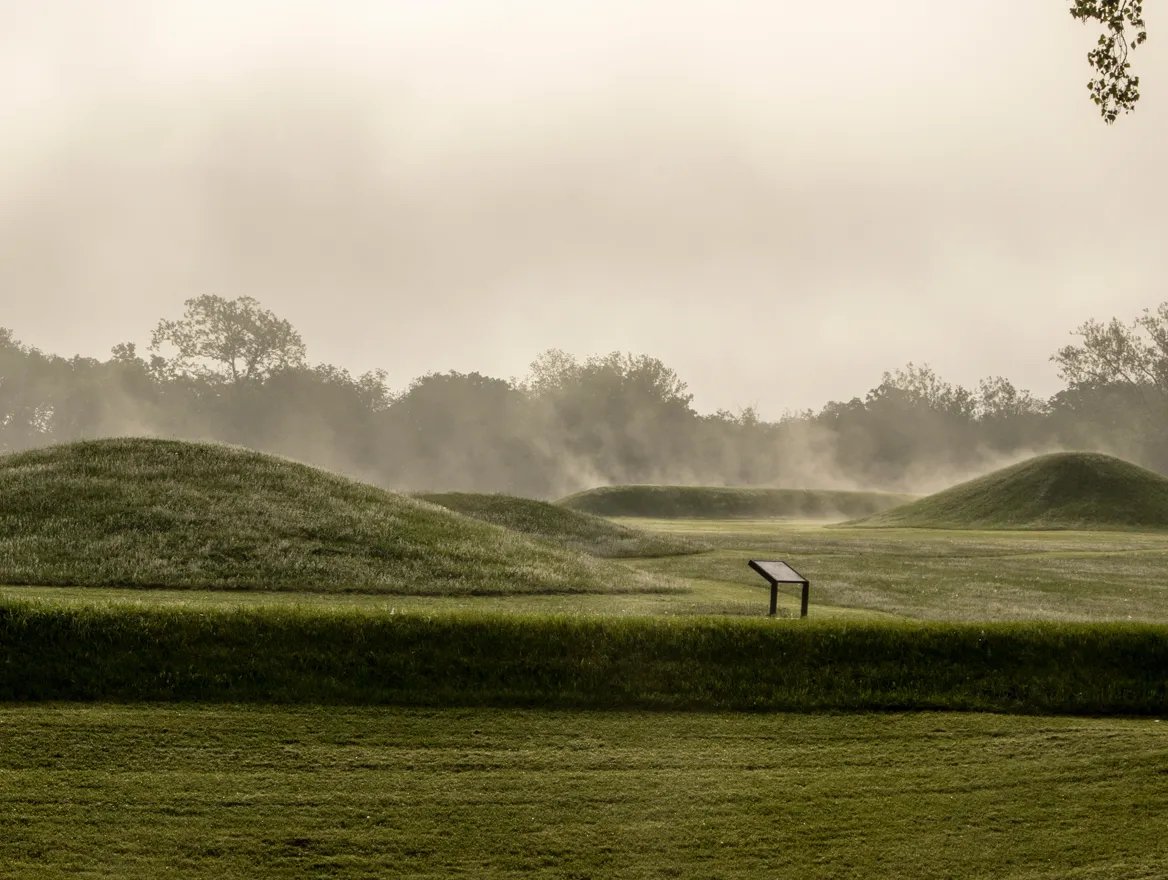
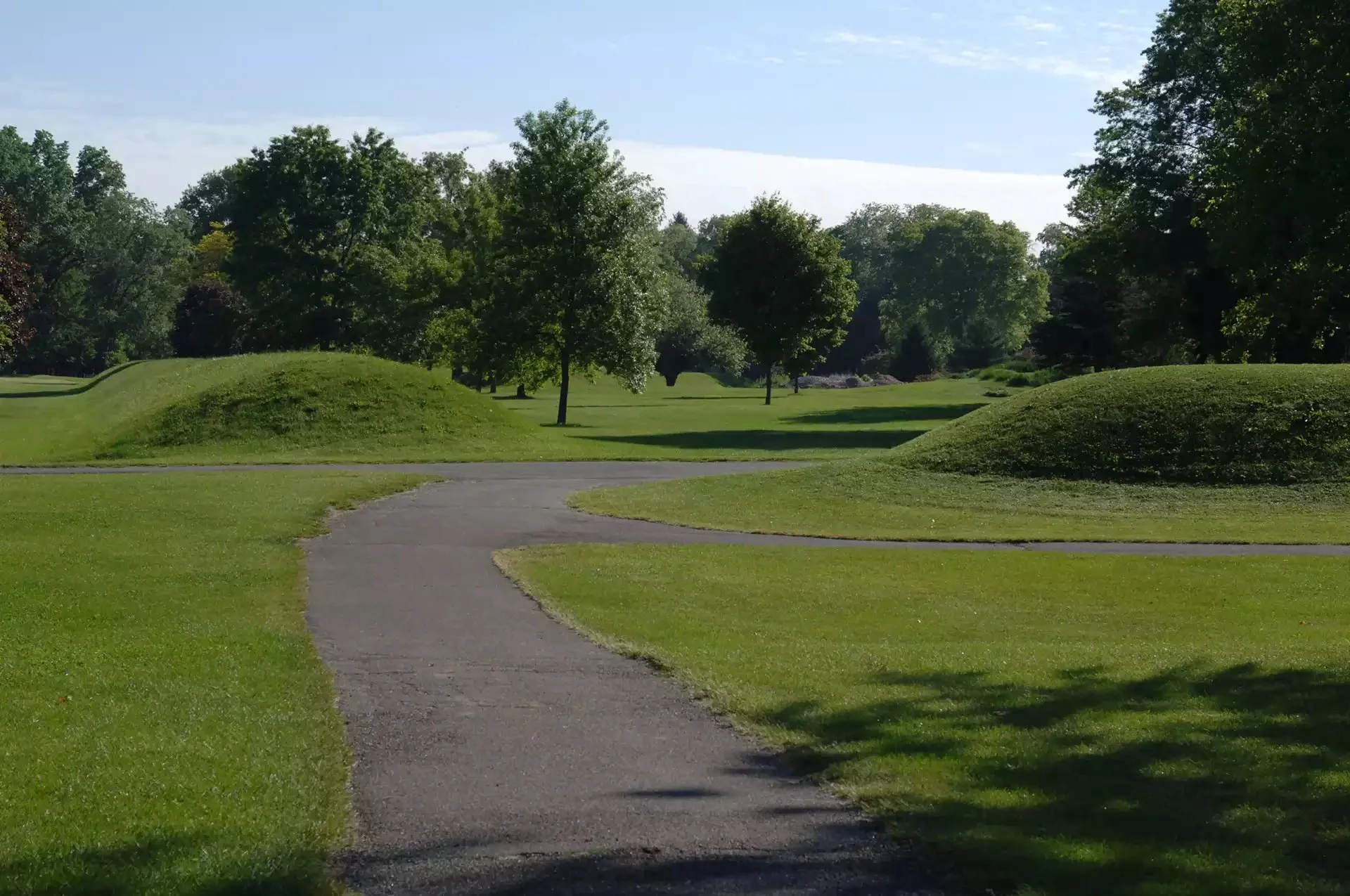
Photo by David Barker
Hopewell Ceremonial Earthworks
While researching the life of Gloria Steinem for my post on her passing on September 2, 2026, I learned that, as she travelled across America, she walked upon sacred landscapes that historical timelines have ignored.
These landscapes are ancient Indigenous earthen mounds. They were built thousands of years ago, not to reach high in the sky, but rather to lie close to, and actually to rise from, the Earth.
The secret of these mounds is that they are physical reminders of a time before the patriarchal order divided us into borders and hierarchies.
Those ancient builders saw the Earth, not as a resource to be conquered, but as a sacred mother whose body carries the geometry of the cosmos.
The sacred mounds harbor another secret.
They have been built with such amazing cosmic calculations that they rival the U.K.’s Stonehenge.
The Indigenous Mounds of North America
Thousands of ancient earthen mounds bear witness to the remarkable civilizations of Indigenous North America.
They exist today in the eastern and central United States, from the Great Lakes and Ohio River Valley to the Mississippi Valley and the Gulf Coast.
Called Earthworks, they were built over many centuries by different Native peoples. They have served as ceremonial and sacred places, burial grounds, gathering spaces, and foundations for important buildings.
Some were constructed in geometric patterns reflecting sophisticated knowledge of mathematics and astronomy.
Among the best-known are the great mound complexes of Ohio and Cahokia, which is near present-day St. Louis, once the center of a flourishing Indigenous city.
These mounds call us to a time long before Europeans arrived, when this continent was home to complex, creative, and spiritually rich societies whose relationships with the Earth shaped their communities and traditions.
Their descendants are living Indigenous peoples whose histories and connections to these places continue today.
Where Earth Meets Sky
The mounds of the Hopewell Earthworks in Ohio deserve particular attention
These earthworks are located on the western side of Newark near the Licking River and Raccoon Creek.
Originally the earthworks complex of circles, squares, octagons, parallel embankments, and circular and elliptical mounds encompassed more than four square miles.
As the City of Newark (founded in 1802) grew during the nineteenth century, large portions of the walls and many of the mounds were destroyed.
Today, the Newark Earthworks includes the Great Circle Earthworks, Octagon Earthworks, and Wright Earthworks and is considered the largest grouping of geometric earthen enclosures in the world.
Likely used as a ceremonial center, the Great Circle Earthworks includes a circular structure surrounding an area of about 26 acres. Roughly 1,200 feet in diameter, the earthwork has 8-foot-high walls. Centered in the circle is the Eagle Mound.
The Octagon Earthworks is 120 acres and features a large octagon and a circular embankment joined by parallel walls about 300 feet in length and 60 feet apart.
Enclosing 50 acres, the octagon has openings at each of its 8 corners; within the octagon opposite these openings are small mounds.
The circle encloses 20 acres. Opposite its entrance, in direct alignment with the parallel walls, Observatory Mound appears to be built across a former gateway; straddling the gateway, the mound is 12 feet tall—8 feet higher than the enclosure walls at that point.
At present, the Octagon Earthworks is also the site of the golf course of the Mound Builders Country Club, founded in 1910.[1]
____________
The Hopewell Ceremonial Earthworks are gigantic earthen enclosures built by American Indigenous people 2,000 years ago. They are masterpieces of human genius.
They are a collective group of eight earthwork regional sites, which were places of ceremony connected to the cosmos by alignments to key risings and settings of the moon and sun.
Stonehenge in America?
Universally Revered, Globally Recognized
UNESCO World Heritage Sites, such as Stonehenge, The Great Pyramid of Giza, and the Great Wall of China, must have outstanding universal value to humanity.
No matter where they are located, these sites serve to honor and preserve the world’s cultural and natural heritage.
The Hopewell Ceremonial Earthworks is now officially inscribed as a UNESCO World Heritage Site because of the outstanding engineering and cultural genius of these structures,[1]
It is the first and only UNESCO site in the state of Ohio.
UNESCO describes the builders of the Hopewell Earthworks as living in relatively small, dispersed, egalitarian communities that came together to construct enormous ceremonial complexes.
These structures required extraordinary cooperation, mathematical precision, and astronomical knowledge. They are complex masterpieces of landscape architecture.
The huge squares, circles, and octagons, which are geometrically precise and align perfectly with the cycles of the sun and moon, were built by dispersed communities of American [Indigenous peoples] who periodically gathered at these special places to worship and stay connected to one another.
There’s a Story here!
Those were my words to Eleanor Rae one day when I was telling her about the mounds that Gloria Steinem had mentioned when she wrote about her good friend, Cherokee Chief Wilma Mankiller (whose name was an inherited one meaning protector of the village).
Before I could continue, Eleanor stopped me, zeroing in on the word “mounds”. What she had to tell me was quite intriguing.
Eleanor then told me about one of her older sisters, Lucy Donohue, who, at some point quite some time ago, had sat daily near a mound on a golf course in Ohio.
in protest to protect the grounds from being taken over by construction.
Eleanor said that Newark, Ohio sounded familiar as being mentioned by her own family as a site near the location.
Turns out, Newark WAS the location where Lucy had been sitting in protest so long ago.
Eleanor’s family story continues thus: after many weeks of sitting guard, other people joined Lucy in a protest that grew large enough to be covered by The New York Times.[6]
As Eleanor told me, however, the NYT article never mentioned Lucy whom her family had declared was the real initiator of the protest effort. The family thought that Lucy should have been mentioned. in the NYT article.
It seems to me this could be a prime example of what our reader MVT mentioned in her comment on my post on Gloria Steinem:
“I’m sure every woman reading this can identify with at least one incidence where she was ignored, put aside, passed over or had her name left off a minutes list of a meeting where she was the only woman present!.”
The story about the mounds that Lucy Donohue was likely protecting might have been one of the Hopewell locations, known as the Octagon Earthworks in Newark, Ohio.
These earthworks are located on the western side of Newark near the Licking River and Raccoon Creek.
Originally the earthworks complex of circles, squares, octagons, parallel embankments, and circular and elliptical mounds encompassed more than four square miles.
As the City of Newark (founded in 1802) grew during the nineteenth century, large portions of the walls and many of the mounds were destroyed.
Today, the Newark Earthworks includes the Great Circle Earthworks, Octagon Earthworks, and Wright Earthworks and is considered the largest grouping of geometric earthen enclosures in the world.
Likely used as a ceremonial center, the Great Circle Earthworks includes a circular structure surrounding an area of about 26 acres. Roughly 1,200 feet in diameter, the earthwork has 8-foot-high walls. Centered in the circle is the Eagle Mound.
The Octagon Earthworks is 120 acres and features a large octagon and a circular embankment joined by parallel walls about 300 feet in length and 60 feet apart. Enclosing 50 acres, the octagon has openings at each of its 8 corners; within the octagon opposite these openings are small mounds. The circle encloses 20 acres. Opposite its entrance, in direct alignment with the parallel walls, Observatory Mound appears to be built across a former gateway; straddling the gateway, the mound is 12 feet tall—8 feet higher than the enclosure walls at that point.
[Until very recently], Octagon Earthworks was also the site of the golf course of the Mound Builders Country Club, founded in 1910.[1]
___________
The story of the Octagon Earthworks goes back to 18??.
Over the years, and until very recently, the area of the Octagon Eathworks was being used as a semi-private golf club.
At one point, very possibly the protest begun by Lucy Donahue around the year 19?? , blocked the construction of a proposed building on the golf club green.
As the years contnued, the mound area encompassed the golf club. However, through litigation which included compromise, and ultimately a payment to allow the golf club to relocate, the Hopewell Octagon Earthworks was rescued for the Indigenous people in 2023 and is now preserved as a park that is open to public visitors.
The change only occurred at the beginning of 2025 when the Ohio History Connection, the state’s historic organization, won its lawsuit, which enabled it to open the Octagon as a park.
On January 1, 2025, they welcomed a crowd of about 800 people.
~~~~~~~~~~~~
The Hopewell culture itself was a highly sophisticated, widespread network of Native American societies that flourished during the Middle Woodland period (c. 100 BCE - 500 CE)
The culture centered primarily in the Ohio River Valley with nfluence that reached across a vast portion of eastern North America. [1]
They were not a single unified tribe, but rather a collection of distinct communities linked by a shared spiritual ideology, monumental earthwork architecture, and a continent-spanning trade network. [1, 2]
[Rich media excluded from paste]
Key Features of the Hopewell Civilization
Geometric Mastery: Unlike the earlier conical burial mounds or later Mississippian platform pyramids, the Hopewell are famous for carving massive geometric enclosures into the landscape. They built near-perfect squares, massive circles, and octagons out of earthworks that spanned hundreds of acres. [1, 2]
Astronomical Alignments: Modern archaeological surveying reveals that these massive earthen walls were precise astronomical calendars.
Complex layouts like the Newark Earthworks accurately track the highly complex 18.6-year lunar cycle, recording the precise northernmost and southernmost risings of the moon.
The Hopewell Interaction Sphere: They managed one of the most extensive trade networks in ancient history. Excavations in their mounds have uncovered raw materials imported from thousands of miles away: obsidian from the Yellowstone region, copper from the Upper Peninsula of Michigan, marine shells from the Gulf of Mexico, and mica from the Appalachian Mountains. [1]
Masterful Artistry: Hopewell artisans used these traded materials to produce exceptionally fine craftwork.
They hammered copper into intricate animal silhouettes, cut translucent mica into celestial shapes, and sculpted highly detailed stone effigy smoking pipes depicting native birds, otters, and bears. [1, 2, 3]
The astronomical alignments built into the Hopewell Earthworks are among the most staggering achievements of ancient North American engineering.
The Hopewell people did not just build mounds; they mapped the cosmos directly onto the landscape, constructing massive "earthen machines" capable of tracking incredibly complex cosmic cycles. [1]
Their architecture shows a sophisticated understanding of both solar movements and the far more intricate cycles of the moon. [1]
The 18.6-Year Lunar Standstill Cycle
While many ancient global cultures tracked the sun, the Hopewell were masters lunar astronomers.
The sun's path on the horizon changes over the course of one year (from summer to winter solstice).
The moon, however, follows a highly complex 18.6-year cycle known as the lunar standstill cycle. [1, 2]
Human Genius
The rhythm of the moon is written into the Octagon Earthworks.
While itʻs not possible to say with certainty why this structure was built, the alignments of the rising and setting of the moon over its 18.6 year long cycle suggest shared beliefs.
A line drawn between the center points of one of the eight other sites, known as the Great Circle, and the Octagon Earthworks’ Observatory Circle point to where the moon rises at its northernmost point on the eastern horizon.
When combined with the many precise alignments to the key moonrises and moonsets at the Octagon Earthworks, it is possible to see that these ancient American peoples were diligent and patient sky watchers for many generations.
They figured out the complicated rhythms of the sun and moon and aligned their sacred earthworks to those rhythms as a way of connecting their ceremonies with the cosmos.
During this cycle, the points where the moon rises and sets drift along the horizon, gradually expanding to their absolute widest points ("major standstill") before contracting back over a span of nearly two decades. Tracking this required meticulous, intergenerational observation. [1, 2]
The Newark Octagon site in Ohio is the premier ancient lunar observatory in the world.
And, all of this has been under the feet of people living in the U.S., most of whom have no knowledge about their existence.
~~~~~~~~~~~~
Some general background:
In general, American Indigenous Native mounds are monumental earthen structures built by various Indigenous cultures across North America over a span of more than 5,000 years. [1]
PERIODS
The Archaic Period (c. 3500 BCE – 1000 BCE): The earliest known earthworks were built during this time. Watson Break and Poverty Point in Louisiana are staggering examples. Poverty Point alone utilized nearly a million cubic yards of dirt, serving as a massive trading hub long before the rise of agriculture or pottery in the region. [1, 2, 3]
The Woodland Period (c. 1000 BCE – 1000 CE): This era gave rise to the Adena and Hopewell cultures. The Adena constructed massive conical burial tombs and began shaping earth into stylized animals. The Hopewell expanded these into highly geometric complexes and established a trade network that brought obsidian from the Rocky Mountains, copper from the Great Lakes, and marine shells from the Gulf Coast. [1, 2, 3, 4]
The Mississippian Period (c. 1000 CE – 1700 CE): This was the pinnacle of urban mound-building. Societies became highly stratified, and their architecture shifted to giant, flat-topped platform pyramids that supported temples and the palaces of elite chieftains. [1, 2, 3]
PURPOSE OF THE MOUNDS
Burial: Many early mounds held human remains and sacred grave goods like pottery and copper. [1, 2]
Ceremonial: Large flat-topped mounds served as elevated platforms for temples and leader residences. [1, 2]
Effigies: Some groups shaped earth into the forms of animals, such as bears, birds, and panthers. [1]
TYPES OF MOUNDS
These civilizations sculpted the earth into four primary shapes, each serving a distinct societal function: [1]
Conical Mounds: Cone-shaped structures used primarily as public burial tombs for spiritual leaders or elites. [1, 2]
Platform Mounds: Massive, flat-topped rectangular pyramids that served as elevated foundations for elite residences, temples, and civic buildings. [1, 2]
Effigy Mounds: Earthworks sculpted into the shapes of animals, humans, or sacred symbols. The most famous is Ohio's Great Serpent Mound, an unburial effigy stretching over 1,330 feet that aligns precisely with solstices and lunar cycles. [1, 2, 3]
Enclosures / Sacred Circles: Large earthen walls built to map out geometric plazas, astronomical observatories, or defensive fortifications. [1, 2, 3]
NOTABLE SITES
Cahokia Mounds State Historic Site (Illinois): The largest pre-Columbian city north of Mexico, featuring the massive Monks Mound. [1, 2]
Effigy Mounds National Monument (Iowa): Protects numerous animal-shaped earthworks in the Upper Mississippi Valley. [1]
Hopewell Culture National Historical Park (Ohio): Preserves extensive ceremonial earthwork complexes. [1]
~~~~~~~~~~~~
IN CONCLUSION
My takeaway form my brief foray into the stories of these mounds and the intricate and intelligent societies surrounding them, is that we need to take part in the attention that has been occurring, for some years now, around the American Indigenous Native population.
Not only were these people brilliant mathematicians and builders of cosmic sites, but some of the societies signal to us evidence of egalitarian societies that existed before patriarchy took hold.
In some, women were respected and honored, holding high positions within their society. Burial sites show that women were entombed wth gems and artifacts that were similar to those of their male compatriots.
THIS STATEMENT IS WORTH REPEATING:
These mounds remind us that long before Europeans arrived, this continent was home to complex, creative, and spiritually rich societies whose relationships with the Earth shaped their communities and traditions.
Their descendants are living Indigenous peoples whose histories and connections to these places continue today.
WE NEED TO HONOR THEM!
WORKS CITED:
Barbara Powers, "Newark Earthworks", Ohio, SAH Archipedia, eds. Gabrielle Esperdy and Karen Kingsley, Charlottesville: UVaP, 2012—, https://sah-archipedia.org/node/79125.
Wikipedia, “Mound Builders https://en.wikipedia.org/wiki/Mound_Builders
World History Encyclopedia, Joshua J. Mark, ”Ten great Native American mound Sites,” 4 May 2021.
https://www.worldhistory.org/article/1746/ten-great-native-american-mound-sites/
3, National Parks Conservation Association, Washington, DC
4, Mississippi Encyclopedia
https://mississippiencyclopedia.org/entries/mound-builders/
5, EBSCO, a Source for research content.
https://www.ebsco.com/research-starters/anthropology/hopewell-people/
6, New York Times
COMMENTS
PREVIOUS POST: “EQUINOX”, written by Anne Andersson, October 3, 2026
—Very nice post! Very timely! I’m noticing that many people in [the support groups that I facilitate] have difficulty with their mental health when shifting from summer to winter. Your post could really inspire many people! 🥰🥰🥰 —MA
—Thank you. It is important to see how nature unites us. —RE
—Dear Anne, I took my time and savored the beauty of the equinox and what it offers us humans to savor. Thank you for this "treat" —Love, LB
WE ARE:
THE CENTER FOR WOMEN, THE EARTH, THE DIVINE
C:WED
Dismantling patriarchy and reimagining the Divine to restore and heal the Earth
We explore the parallels that exist between the imaging and treatment of women and of the Earth under patriarchy, and how images of the Divine are related to these parallels.
Join us in support of our work!
❤️