Girls in Mozambique: A Look at Justice- Mini-Series #4
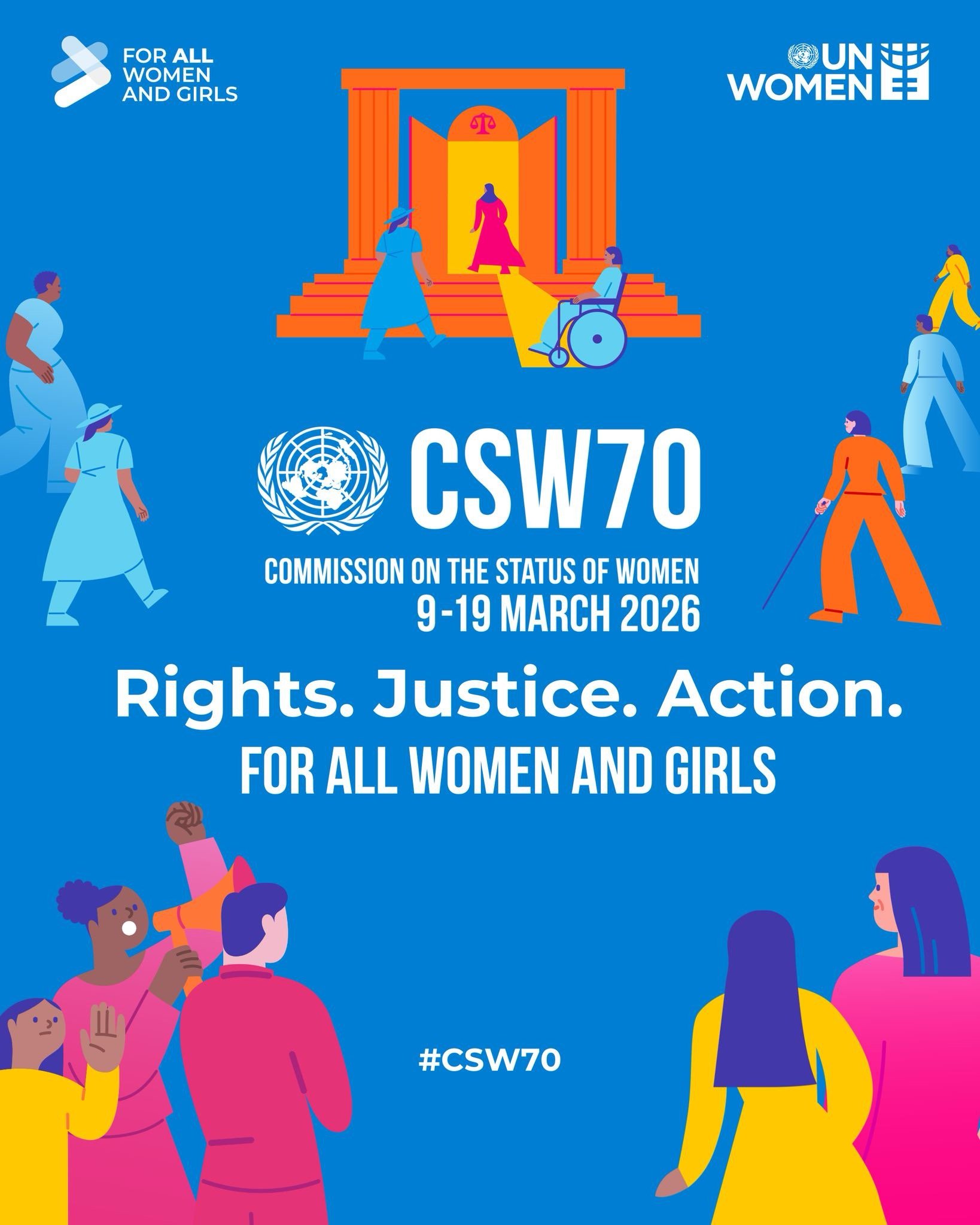
CSW70 was the most recent United Nations Commission on the Status of Women held at the UN in mid-March 2026—and scheduled to coincide with International Women's Day, which was on March 8th.
Recap: The Commission on the Status of Women (CSW) was established by the United Nations Economic and Social Council (ECOSOC) on June 21, 1946, following the UN’s inaugural meetings.
CSW was created as a functional commission, which acts as the principal global body focusing on gender equality and is dedicated to promoting women’s rights, equality, and empowerment.
During its annual two week sessions, CSW welcomes two types of events: Side Events and Parallel Events.
Side Events are talks that occur within the physical buildings of the UN, although some are run virtually. They are specific UN events, which require special passes for attendance.
Parallel Events are sponsored by other organizations that are connected to the UN as non-governmental organizations (NGOs); some have the additional status of being UN ECOSOC members. Parallel events are held in the vicinity of the UN buildings; some occur virtually; and most are generally open for attendance.
Fun Fact: C:WED was such an NGO with UN ECOSOC status for many years. Eleanor Rae initiated the Earth Values Caucus at the UN, and the Center for Women, the Earth, the Divine (C:WED) is listed in UN historical data.
~~~
Quick Recap on our C:WED Mini-Series: At present, I have been covering the teen girls who were presenting panelists for the parallel event that was co-sponsored by The Grail (1) and United for Equity and Ending Racism (UFER) (2) for CSW70 on March 11, 2026:
entitled
GIRLS’ VOICES: WITHOUT US, NO JUSTICE
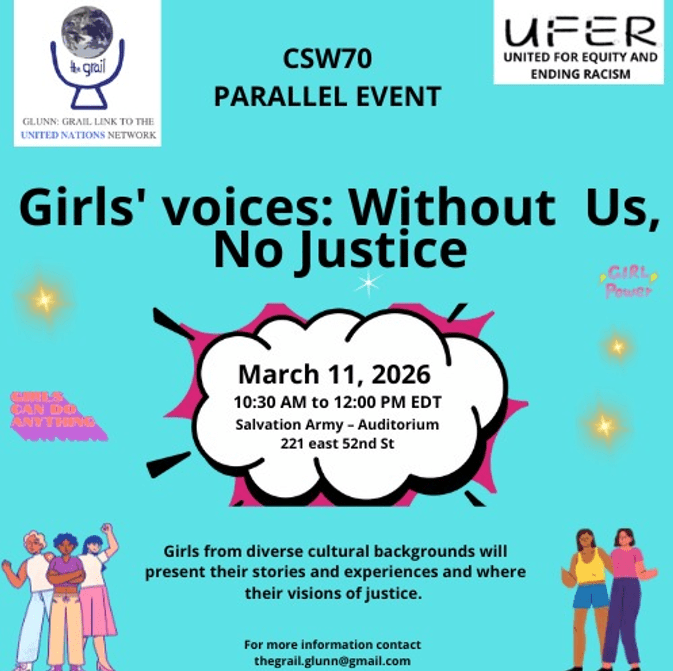
The panel addressed
the CSW70 2026 Priority Theme:
Ensuring and strengthening access to justice for all women and girls, including by promoting inclusive and equitable legal systems, eliminating discriminatory laws, policies, and practices, and addressing structural barriers.
For this post:
Teen co-moderator Quinn introduces the next panelist: Sirira
Quinn:
Sirira is a 17-year old journalism student from Mozambique. She lives in a community where girls face structural inequalities, restrictive social norms, and increased risks of school dropout, child marriage, and early pregnancy.
Despite these challenges, she has emerged as a dynamic and proactive adolescent leader committed to advancing girls’ rights and gender equality.
From an early age, Sirira has demonstrated leadership at school—serving as a class representative for four consecutive years—where she advocated for students’ rights and mobilized her peers to address issues such as sanitation, safety, and dignity for girls in the school environment.
She will argue that true justice for girls in Mozambique begins with awareness, education, and safe spaces, so that girls understand their rights and can report abuse, resist harmful practices like child marriage, and access the justice system.
Sirira, over to you!
Grail-UFER Girls Parallel Event Presentation:
Sirira
Thank you, Quinn , for the introduction.
For me as a girl, justice means safety, protection, prevention, dignity, support, repair, and respect to mention some.
What can I say about access to justice? Let me bring you into the reality of my community. Access to justice is a fundamental human right, the right to know the law, claim protection, and exercise justice without discrimination.
In Mozambique, access to justice for girls remains uneven. Harmful cultural practices persist despite legal reforms. Implementation remains critically inconsistent. Enforcement gaps persist. Most girls remain excluded from meaningful access to justice.
Many girls do not know how to report to the police, what kind of support they can receive or what their rights are during the process.
Without understanding how the path to justice works, justice seems distant. For example, in my community many girls who suffer domestic violence at home do not report it because the social norms teach them that what happens at home is not to be told to people outside.
In addition to physical and sexual violence, many girls are victims of digital violence. I remember how a girl in my community met a man on the internet. After chatting for a while, she was lured into meeting the man in person. She was raped and killed.
Yes, another case of feminicide that has become part of the uncounted statistics. This was clear evidence of the importance of informing girls of the dangers they can encounter when using the internet and social media.
In my community, I am part of a girls' club created by The Grail, which I consider safe and welcoming, where I can express myself freely and learn from sharing experiences and stories with other girls.
Through this safe space, I had the opportunity to participate in a project on digital literacy where I learned digital skills that help me to navigate the internet safely, identify misinformation, and protect my privacy.
Also, I learned how to practice my advocacy in social media. Together with other girls, we develop our demands and recommendations, which we then communicate to decision makers through various channels.
Girls are not aware that situations they experience daily are considered violations of their rights and dignity. They are forced to drop out of school and take care of household chores, limiting their opportunities and dreams.
Access to justice is not limited to courtrooms but is grounded in dignity, non-discrimination and accountability.
Access to justice for girls becomes real when the community acts and the government invests.
To break these barriers and expand access to justice for girls, we must act.
We need legal education in schools, so girls learn about their rights from an early age.
We need community awareness programs.
We need safe spaces for reporting abuse, where girls can speak without fear.
We need affordable justice services.
And most importantly, girls must be informed, included, and heard in decision-making processes that affect their lives.
BRING THE GIRLS FROM THE MARGINS TO THE CENTER
Because if we truly want justice for girls, we must ensure that girls:
know their rights,
know where to seek help,
and understand how the path to justice works.
Without safe spaces, the law becomes just words on paper.
When a girl has information, she becomes aware.
When she has knowledge, she gains power.
When she has a safe space, she gains courage.
And without girls’ voices, there is no justice.
BECAUSE THERE CAN BE NO JUSTICE FOR US, WITHOUT US!
Thank you.
UN WOMEN IS AN ARM OF THE UNITED NATIONS THAT FOCUSES ON SUPPORTING RIGHTS FOR WOMEN—AND OVERSEES CSW EACH YEAR.
UN WOMEN IS ACTIVE IN MOZAMBIQUE.
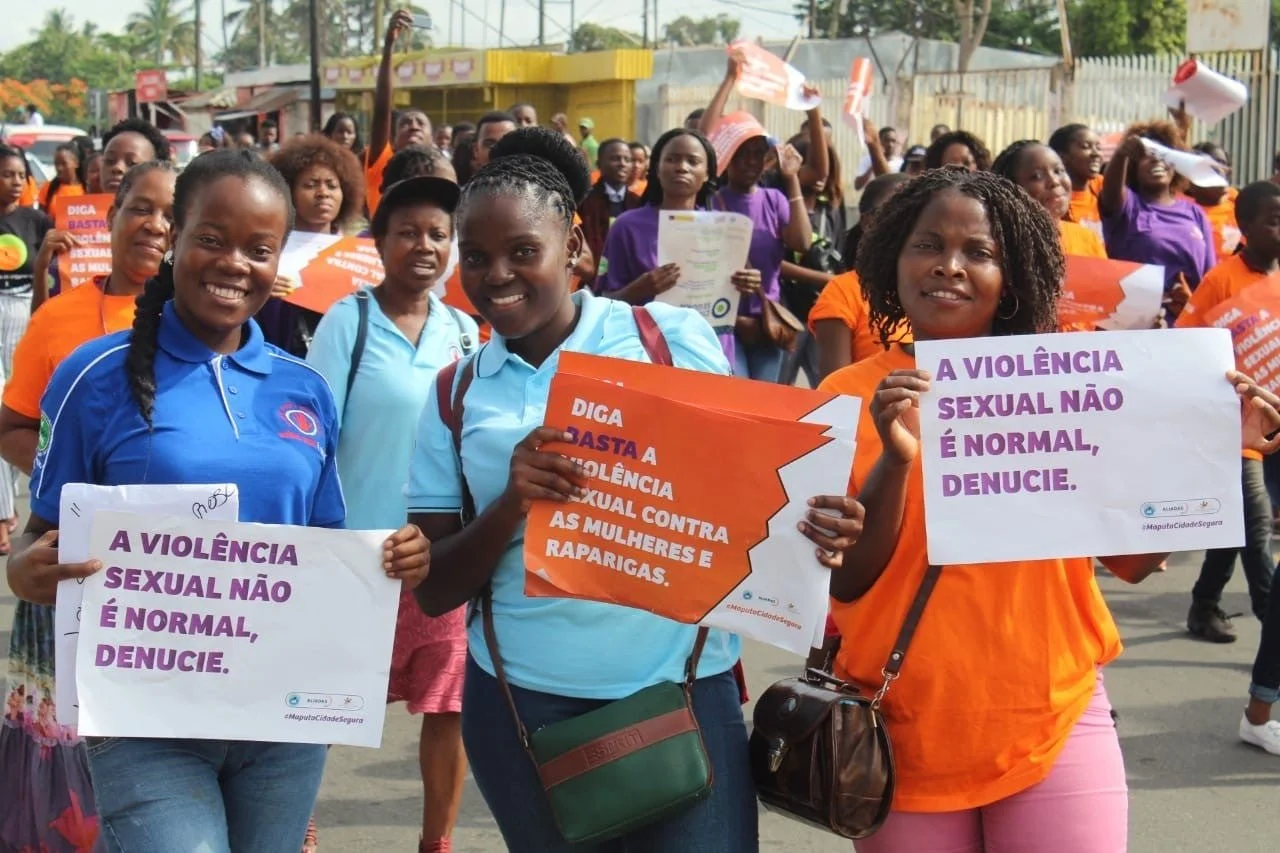
UN Women Mozambique supports young women.
As a C:WED community member,
I invite you to try this:
Critical Thinking Challenge: Finding the Patterns
Here are links to my last two posts, each of which includes a teen girl’s presentation on justice for girls.
(NOTE: Scroll down in each post to the girl’s presentations.)
NEW UPDATE:
Going forward: When you click on a link in my post, you may now return directly back to the same page you were on before clicking the link.
Esmeralda, a 17-year old girl from The Bronx, New York, USA in my post: “Girls’ Voices on Justice—Mini-Series #2”
and
Emiliana, a 16-year old girl from Cuernavaca, Mexico, in my post: “Justice in a Girl’s Voice: Femicide and Justice—Mini-Series #3” (Note: I did change the title.)
In relation to those girls’ stories and to Sirera’s, the17-year old girl from Mozambique in this current post: “Girls in Mozambique: A Look at Justice—Mini-Series #4,”
The challenge questions:
Do you see any patterns developing from the girls stories?
Are there similarities in their perspectives on justice — or lack of it—for girls in their communities?
Anything being repeated in each of their stories even though from different countries?
Any unique instances that stand out to you?
Let us know what you see!
Send us your inspirations at: info@cwed.org
Notes:
The Grail is an international movement of women founded in 1921 in Holland by a Jesuit priest and five Catholic lay women. Its mission is focused on social transformation, spiritual search, environmental sustainability, women's empowerment, and global solidarity.
The International Grail has been a registered non-governmental organization (NGO) at the United Nations since 1953, with Special Consultative status through ECOSOC since 1998. It works on issues such as the Commission on the Status of Women (CSW), anti-racism, and sustainable development.
Headquartered at Granville in Loveland, Ohio, the Grail operates in roughly 22 countries, with a significant presence in the USA.
Grail in the USA: https://www.grail-us.org/
International Grail Movement: https://grailmovement.net/
2. United for Equity and Ending Racism (UFER) has worked to eliminate all forms of racism, xenophobia, discrimination and related intolerance since its founding in 1952.
Through representation as a non-governmental organization (NGO) at the United Nations in New York and Geneva, UFER collaborates with other international actors to promote policies for racial equity at the global level, while condemning the transatlantic slave trade and colonial genocide of indigenous peoples as flagrant crimes against humanity.
UFER’s mission is to build a peaceful world free of all forms of racism, casteism, inequity and injustice where all members of one human race enjoy full health, dignity and well-being in a context of freedom, equality and justice protected by universal human rights principles.
UFER International: https://ufer.international/
IN YOUR OWN WORDS:
Previous Post:“Justice in a Girl’s Voice: Femicide and Justice—Mini-Series #3”
Written by Anne Andersson April 24, 2026
—”Powerful!” —ER
Do Remember
that
the adult women who are the present-day survivors of the Epstein sex-trafficking ring
were,
when they suffered the abuses,
of similar ages to the girls who are presenting their perspectives on justice in this Mini-Series!
Some Epstein survivors were as young as 14 years of age.
They did not receive justice then,
and
they are not receiving it now!
Call for justice!
Stay the focus!
C:WED Wish List:
We love it when we hear from you. Your thoughts have been inspirational; your ideas are wonderful!
We are a community.
Also, if you find that you can offer us some assistance, we would so appreciate it.
If you can help, please click on this safe button below: