
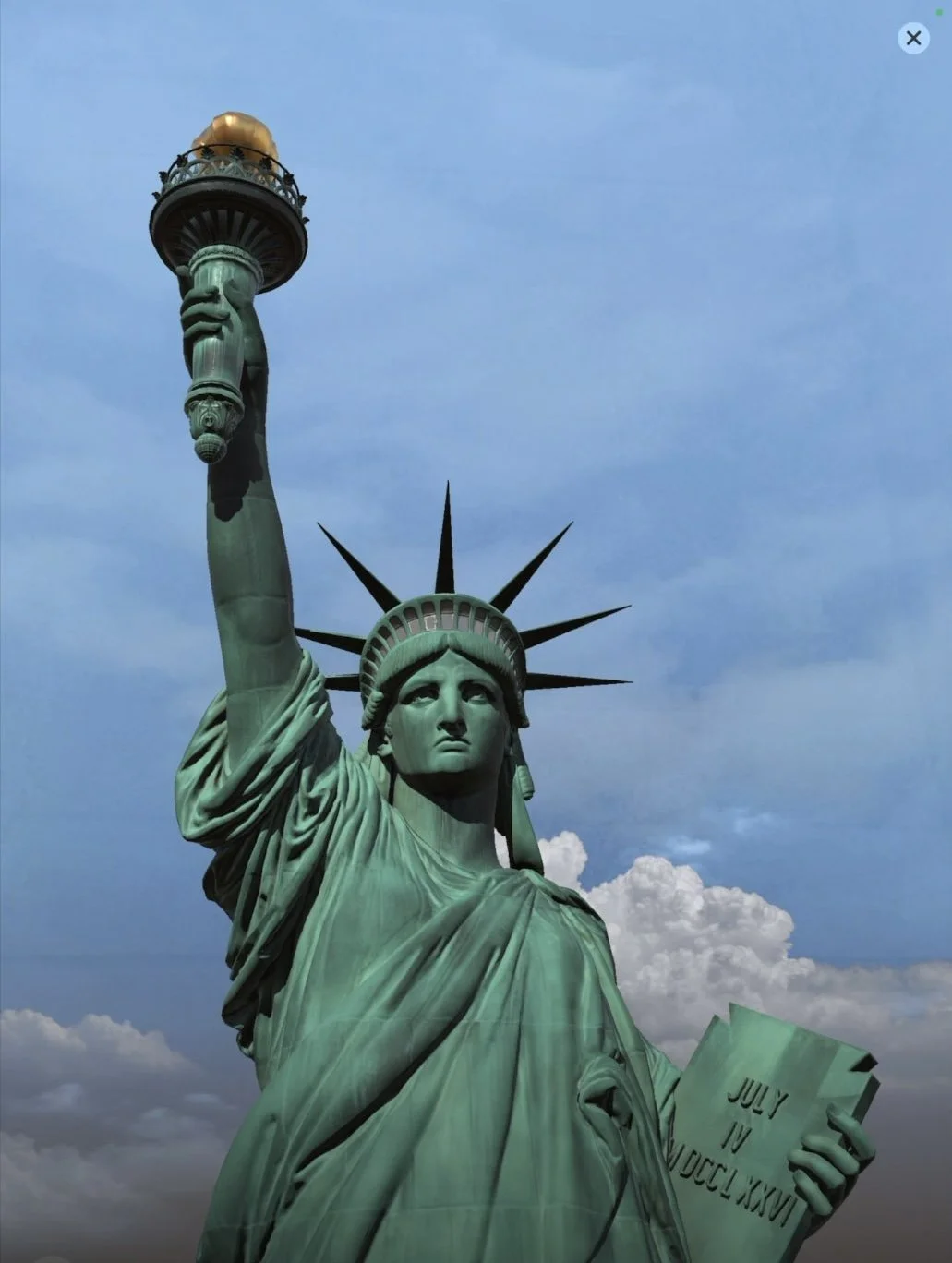
We usually do not study the facial expression of our Statue of Liberty; because, of course, we are never nearly that close.
In this closeup, she appears resolute, strong, determined. Her mouth is set. She is firm. Does she suggest a challenge?
The Statue of Liberty was a gift to the United States from France in the late 19th century, celebrating the friendship between the two countries.
This was a period of increased immigration to the US.
The poem/sonnet,“The New Colossus,” written by Emma Lazarus, the lines of which stand embossed on a plaque in the pedestal at the statue’s base, seems to identify the soul of America as a refuge of the homeless:
Not like the brazen giant of Greek fame,
With conquering limbs astride from land to land;
Here at our sea-washed, sunset gates shall stand
A mighty woman with a torch, whose flame
Is the imprisoned lightning, and her name
Mother of Exiles.
From her beacon-hand
Glows world-wide welcome; her mild eyes command
The air-bridged harbor that twin cities frame.
“Keep, ancient lands, your storied pomp!” cries she
With silent lips. “Give me your tired, your poor,
Your huddled masses yearning to breathe free,
The wretched refuse of your teeming shore.
Send these, the homeless, tempest-tost to me,
I lift my lamp beside the golden door!”
This was the vision. Where are we today?
~~~~
In the past two years, I wrote at this time about “America, the Beautiful.”
It is a much more difficult task to write that way this year.
America is still beautiful in many ways: in its legacy of dreams and vision, in many of its people.
However, we have had a wake-up call:
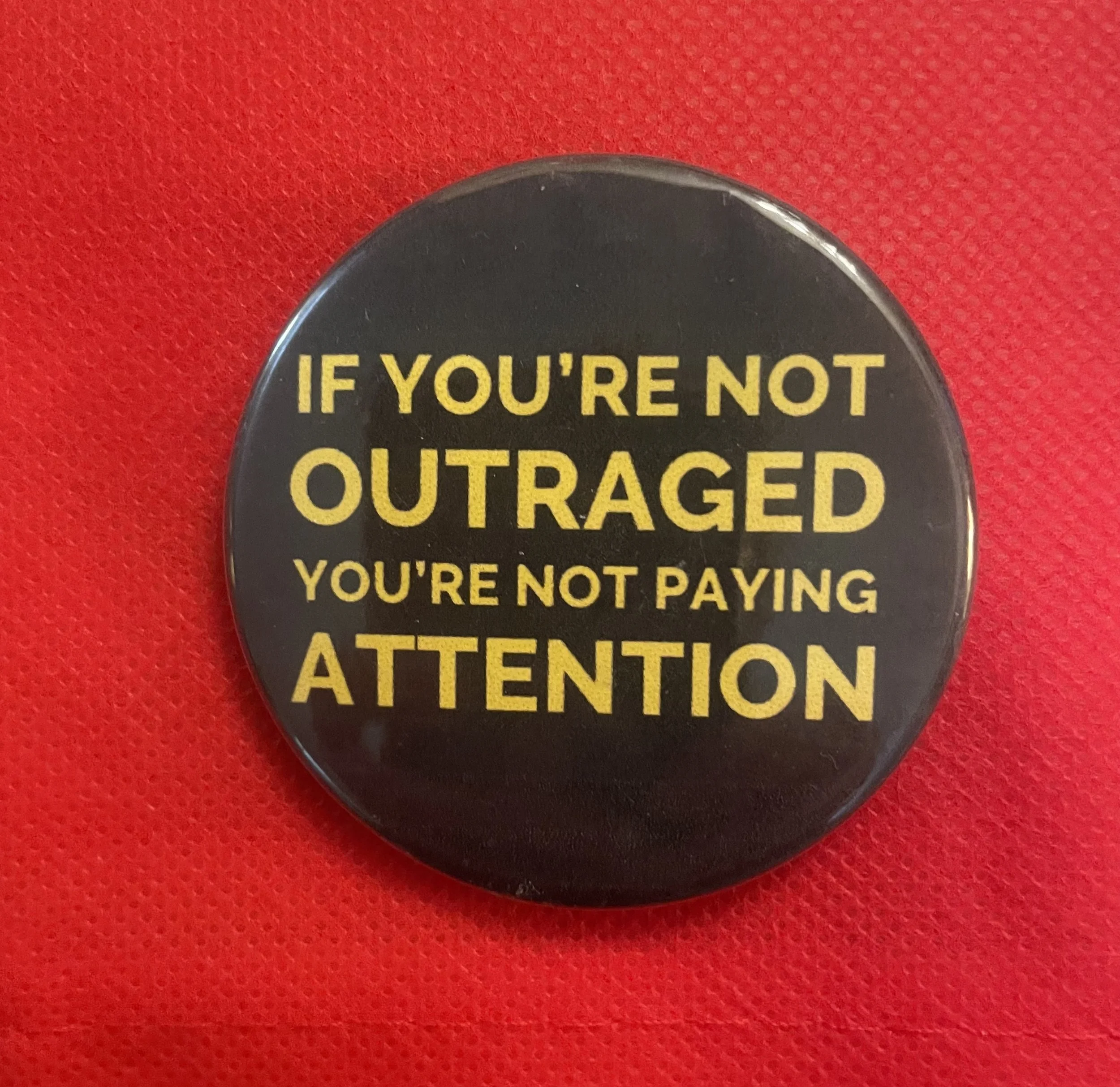
We have been faced with unsettling patterns and trends that cannot be ignored.
—Political disagreements increasingly divide families, communities, churches, and civic institutions.
—Expansion of executive power.
—Increasing military action at home and abroad.
—Increasingly harsh immigration enforcement. This includes the large-scale detention of immigrants in facilities that have drawn criticism over their conditions, and documented cases of wrongful detention of some U.S. citizens during immigration enforcement operations.
—Language, certain actions, and statements that some historians, constitutional scholars, and political scientists argue exhibit authoritarian tendencies. These include efforts to concentrate executive power, challenge institutional checks and balances, and question the legitimacy of independent courts, the press, or elections.
—A push toward regression of women’s freedom and rights with the rise in “trad wives” (traditional wives), a subculture of women who advocate for a return to traditional, male-breadwinner family structures and strict gender roles.
And, there have been statements about the U.S. returning to a family vote system with the only voter being the man of the family. A woman’s place clearly is being understood, in some circles, as only in the home.
Taken together, these developments have prompted debate about the health of American democracy and the nation’s commitment to constitutional principles and human rights.
So, how do we celebrate or commemorate it?
America, in this, its Semiquincentennial year, commemorates, on July 4, 2026, the 250th anniversary of the signing of the Declaration of Independence.
That document, signed in 1776, declared the country’s independence from the rule of Britain, thereby declaring null and void Britain’s colonial rule of the people across the ocean. It was signed after fierce fighting in what we know as the American Revolution.
America was founded in revolt against tyranny (“No taxation without representation.”)
So, if the experts are right (and I believe they are) and there is tyranny lurking in the dark, then we all had better fight like hell at the voting cubicles to keep it at bay. History tells us that keeping it at bay may be the best we can ever do.
There is beauty still, of course, in America at 250. It is in the people, great and small. People like us. People who are us.
I quickly realized how I could write about this year as America celebrates its 250th: I could write about the people who have made, or are making, America Great!
I will start with some of the people in my own experience.
Then I will take a look at the short list I created from a much longer list of 250 people on History.com, their list of some of the people who have contributed to the Making of America Great through the years.
Here goes: these are my own personal choices of the Greats:
Mariska Hargitay—has remained in her role as Captain Olivia Benson of the TV series Law & Order: SVU for 27 years. To prepare for her role, she trained to become a certified rape crisis counselor to better understand and advocate for survivors.
In her personal life, Hargitay founded the non-profit organization, The Joyful Heart Foundation in 2004 to help survivors of sexual assault, domestic violence, and child abuse heal and reclaim their lives.
In her newer intersectional work with domestic violence and animal welfare, she serves as a prominent voice for the Purple Leash Project, a national initiative that focuses on making domestic violence shelters pet-friendly so survivors do not have to leave their animals behind.
Here is one of my all-time favorites! He is in the List of the 250 Greats:
Fred Rogers (1928-2003)-Through his long-running public television series “Mr. Rogers’ Neighborhood,” he taught generations of children gentle lessons about kindness and cooperation, self-worth and coping with life’s dark moments. He was a Presbyterian minister. He often told this story: “When I was a boy and I would see scary things in the news, my mother would say to me, 'Look for the helpers. You will always find people who are helping.'“
And then there are those unnamed helpers, the little ones, those among us, and those who are us:
Teresa is my neighbor who seems to know almost everyone in our New York City apartment building—and also seems to care about each one!
We were in conversation in the lobby a week ago; Teresa paused our talk several times to call after other residents who had come in and were waiting for the elevator: “Jim, how is your mother? I haven’t seen her in a while.” Or: “Mary, how is your father? Is he home from the hospital?” Teresa is also a person who checks the mailroom and will hand-deliver a package to someone—even if that person does not live on her own floor of the building.
Teresa is a mensch. While the German root Mensch simply means an "ordinary human being," the Yiddish evolution shifted it to mean "a good human being." Teresa is both!
Dr. Jason Chertoff looked into “A forgotten, underappreciated population.”
Austin Fast, a USA TODAY investigative data reporter, wrote about him:
Today, Dr. Jason Chertoff treats patients in the intensive care unit of a hospital in Zanesville, Ohio, but about a decade ago, he was learning about critical care at the University of Florida.
“We had a lot of prisoners come into our ICU. Anecdotally, by the time the prisoners got to us with sepsis, it was already too late to do anything. Most of them, if not all of them, would die, which is not typical,” Chertoff said. “Septic shock is certainly life-threatening and serious, but if caught early, it’s very, very treatable.”
Chertoff and two colleagues combed through thousands of sepsis cases treated at their hospital and discovered incarcerated patients had roughly three times the risk of dying from sepsis when compared to non-incarcerated patients. Almost half of the inmates died, compared to 15% of the non-inmates.
Together, they published their findings in 2018 in one of the very few studies on sepsis mortality among prisoners.
“It's just kind of a forgotten, underappreciated population that, frankly it sounds awful, but not many people care about,” Chertoff said. “A lot of people probably think, ‘Oh, they deserve that treatment.’”
Chertoff said those behind bars face increased barriers and delays in getting emergency care. On-site medical staff is often limited, and inmates may need to submit formal requests for any sort of care.
“You or I could just go to the ER if we're not feeling well and feel like we're dying, but they have to go through hoops just to get EMS to be called to address their issues,” Chertoff said.
—from “Sepsis is 'very treatable.' For inmates, it's often a death sentence,” by Austin Fast, USA TODAY. November 20, 2025.
Thank you Michael Andersson for sending us this story.
Then there are the teachers who inspire their students.
And, we remember, of course, the first responders who are the ones running toward the crisis when others are running away.
There was my own grandmother Rose, at whose wake the day before her funeral in 1982, I heard, for the first time, stories from relatives whom she had helped—often running to them in their need when they were in crisis, even if it were in the middle of the night.
And there was my mother Lillian, who suffered from multiple sclerosis in the years before treatment was available. Each time she lost the use of some functon in a limb, she did not look back to lament what was lost, but rather focused on what she could still do—and seemed to be at peace with it.
For years after her death in 2000, people were telling me how much she inspired them when they were faced with a crisis in their own lives.
~~~
Now, let’s take a look at my more formal choices from history.com’s list of Greats.
Their list is entitled: “250 People Who Shaped America.”
For the full list of 250 people, you may go to history.com
or use this URL:
https://www.history.com/articles/250-people-who-shaped-america
My criteria for creating this limited list were three. I focused on Humanitarians, Environmentalists, and Voices of the Voiceless.
Basically, these were, and are, magnifiers of this part of the “America the Beautiful” song lyrics:
“God shed God’s grace on thee.”
~~~
They Took a Stand—Some Paid a Price.
Admittedly, the flaws of some of these Greats have been made known for some time. However, we can still recognize them for their contributions to Making America Great.
So, let’s start:
FREEDOM FIGHTERS FOR SOCIAL JUSTICE
POLITICAL
Thomas Paine—an English American writer whose Common Sense was a pamphlet, not a book. It had a compact format and accessible language, which made it perfect for mass communication at the time. He wrote in simple, everyday language that everyday people could easily read and understand. Because of this, it sold an estimated 120,000 copies in its first three months alone. It influenced the American Revolution, shifting the political landscape and paving the way for the Declaration of Independence.
George Washington —refused to be a dictator. He would only serve one term as president, and retired gracefully to avoid the appearance of creating an empire.
Thomas Jefferson—Authored the Declaration of Independence, articulating the fundamental American ideals of liberty and equality.
Benjamin Franklin—His insatiable mind tackled questions from the nature of electricity to humankind’s universal rights. His science-based pragmatism became a defining American value, shaping institutions from America’s first lending library to its first public hospital.
Abraham Lincoln—The 16th president who successfully navigated the American Civil War, preserved the Union, and issued the Emancipation Proclamation, which secured emancipation for enslaved people.
Eleanor Roosevelt—As a passionate advocate for women’s rights, racial justice and human dignity, Roosevelt ignored traditional first lady constraints. She advised the president on policy and barnstormed the country, delivering speeches and writing a syndicated column.
Franklin D. Roosevelt—FDR led America through two historic crises, the Great Depression and World War II. His New Deal permanently reshaped government, creating enduring safety nets like Social Security.
John F. Kennedy—inspired the young and helped drive interest in public service through programs like the Peace Corps.
Lyndon B. Johnson—steered the passage of historic civil rights legislation that outlawed segregation and protected voting rights, while creating new social programs for healthcare, education, and more.
Shirley Chisholm—The first Black woman elected to Congress, she fought for food stamps, reproductive rights and the minimum wage. She ran for president in 1972, promising to be "unbought and unbossed."
Jimmy Carter—The 39h president who continued humanitarian efforts long after leaving his time in public office (1977-1981)—until his death in 2024 at the age of 99.
WOMEN’S RIGHTS
Abigail Adams—When her husband John Adams and the Continental Congress were drafting a new code of laws for the new nation, she wrote to him.
Following are her own words (and spelling). Abigall was referring to the coverture* rules that seriously restricted women, especially those who were wives.
“Remember the Ladies, and be more generous and favourable to them than your ancestors. Do not put such unlimited power into the hands of the Husbands. Remember all Men would be tyrants if they could. If perticuliar care and attention is not paid to the Laidies we are determined to foment a Rebelion, and will not hold ourselves bound by any Laws in which we have no voice, or Representation.
That your Sex are Naturally Tyrannical is a Truth so thoroughly established as to admit of no dispute, but such of you as wish to be happy willingly give up the harsh title of Master for the more tender and endearing one of Friend.”
Susan B. Anthony—A foundational figure in the women's suffrage movement who tirelessly campaigned for women's right to vote. She never saw the 19th Amendment pass, but it’s often called the Susan B. Anthony Amendment—earned through decades of tireless fighting for women’s suffrage, including her 1872 arrest for voting.
Elizabeth Cady Stanton—She was an abolitionist, human rights activist and one of the first leaders of the women’s rights movement. Stanton worked closely with Susan B. Anthony for over 50 years to win the women’s right to vote.
In 1848, she helped organize the First Women’s Rights Convention—often called the Seneca Falls Convention. She helped write the Declaration of Sentiments, a document modeled after the Declaration of Independence. It laid out what the rights of American women should be — as against what they were under the laws of coverture. She compared the women’s rights struggle to the Founding Fathers’ fight for independence from the British.
Sojourner Truth—She escaped slavery, sued a white man for her son's freedom—and won. Then she delivered one of the era’s most powerful speeches, “Ain’t I a Woman?,” advancing abolition and women’s rights while challenging America to broaden its vision of equality.
Alice Paul—Pickets. Hunger Strikes. Arrests. Her unyielding activism helped women win the vote. Then she drafted the Equal Rights Amendment (ERA), determined to make women’s equality a constitutional claim. The ERA has still not passed into law to this day.
Gloria Steinem—With her undercover Playboy Club exposé and women's magazine Ms., she helped usher feminism from marches and meetings into periodicals, turning women’s liberation into a mass cultural movement.
Betty Friedan—Her 1963 book The Feminine Mystique shattered the myth of the happy housewife, sparking second-wave feminism and influencing a generation of women to look beyond traditional roles.
RACIAL JUSTICE
Harriet Tubman—She guided enslaved people to freedom on the “Underground Railroad.” Later, she pushed for abolition and women’s suffrage.
Ida B. Wells-Barnett—After a white mob killed her friend, she investigated lynchings and published indisputable data on the pervasive violence, turning journalists into evidence-based moral confrontation.
Frederick Douglass—After liberating himself from slavery and publishing a bestselling autobiography, he used scorching oratory and sharp political skill to demand abolition and equal rights.
Rev. Martin Luther King, Jr.—a modern-day prophet, he had a dream for a great America. He was the defining leader of the civil rights movement, who used nonviolent activism to fight for racial equality and desegregation.
Rabbi Abraham Joshua Heschel—“I felt my legs were praying,” he said after marching beside his friend Martin Luther King, Jr. from Selma to Montgomery in 1965 for voting rights. A leading Jewish theologian who barely escaped the Nazis and lost most of his family in the Holocaust, Heschel insisted that, in the face of injustice, faith demanded action. He became a visible ally in the Civil Rights Movement.
John Lewis, and the courageous Edmund Pettus Bridge walkers—When John Lewis stood up for voters in Selma he was severely struck on the head with a billy club. The image horrified America, helping pass the Voting Rights Act of 1965. John Lewis went on to be the “conscience of Congress.”
Rosa Parks—Convicted for refusing to give up her bus seat to a white passenger, it sparked a local bus boycott in Montgomery, Alabama, and national outrage over segregation. The people boycotting buses had no other means of getting to work except by walking. Their neighbors with cars gave them rides to help them get to work during the long course of the boycott (December 5, 1955 - December 20, 1956).
Ruby Bridges—At age 6, she showed a nation what courage looked like, walking past an angry mob day after day as federal marshals escorted her into the all-white school she single-handedly integrated.
Jackie Robinson-He stepped across Ebbets Field’s white lines—and baseball’s color line—on April 15, 1947. Enduring taunts from fans, opponents and even teammates, the Hall of Famer integrated the national pastime and helped to spark the Civil Rights Movement.
When “42”, the film about Jackie was released in 2013, my brother-in-law George, who grew up in Brooklyn and, from the age of 10 through his teens, was a constant presence in the seats of Ebbets Field, said to me: “I don’t have to see the film! I was there! I saw it all—the mobs, the shouting.”
Mary McLeod Bethune—She turned education into a path to power for Black Americans, building institutions and shaping national policy. Born to formerly enslaved parents, Bethune taught her family to read and, after college, founded a school for girls that grew into a fully accredited college, one of the few in America open to Black students at that time.
Pauli Murray—Anna Pauline “Pauli” Murray blazed a trail for civil and women’s rights by waging an intellectual battle against dual racial and gender discrimination—which she coined “Jane Crow.”
The first African American to earn a doctorate from Yale Law School and the first Black woman Episcopal priest in the U.S., she also co-founded the National Organization for Women.
Norman Lear—With legendary TV sitcoms like “All in the Family, “Maude” and “The Jeffersons,” the producer bridged divisive issues, using comedy to address taboo topics like racism.
Yuri Kochiyama—Her experience in an Arkansas internment camp told her she wasn’t fully a citizen in her government’s eyes. As a leader of the Asian American Movement, she allied with Black Power activists and raised her voice to demand redress for Japanese Americans.
LGBTQ RIGHTS AND JUSTICE
Harvey Milk—One of the first openly gay U.S. officeholders, the San Francisco supervisor backed a gay rights ordinance and opposed a state measure banning LGBTQ teachers before his 1978 murder.
ENVIRONMENTAL JUSTICE
Rachel Carson—Her book Silent Spring, which cast pesticides as “biocides” threatening all life, awakened modern environmental consciousness.
HEALTH AND SOCIAL JUSTICE
Jane Addams—called the “mother of social service,” she founded a pioneering settlement house in a Chicago immigrant slum in 1889, pushing for civic provisions for daycare, nursing, and elder care.
Dorothea Dix—Shocked by the chaining, flogging, and neglect of mentally ill people in inhumane jails, she helped create or expand more than 30 mental hospitals, transforming mental health treatment.
Clara Barton—The Civil War’s “Angel of the Battlefield” nursed the wounded under fire (catching a bullet through her sleeve); she identified 22,000 missing soldiers and founded the American Red Cross—institutionalizing humanitarian aid as a civic responsibility.
Helen Keller—Blind and deaf before age two, she graduated from Radcliffe, wrote 14 books, and became a fierce advocate for disability rights, labor causes, and social justice.
Jonas Salk—His polio vaccine, introduced in 1955, all but eradicated a disease that once paralyzed thousands of children. To make the vaccine as widely available as possible, he didn’t patent it.
Oprah Winfrey—”The Oprah Winfrey Show” brought new intimacy to daytime talk TV. She invested in raising underrepresented voices, airing hot-button topics like incest, addiction, and abuse.
LABOR, LIVING CONDITIONS, AND SOCIAL JUSTICE
Frances Perkins—The acid smoke and workers’ screams haunted her. A witness to the 1911 Triangle Shirtwaist Factory fire, she dedicated herself to public service and labor reform to prevent similar tragedies.
Jacob Riis— He hauled cameras into crowded tenements on the Lower East Side, capturing the anguish of poor families packed into dark, unventilated rooms. His shocking humane photos spurred slum reform.
Joan Baez—She elevated American folk music with her singular soprano voice and wove activism and protest into her songs—and life—becoming an influential advocate for social, political and human rights.
Now it’s your turn.
We would love to receive your own choices of the people whom you think have Made America Great and you would like us to add to this list!
You may send us their names with your reason for choosing them to: C:WED at info@cwed.org
America’s crowning glory has been its private and fair ballot system of elections. With our votes, we, the people, get to elect those who, when in charge, we hope will fight for rights, as the colonists. Stand up as the voice of the people.
I think one could say that America is a work in progress. The dream, the vision of the “Mother of Exiles” that was there at its founding 250 years ago, still can be there—and certainly is still there in many quarters.
The question is: Are we courageous enough to own the vision ourselves?
“America the Beautiful”
O beautiful for spacious skies,
For amber waves of grain,
For purple mountain majesties
Above the fruited plain!
America! America!
God shed his grace on thee
And crown thy good with brotherhood
From sea to shining sea!
O beautiful for pilgrim feet
Whose stern, impassioned stress
A thoroughfare for freedom beat
Across the wilderness!
America! America!
God mend thine every flaw,
Confirm thy soul in self-control,
Thy liberty in law!
O beautiful for heroes proved
In liberating strife,
Who more than self their country loved,
And mercy more than life!
America! America!
May God thy gold refine
Till all success be nobleness
And every gain divine!
O beautiful for patriot dream
That sees beyond the years
Thine alabaster cities gleam
Undimmed by human tears!
America! America!
God shed his grace on thee
And crown thy good with brotherhood
From sea to shining sea!
I used the following image to represent The Soul of America in one of my early posts.
It still works:

The Soul of America:
Within people lie the means to Make America Great: it comprises the way we act; what we have in our hearts—it consists of our kindnesses, compassion, listening, caring, looking out for one another, especially those without a voice. It is our courage. Basically, it is love.
Loving our neighbor as we love ourselves.
Making America Great can always happen when we understand this:
“The Reign of God
(a.k.a. The Kingdom of God)
is
within us.”
—Luke 17:21
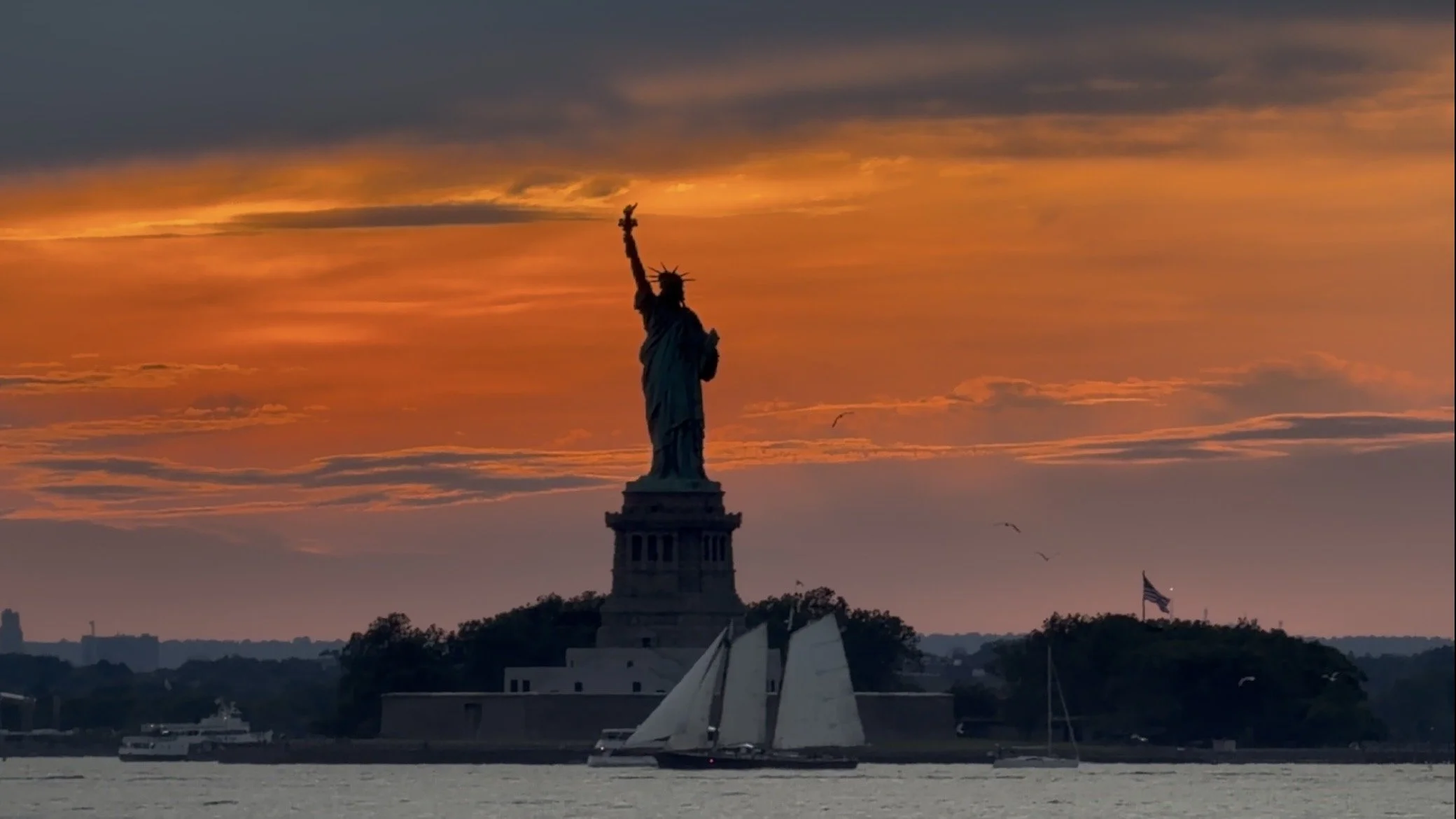
Photo by Andersson and Fine
June 26, 2026
Resources:
*Coverture: From Wikipedia “Coverture”
Coverture was a legal doctrine in English common law under which a married woman's legal existence was considered to be merged with that of her husband. Upon marriage, she had no independent legal existence of her own, in keeping with society's expectation that her husband was to provide for and protect her. Under coverture a woman became a feme covert, whose legal rights and obligations were mostly subsumed by those of her husband. An unmarried woman, or feme sole, retained the right to own property and make contracts in her own name.
Coverture became well-established in the common law for several centuries and was inherited by many other other common-law jurisdictions, including the United States.
After the rise of the women’s rights movement in the mid-19th century, coverture came under increasing criticism as oppressive and as hindering women from exercising ordinary property rights or entering professions. Coverture was first substantially modified by late-19th-century, with the “Married Women’s Property Acts” passed in various common-law jurisdictions, and was weakened and eventually eliminated by later reforms. Certain aspects of coverture (mainly concerned with preventing a wife from unilaterally incurring major financial obligation for which her husband would be liable) survived as late as the 1960s in some states of the United States.
—Wikipedia: “Coverture”
See also my two posts:
“PAGES OF OUR LIVES Women Became Aware,” February 10, 2025
and
“UPON WHAT LAW? What was the legal source of coverture?,” February 14, 2025
IN YOUR OWN WORDS:
Previous Post: "Summer Solstice 2026 Meditation,” Written by Anne Andersson June 12, 2026
—Beautiful photos! ❤️ Thank you for taking me on such a picturesque journey!!! 🌅🌄☀️🌞 —MA
—The pictures are cool! —CA
—Nice photos. —DA
—Exquisite!!! Thank you very much. —EA
—Thank you, Anne! Beautiful to see xo—JW
Thank you Anne! These are exquisite. 🙏 —HT
—Anne, beautiful pictures and never realized there were so many stones and that they were within a circle. Thank you for sharing your photos and the lovely video. —Maryanne
—Magnificent! I will pretend that I was there! —LB
—Thanks so much for the pictures. It was truly an enlightening experience. —BM
~~~
REMEMBER THE EPSTEIN WOMEN!
NEVER FORGET!
~~~
C:WED WISH LIST:
If you find that you are able to gift us at this time, we would greatly appreciate your support.